Placed on a bed of sacred cedar boughs, the containers look banal – plain cardboard, pale blue archival file boxes, a big black plastic bin – but their contents are shocking.
The boxes have come to Haida Gwaii from universities and museums across the country, and they contain the remains of ancestors dug up by treasure hunters and archaeologists of previous generations. Some may be thousands of years old, others only a few hundred; the remains include those of two young children.
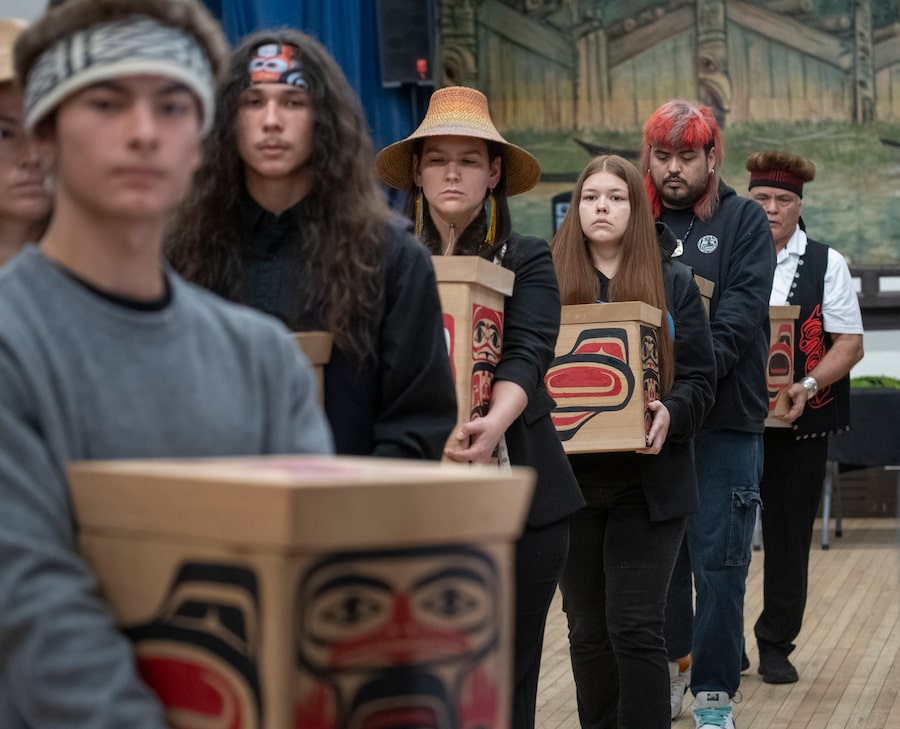
Set on a table at the Haida Heritage Centre at Skidegate, B.C., this January, they are being prepared for reburial. A dozen Haida volunteers, many of them still in their 20s and marked with ochre on the cheeks and around the wrists for protection, face the difficult task of transferring their ancestors to traditional bentwood boxes made for the occasion. Each one is painted with a butterfly, the Haida symbol for the repatriation movement.
The next day, after a ceremony of speeches and songs, the volunteers help bury the boxes at the community cemetery, shovelling dirt until the graves are full. Grave markers will permanently identify the institutions that returned the ancestors to Haida Gwaii: the archeology lab at the University of British Columbia in Vancouver, the Royal BC Museum in Victoria, the University of Toronto and the Canadian Museum of History in Gatineau, Que.
Before they begin the transfer, elders offer a few warnings to the volunteers. Now or later, they may feel overcome with emotion.
Most of the remains are already bundled in cloth inside the storage boxes but a few are not. There are several skulls returned from the University of Toronto’s anthropology department and whoever handles those may see faint traces of ink where once doctors’ names had been used to identify what they considered medical specimens.


But T’aaw ‘Yuuwans Jisgang Nika Collison, director of the Haida Gwaii Museum and co-chair of the Haida repatriation committee, counsels the group not to be mad at the contemporary university, which employed conservators to remove the ink.
“Feel the anger, feel the grief but feel the joy that people want our ancestors to come home,” Collison said. “Times are changing.”
When it comes to returning both ancestors and belongings to First Nations in Canada, times have indeed changed, and rapidly, since the Truth and Reconciliation Commission in 2015 called for federal funding so that the Canadian Museums Association could review the situation.
After paying for that review, the government has not yet followed through with legislation or targeted funding, but First Nations, museums and universities, whose anthropology departments are often repositories of ancestral remains, are driving repatriation forward.

It is, however, difficult to assess how much actual progress has been made in an area that potentially covers thousands of ancestors and hundreds of thousands of belongings, only a fraction of which have been returned to First Nations. Institutions will not discuss an individual repatriation unless a First Nation has already made it public, and some cite concerns with privacy and trauma when asked about the numbers of ancestors they still hold.
Examples abound of heartwarming repatriations, but a decade after Truth and Reconciliation, it is apparent that the project is years from completion.
Talk of bringing things home is in the air these days – with the recent return of Indigenous belongings from the Vatican and discussions over First Nations’ interpretation of the Hudson Bay charter purchased by donors to transfer to Canadian museums.
On Haida Gwaii, more than a dozen ancestors were reburied with solemn ceremony in January at Skidegate, and 100 kilometres north at Old Massett, the latest in hundreds brought home. Last summer after a 120-year-absence, the Whalers’ Shrine was returned to Yuquot from the American Museum of Natural History in New York. After five years of negotiations, Chief Crowfoot’s regalia came home from a British museum in 2022 and is now displayed at the Blackfoot Crossing Historical Park on Siksika territory in Alberta.
“We are taking back what was lost or what was stolen,” Andy Wilson, one of the original members of the committee that began repatriation work on Haida Gwaii in the 1990s, told the Skidegate group. “When we started repatriation it was a way of saying: ‘Enough is enough. You can’t take away our history or our knowledge any more. We are taking it all back.’”
Most Indigenous ancestral remains are those of unknown people and sometimes thousands of years old. There is evidence of human habitation on Haida Gwaii going back more than 13,000 years; some of the remains reburied in January at Old Massett came from a 1973 dig at Blue Jackets Creek, which uncovered one of the most ancient intact burial grounds in North America, estimated at almost 5,000 years old. Those were removed without Haida permission, Collison said.


Repatriation of both ancestors and sacred belongings is considered a spiritual task by First Nations that undertake it, but also an expression of cultural pride and independence from colonial institutions. It is a way of reconnecting with traditions and passing them on to the next generation. And, on a practical note, it can help a community build cultural infrastructure.
“It’s had a cultural and spiritual impact, and healing,” said Blackfoot Crossing director Shannon Bear Chief about the return of Chief Crowfoot’s regalia. “It’s not only restored the sacred item back to its rightful home, it has also strengthened our identity, brought back some pride.”
But she goes on to cite how the repatriation, from the Royal Albert Memorial Museum in Exeter in 2022, led Blackfoot Crossing to apply for certification with the Canadian and Alberta museum associations to demonstrate the facility’s professional standards and potentially secure more funding. This spring, the Glenbow Museum in Calgary will return Chief Crowfoot’s knife and sheath to add to the park’s display.
Direct contact with ancestral belongings can also provide contemporary Indigenous artists with models for their work. The Haida Gwaii ceremonies included a display of several hundred recently returned objects, which visitors combed for information about media and techniques. “To be able to look at these, that’s how they learn,” said elder Gaajiiaawa Linda Tollas, pointing out that a spruce root basket was using strips cut finer than current practice.
Hereditary chief 7IDANsuu James Hart and artist and filmmaker Gwaai Edenshaw were fascinated by a mid-19th century painted bentwood chest returned from a private collection: Its pattern was incised into the wood where most artists would have painted on a flat surface. “This is one to go to school on, to study this amazing, painstaking work,” Hart said. “Look how crisp and precise those old guys were.”


First Nations have knocked on museum doors since the 1990s, asking for the return of ancestors and belongings. The Haida, considered international leaders in the repatriation movement for their early and comprehensive quest for both remains and belongings, have built a network of cordial relationships with museums in Canada, the United States and overseas, as well as with universities and private collectors.
“People reach out to us now. It’s a beautiful thing,” Collison said.
What has happened since the Truth and Reconciliation Commission in 2015 is a sea change at museums and in university archeology and anthropology departments. Archeology had evolved from grave robbing and treasure hunting in the 19th and early 20th centuries to professional digs conducted on First Nations territory, which continued without Indigenous permission through the 1970s. Today, digs are undertaken with Indigenous participation, or at the very least consultation.
Many of the larger museums have now established repatriation departments overseen by Indigenous museum professionals.

Assembly of First Nations Chief Cindy Woodhouse Nepinak, centre, holds a Tikinagan baby cradle as sacred items are unveiled following their return from the Vatican collection at the Canadian Museum of History in Gatineau, Que. in March.Spencer Colby/The Canadian Press
“You realize how important it is to folks, for reconciliation, for moving forward in a good way. A key aspect of the work is the concept of self-determination,” said John Creese, the Royal Ontario Museum’s curator of North American archaeology. He said non-Indigenous scholars like himself can offer archeology to Indigenous communities as a tool to help find answers to their questions.
Toronto’s ROM, the biggest museum in Canada, holds 35,000 artifacts in its Indigenous Americas collection, mainly from what are now Canada and the U.S. Museum holdings are vast while returns of belongings usually feature a small number of sacred objects, which may explain why museum professionals are largely unconcerned about depleting their collections. Last September, when the Manitoba Museum returned 19 belongings associated with Chief Piapot to the Piapot First Nation in Saskatchewan, it represented a very significant repatriation and the largest that museum had ever undertaken.
The Canadian Museum of History has repatriated hundreds of objects and ancestors since 2015 but still holds a North American ethnology collection of 60,000 items. And after returning Chief Crowfoot’s knife and sheath, the Glenbow Museum still holds more than 20,000 items.

Chief Crowfoot's regalia, repatriated from the Royal Albert Memorial Museum in Exeter, U.K. to the Blackfoot Crossing Historical Centre on Siksika territory in Alberta, includes this buckskin shirt.Exeter City Council/Supplied
In 2019, as part of a regular survey of heritage institutions, the federal department of Canadian Heritage asked museums and historic sites to enumerate these holdings: They reported 6.7 million Indigenous cultural artifacts concentrated in eight of the largest institutions. These numbers are huge because the museums included their archeological collections, which cover millions of fragments, including animal bones and flakes of stone from toolmaking.
A quarter of the institutions held artifacts but less than two per cent held remains, totalling 2,500. (That does not necessarily mean the institutions hold the remains of 2,500 individual ancestors; the remains are often fragmentary. Archaeologists sometimes provide a minimum number of individuals when estimating what human remains represent.)
However, the 2019 survey was missing a significant repository: It did not fully cover universities where hundreds more remains are housed in anthropology departments, sometimes unearthed by scholars, sometimes uncovered during construction projects. In 2017, the Indigenous broadcaster APTN had surveyed 12 Canadian universities and found 11 of them held ancestral remains. The University of Toronto held 500 while McGill had 200 stored at the McCord Stewart Museum in Montreal.

Repatriated belongings displayed at the Haida Gwaii Museum included an apron with a frog motif, part of ceremonial dance regalia.
It is difficult to judge what progress the universities are making in returning these because, when asked by The Globe, several declined to provide updated numbers. Their reasons included privacy, keeping Indigenous data under Indigenous control and the fear people will be traumatized by hearing the numbers.
The universities of Toronto, Winnipeg and Manitoba all declined to update the numbers, although all three have been actively repatriating ancestors.
McGill, on the other hand, explained that the 200 figure had been taken from an outdated database and that, with the establishment of a repatriation task force last year, the university can now report it holds 742 human bones, but cautions these fragments do not represent 742 individuals.
Since Haida Gwaii is an island nation that doesn’t border others, it is possible to claim anything found there as ancestral. Similarly, when the ROM repatriated remains estimated to represent 60 to 100 individuals to Rainy River First Nations at Rainy River, Ont., in 2019, it was returning ancestors unearthed from burial mounds on that territory.
However, identifying to whom remains should be returned can prove difficult in areas where multiple nations overlapped or construction projects have unearthed ancestral remains: For example, the University of Manitoba still holds significant remains of unknown origin uncovered in the 1960s during construction of the Red River Floodway.

That university is very active in the repatriation movement, establishing the Respectful Rematriation and Repatriation Ceremony Council with Indigenous collaboration in 2020 and offering a public apology for holding remains, burial goods and other objects in 2024. It is now discussing with First Nations the idea of either a multination group or individual nations adopting ancestors whose origins cannot be identified to oversee their reburial.
Human remains pose very specific problems for the institutions, which now agree they should not hold any Indigenous ancestors. Before remains can be returned, origin must be determined and burial sites must be selected. But then, the next steps seem fairly straightforward: They are reburied, or rematriated as it is sometimes described, because they are returned to Mother Earth.
Some nations are interested in dating ancestors or taking DNA samples, testing that might provide further evidence of ancient Indigenous presence on the one hand or contemporary continuity on the other, but the tests are intrusive and often inconclusive. Most nations decide the less intervention the better and are mainly eager to see ancestors reburied with dignity. On Haida Gwaii, elder Jenny Cross recalled the heartbreak of seeing shelves upon shelves of storage boxes during a visit to the Field Museum in Chicago, which returned 160 ancestors to the archipelago in 2003.


Burial goods that were dug up with bones are also reburied, but other artifacts, which can sometimes be traced to historic individuals, can only be returned once any competing claims from descendants or multiple nations have been resolved. Then they need to find an appropriate home.
The Haida are blessed with a museum, established in 1976. It houses the returned artifacts, yet on its walls today there are photographs of hundreds more items in Canadian and international museums that the Haida would like back: The museum would have to expand to accommodate even a fraction of these objects. Thus far it has identified the need for more storage and for a second cultural facility at Old Massett.
On the Piapot First Nation in Saskatchewan, Chief Piapot’s belongings are now on display in the Medicine House but the nation hopes to build a museum within the next two years to house them and provide an interpretative centre on subjects such as residential schools and language revitalization.
For many nations, however, that kind of infrastructure is out of sight. Some take artifacts back and simply keep them in storage or display then in schools and community centres; others chose to leave belongings in museums on the understanding they can visit them or claim them in the future.
The Royal BC Museum routinely does temporary transfers of masks and blankets for use in potlatch ceremonies. Whatever the solution, reclaiming objects can take years. The Haida have been working at it since the 1990s, while at Blackfoot Crossing, Bear Chief has a list she optimistically estimates it will take another 25 years to complete.

Members of the Nuxalk Nation bless a totem pole with eagle feathers and eagle down after it was returned to them from the Royal BC Museum in Victoria in 2023.CHAD HIPOLITO/The Canadian Press
Would any of this be expedited by federal laws in the area? The Truth and Reconciliation Commission’s calls to action required the Canadian Museums Association to review compliance with the United Nations Declaration on the Rights of Indigenous Peoples (UNDRIP), which Canada passed into law in 2021. The CMA produced its review in 2022, calling in turn for federal legislation and funding.
“It’s not that there’s a lack of willingness,” said Janis Bomberry, a Six Nations museologist who served as director of the Canadian Museums Association until January. “I think the biggest problem is that, because there’s no legislation or framework in this country, there’s also no funding. Museums at all levels are sort of stuck at the same point where they don’t have the funding to undertake this work.” Labour-intensive research is required to update databases and determine where objects and ancestors came from, she said.
There was a private members’ bill on the subject in 2019 but it got stuck in the Senate, and the government has never proposed its own legislation, although it has occasionally promised some kind of framework for repatriation.
Developing a framework was included in Steven Guilbeault‘s mandate letter when he was appointed minister of Canadian Heritage in 2019; his successor, Pascale St-Onge, repeated that commitment to a standing committee of Parliament in 2023.
Currently, the Department of Canadian Heritage says it is in preliminary discussions with Indigenous groups about next steps. Alberta has legislation dating to 2000, which covers Blackfoot sacred ceremonial objects and requires ministerial permission and public notice to repatriate them, while B.C. is working on a policy framework.
While the CMA supports federal legislation, looking to the U.S. example of the Native American Graves Protection and Repatriation Act, which was passed in 1990, not everyone agrees that is desirable.
SGaan Kwahagang James McGuire, director of Indigenous collections and repatriation at the Royal BC Museum, values the way NAGPRA required museums to give public notice of their holdings, but he also fears that laws allow institutions to stop at a minimum legal standard.
McGuire, who is Haida, stresses that repatriation requires years of work building flexible relations between museums and First Nations. “We can’t federalize or mandate a formula for building trust,” he said.
The American law has certainly proved a mixed blessing. NAGPRA became mired in controversy in 2024 when new regulations were added requiring museums to seek permission to show any Native American material. Several major U.S. museums began covering displays, contrary to the spirit of the law, which was intended to get museums to work with native tribes. Archaeologists have also complained that the law prevents them from studying ancient remains of unknown Indigenous origin.
“In the museum world we are stuck halfway between, holding on to what museums were but also holding on to what they could be,” McGuire said. “Museums are stewards of history, not owners of it,” he added.
In the absence of any Canadian law compelling institutions to repatriate or cover the costs, First Nations, museums and universities continue the slow work on their own, object by object, ancestor by ancestor.


At Old Massett on Haida Gwaii, that community’s reburial takes place in a local church and at the nearby graveyard, with the names of museums and universities marked on the crosses.
Afterwards people gather for a traditional food burning ceremony, offering nourishment for the ancestors. As the fire burns, elder John Parnell, who sits on the Council of the Haida Nation, steps forward to say a few words to his neighbours.
He’s old enough to remember playing at Blue Jackets in the 1970s and one day he came across archaeologists engaged in a dig. Their finds were spread out on a table and they warned the boy not to touch the objects they had unearthed from a grave where bones were still lying.
“It has come full circle for me,” he said with satisfaction before he stepped forward to put an offering of tobacco on the fire.