
Stroll along the streets of Yellowknife and into the historic Old Town and you will see vibrant, uniquely northern public art: colourful murals on garage doors; paintings splashed on dumpsters and the sides of stores; art etched on rock; and sculptures hanging off the front of houses.
You will not see any visual art, however, in a dedicated public art gallery, because the capital of the Northwest Territories doesn’t have one.
The NWT Art Centre Initiative hopes to change that. The organization, staffed by three people, is aiming to create a non-commercial art gallery that, along with displaying the territory’s northern and Indigenous art, will host community gatherings and offer classes. If funding is successful, construction could begin as soon as 2028.


It’s a timely effort. Canadian identity – and articulating our cultural narrative – is a growing public discussion. The northern and Arctic regions, a distinct part of the country’s identity, are important both for their growing geopolitical significance but also for their unique creative contributions.
An art centre would give northern artists a home to showcase their work to the world, help diversify the territory’s economy and teach people new skills, said Adrian Bell, project director for the initiative.
One of the main objectives of the proposed NWT Art Centre “is to provide a path for young artists from across the Northwest Territories to pursue a career in visual arts,” he said.

Melaw Nakehk’o works in her studio at her home in Yellowknife.
Melaw Nakehk’o, a Dene and Dënesųłiné multidisciplinary artist based in Yellowknife, said an art centre would be a crucial physical place for her and other artists to gather and collectively explore their distinctive identities as northern artists.
“We’re trying to have conversations around us as artists in the North, developing our own style and our own look, and communicating our lived experience in the North,” she said in an interview in Yellowknife.
Across Canada, every other provincial and territorial capital city has a dedicated art centre or public art gallery, except for Yellowknife and Iqaluit. (A planned heritage centre in Iqaluit, with an opening slated for 2031, will house Inuit artwork.)
The NWT initiative’s staff are looking to other models, including circumpolar facilities and Indigenous-led projects, for inspiration – places like the Yukon Arts Centre, the Nuuk Art Museum in Greenland and the planned Nunavut Inuit Heritage Centre.

Jackie Olson was a finalist for the 2025 Yukon Prize for Visual Arts from the Yukon Arts Centre.Mike Thomas/Supplied
The Yukon, with its art centre in Whitehorse, is currently the only territory in Canada that has this kind of space. It opened in 1992 after a decade of lobbying. Funded by three levels of government, it houses a 4,200-square-foot public art gallery, along with a theatre.
The centre acts as a community hub in Whitehorse, building support for artists and bolstering mental health and well-being, said Casey Prescott, chief executive officer of the centre. “It makes people’s lives richer.”
That’s especially important in the middle of January. “This time of year right now, this is when you need the arts,” said Prescott. “This is when people are really struggling with the darkness and the cold. We have to keep going and keep our doors open.”
The Yukon Arts Centre has succeeded in elevating artists in the territory, including supporting the creation of the Yukon Prize for Visual Arts, which celebrates artists and gives them exposure on a bigger stage.

One of the potential locations for an arts centre is an empty lot that was once the site of Akaitcho Hall, a former residential school in Yellowknife.
In recent months, the NWT Art Centre Initiative has settled on a proposed location: the site of Akaitcho Hall, a former residence beside a school in the city, in view of Great Slave Lake. It was operated by the federal and territorial governments, without church involvement, from 1958 to 1994. Both Indigenous and non-Indigenous students attended.
The National Centre for Truth and Reconciliation lists it as a residential school and includes the names of four children who died there. The art centre proposal includes hosting a truth-and-reconciliation space to educate the public about the history of the site and residential schools.
Fred Sangris, elder and chief of the Yellowknives Dene First Nation, has thrown his support behind the initiative – and the proposed location as a place dedicated to the memories of the students who went there.
“I did recommend we build a centre on that site, of the old Akaitcho Hall, where it’s quiet, spiritual and where artists can come together and share their ideas or carve or paint ... a place where they can go and do their work.”
The territory is full of artists, but many wind up moving away because of the high cost of living, lower market demand and the shortage of physical work space, he said.
“This cold in the North is six months or more. It’s very difficult if you don’t have a support or a place where you can go. This is a really good idea for the community here,” said Sangris. “A lot of artists will make good use of it and benefit from it.”
Artists in the territory struggle for financial support, and some have noted disparities in national grants. All three territories have similar population numbers but Canada Council for the Arts grants received by NWT artists and arts organizations are well below the amounts in the other territories.
In 2024-2025, the Canada Council gave the Yukon $1.3-million in grants and prizes, and Nunavut $1.5-million. The NWT received $740,900.
When asked to comment on the difference, the Canada Council said its funding levels reflect demand, and for that year the council received about 40 per cent more applications from Yukon-based applicants than from applicants in the NWT.
“The Canada Council is undertaking outreach in the NWT to ensure artists are aware of its programs and supports,” said Lise Ann Johnson, director general of the council’s arts granting programs, in an e-mailed statement, noting that it also invested $275,000 in 2024-2025 to strengthen arts organizations in the NWT.
One barrier for artists in getting funding, NWT Art Centre Initiative’s Adrian Bell said, is that they need to display their art in order to qualify for many grants. With no dedicated public art centre, there are few opportunities to showcase visual works, particularly for larger installations.
Local groups have been lobbying for this space for decades. The art centre initiative, which started in 2022 and is planned as a 32,000-square-foot space, is seeking funding from foundations, individuals and businesses. Bell is hoping the initiative will get charitable status this year.

The Art Gallery of NWT is one of the few 'galleries' in the Northwest Territories. It was created by the Yellowknife Artist Run Community Centre as a tongue-in-cheek reminder that the NWT does not have a proper non-commercial gallery.
It is also seeking commitments from local, territorial and federal governments. It is in talks with the territory over the use of land on which the centre would be built. A private foundation has pledged $30-million for the centre, Bell said – conditional on governments and others matching this contribution.
The territorial government told The Globe and Mail it supports the initiative. It acknowledged that the NWT doesn’t have a “dedicated, arm’s-length, non-commercial collecting art gallery,” and said there is an “identified need” in this area.
The federal Department of Canadian Heritage said it hasn’t yet received a formal funding application for the proposed centre, but it recognized “the unique cultural landscape of the North and the importance of supporting Indigenous and northern artists.”
A visual arts centre could also be an economic opportunity for the territory, whose fiscal situation has deteriorated – with rising costs shrinking its surplus just as the diamond mines it relies on for revenue are approaching their end of life. Northern arts advocates, such as curator and writer Sarah Swan, said the proposed art centre will help the territory diversify its economy.
Tourism in the territory has grown, particularly for Aurora viewing; proponents say an arts centre will give visitors meaningful cultural insights while they’re in Yellowknife.

The aurora borealis brings many visitors to the area every year.
NWT art is rooted in its diverse cultures and connection with the land. Half of the territory’s population is Indigenous, and it has 11 official languages, the most in the country. Art traditions include hide tanning, quillwork, fish-scale art, beadwork and moose-hair tufting, along with contemporary work.
Nearly one in six people in the territory’s population produce arts and crafts, NWT statistics show. And with half the population being Indigenous, said Swan, “we have a huge, huge, beautiful and complex legacy of master craftspeople.”
But for now, she said, “where do you see this work? You see it spread on tables and craft sales. That’s fine. It gives these makers their income. But why can’t this work be appreciated and studied and researched in the way that other art forms across the country are, in the art world at large?”
Melaw Nakehk’o has spent years trying to make a living from her art. She works with moosehide and beading; she is a painter and podcaster who has acted and modelled clothing of Indigenous designers.
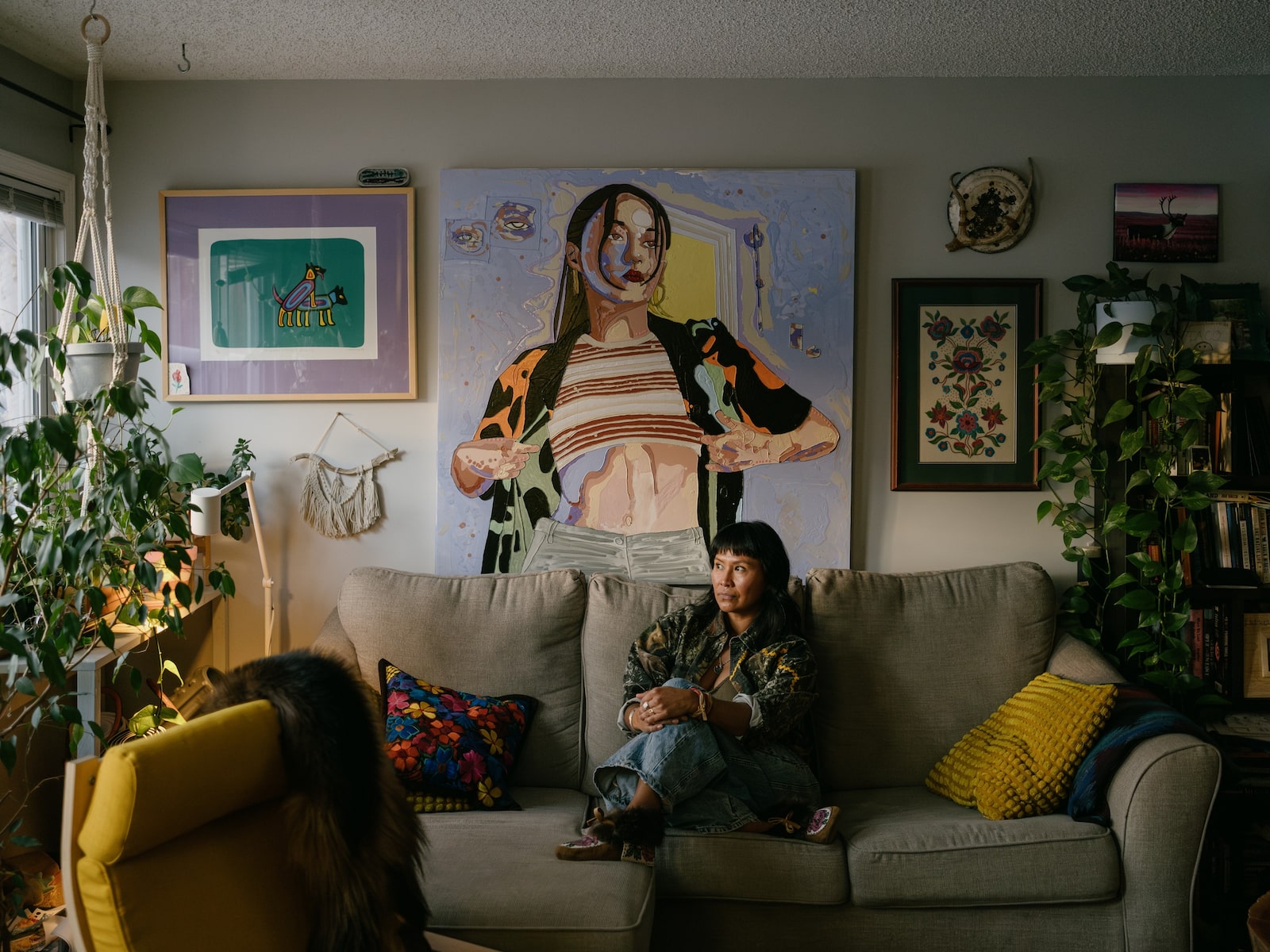

In recent years, her art has been shown in Montreal, Guelph, Ont., and Charlottetown. In her own hometown, however, she lacks a place to display it, and having such a space would help her further her artistic development.
“I’m still working through ideas – I’m making art to explore different things ... to challenge myself, develop my identity as an artist, communicate who I am and my relationship with where I’m from.”
The arts centre would also create programs and workshops for children both in their communities and in Yellowknife. “It’s really the next generations – finding them, supporting them and creating a new sector that they can aspire to be a part of,” said Bell.

An archival Globe and Mail ad from Sept. 18, 1982, advocating for the creation of a performing arts centre in Yellowknife.
Although there isn’t a dedicated public gallery for visual arts in Yellowknife, there are a few smaller public spaces that display work: a mobile trailer, a school foyer, a room within a mall’s visitor centre and temporary exhibits in a hallway of the Prince of Wales Northern Heritage Centre.
Yellowknife is also home to the Northern Arts and Culture Centre, which focuses on performing arts such as dance, theatre, storytelling and music. It opened in 1984. (The Globe and Mail donated $10,000 in seed money in the early eighties to help create the theatre, and ran full-page ads in a fundraising campaign.)
The proposed arts centre is planned as a Category A cultural facility, which means it will be climate-controlled and allowed to receive donations of art. If fundraising goes well, Bell hopes construction would start in 2028, to be completed around 2031.
The Canada Council’s Johnson, for her part, says the council sees “significant value” in the creation of an NWT arts centre. “Dedicated arts infrastructure plays an important role in increasing visibility, access and long-term sustainability for artists based in the North,” she said.
Nakehk’o said this kind of art centre would be transformative – a “physical space where people can aspire to have their work shown in, and elevate people’s work,” such as that of Indigenous fashion designers.
“It gives us pride for being in the North, of knowing what is being made, what people are doing and how far people are pushing things.”
