As I drove endlessly along narrow roads in southwest Wales searching for Jackie Morris’s cottage on the edge of the Irish Sea, a text flashed on my cellphone: “My house has a bear on the roof.”
The bear, or rather a weather vane depicting a girl riding a bear, is just about the only way to find her stone semi-detached house. It’s tucked behind a row of unruly bushes at the end of a long lane in the hamlet of Treleddyd-fawr, barely a speck on Google Maps.
The girl on the bear is from Morris’s rendition of a Norwegian fairy tale called East of the Sun, West of the Moon, one of 60 books she has illustrated or written over her 30-plus-year career.

We’ve arranged to meet to discuss her forthcoming and most ambitious work yet: The Book of Birds, a 383-page field guide to 49 threatened species. The illustrated compendium is divided into seven themes or “wonders” – nest, egg, beak, song, feather, flight and migration. It’s her third collaboration with renowned British author Robert Macfarlane, whose poetic text accompanies Morris’s watercolour drawings.
Whenever Morris collaborates with writers, it’s usually the authors who get the attention from the media, she said. When she’s told that I’m profiling just her, she’s so thrilled she invites me for the day and draws up an itinerary that included a bird watching walk, a lunch of her homemade carrot and coconut soup, an invitation to dinner with her partner and coffee the next morning before I drove back to England.
Morris greets me at the front door. She lives alone with her faithful cocker spaniel, Pi, and three cats: White Cat, Spit and Fish Heads. Her long-time partner lives in nearby St. Davids.
Her tall frame gives the illustrator an imposing presence in the tight quarters. She has mid-length black hair, a few streaks of grey and a dark, self-deprecating sense of humour that quickly dispels any notions of an aloof artist.
There’s a tiny badge on the left lapel of her cardigan that said “KIND” – a reminder, she said, to be nice to people.
“When you’re cruel it hurts you as much as it does anybody else,” she said, and then added with a wry smile: “I try to be kind.” At 63, she has less patience for niceties.
She took me up to the attic, a renovated space where she draws, paints and marvels at the miracles of nature.
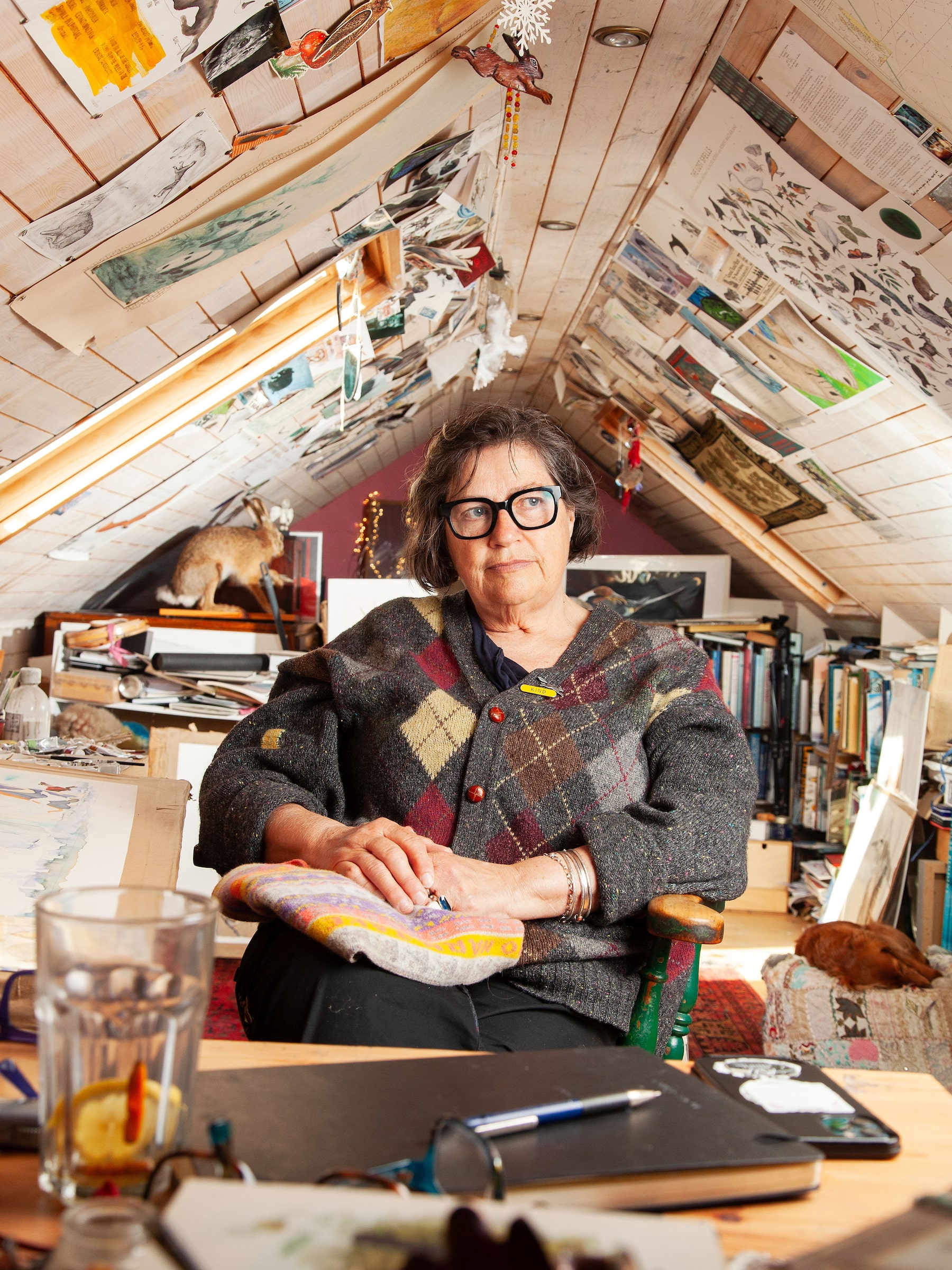
A sign just inside the door read “Entrance” – not the noun but the verb, to be filled with wonder. It’s a fitting welcome to what can only be described as a world of wonders.
Two large skylights illuminated an assortment of striking oddities and taxidermy. In one corner, a leveret – a baby hare – wearing Victorian lace stood in a glass case. A mallard duck sat in a birdcage on a shelf near a box of bird beaks. A barn owl stared out from a wooden perch not far from a large hare depicted in mid-step. None, she assures me, were killed by her.
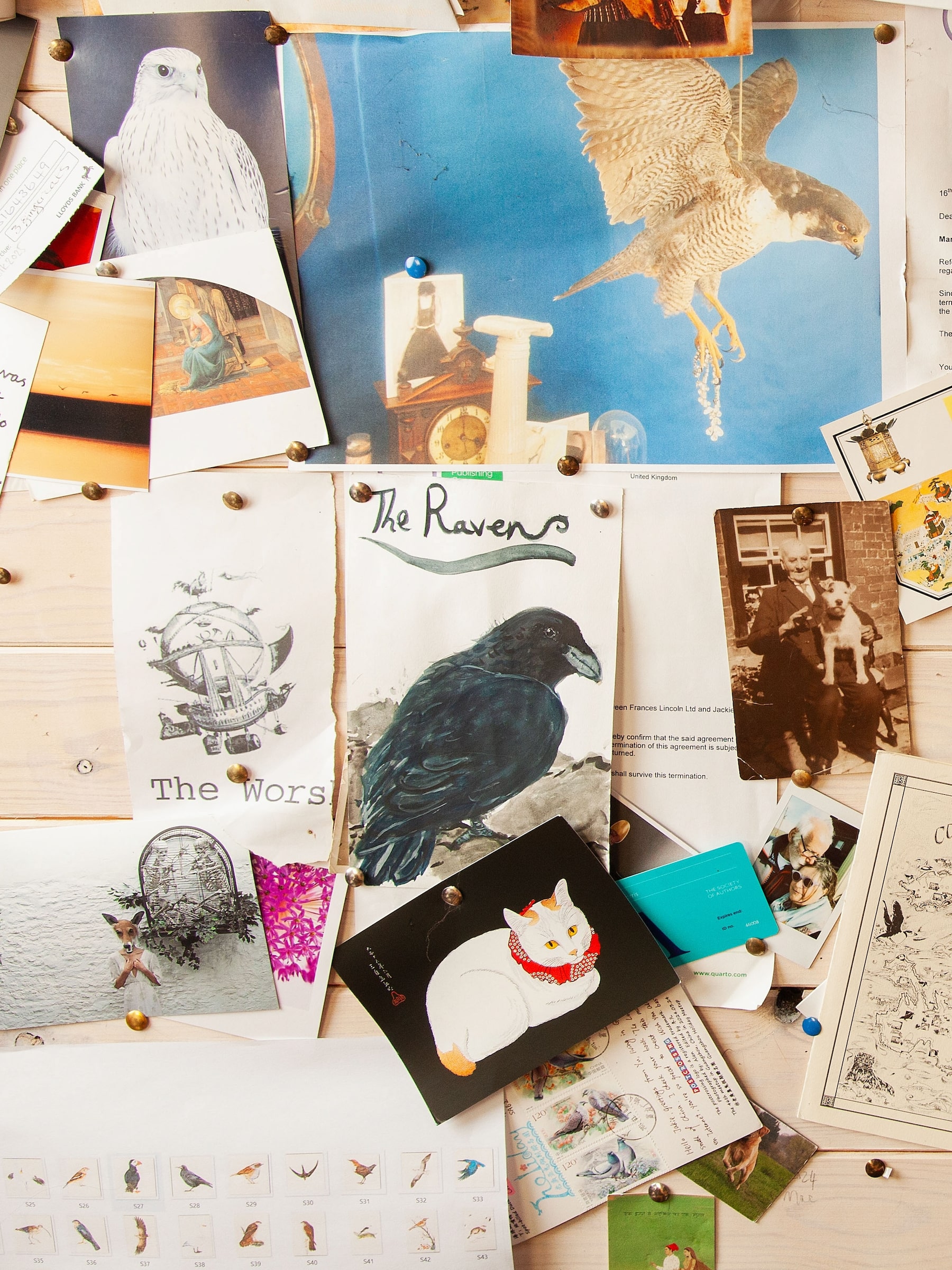
The sloped ceiling was lined with postcards, notes, photographs, posters and a copy of an e-mail rejecting a story idea. And everywhere there were drawings, of bears, dragons, horses and birds. Lots and lots of birds.
“I just can’t stop doing birds,” she said.

The artist uses an array of materials for painting and illustrating.
She’s been drawing birds ever since she was six years old and watched her father, a policeman, sketch a lapwing at the dining room table in the family’s home in Evesham, south of Birmingham. He taught Morris, his youngest daughter, the names of local birds and gave her a copy of The Birds of Britain, published by Reader’s Digest. She still has the book, which she admits she never read and only used to practise sketching.
She and Macfarlane spent eight years on The Book of Birds, which will be released in Britain on May 7 and later this spring in Canada and the United States.
It’s their third nature book, after bestsellers The Lost Spells and The Lost Words, a collection of acrostic spell-poems highlighting words that are slipping out of usage, such as bluebell, heron, acorn, wren and kingfisher. The Lost Words came out in 2017 and has inspired adaptations in music, film, rap, dance, theatre, card games and jigsaw puzzles. The Lost Spells was published three years later as a companion.
Macfarlane, who is 49 and also has a lifelong passion for birds, said the pair were overwhelmed at the success of The Lost Words. “It lived such a wild life that we weren’t going to stop there,” he said.
Morris struggled at first with how to capture the themes of The Book of Birds. “We had this idea of the seven wonders,” she said. “We knew what they were, but I didn’t know how I was going to paint them. And then for every bird I thought ‘This is how to do it.’”

Morris shows illustrations from one of her many published books.
For each species, she drew a traditional portrait and a two-page spread of the bird flying. “Because if you look through old bird books, there are not many where the birds are in flight,” she explained.
Despite her father’s passion for drawing, Morris’s parents were horrified when she expressed an interest in becoming an artist. “They wanted me to go to secretarial college,” she recalled. “We were a very, very working class family. Nobody in our family went on to further education at all.”
She quickly realized as a teenager that artists didn’t earn much on their own, but illustrating for magazines, newspapers and publishers looked promising. “I’d seen all these illustrations so I thought, ‘Well, somebody’s getting paid to do these.’”

Morris's cocker spaniel, Pi is never far from her side in the studio.
She enrolled in an art college in Exeter and then transferred to another school in Bath. Instructors at both colleges were not encouraging. “You’re a long way from brilliant,” she remembers one teacher at Bath telling her. “In fact, you’re not very good, but you’re really hungry to learn.”
After graduating, she headed to London. She landed a few jobs illustrating for magazines and supported herself by washing dishes in a restaurant. Everyone told her she had to travel to get some experience, so she went to Australia for a year and handed out flyers for a strip club.
She returned to England and caught a break in 1990 when she was hired to do a series of greeting cards. Flush with some extra cash, she headed to Wales with her then-husband, who dreamed of working on an island off the coast of St. Davids and raising a brood of kids while Morris drew at leisure. It seemed idyllic and they moved into the cottage in Treleddyd-fawr.
The marriage ended within a couple of years. Morris was left with the cottage, two kids and a stack of bills. She took whatever jobs she could get, including illustrating a children’s book just as she was about to deliver her second child. “I said, ‘Yeah, I’m having a baby next week. I’ll start it the week after.’”
“People used to say, ‘Where did you get your inspiration?’ And I’d go: ‘Two kids and a mortgage.’ It’s not about waiting for the muse. It’s just getting on with it, really.”
She’s successful enough now that she can be choosey about projects. But her work ethic still runs deep and she feels compelled to draw every day. “I’ve struggled all my life with the fact that I don’t like what I do when I’m finished. It’s because there’s always something that didn’t come out right,” she said.

One of the joys of working with Morris, Macfarlane said, are her letters. “She sends me postcards and letters in this beautiful looping handwriting of hers and they almost always contain original paintings.” But she also has a scary side, he added. “She says she would ideally have grown up to be a bear, not a human. And there’s a bit of that to her.”
Her years of drawing birds and animals have given her an appreciation of the fragility of nature and a boiling rage at the impact of humans.
She’s been approached to do a book on bird eggs for her next project, which will touch on the controversial issue of egg collecting.
For years, naturalists and hobbyists used to take unhatched eggs from nests and display their collections. While the practice has been outlawed in Britain since the 1950s, many eggs continue to be sold on the black market.
“I can’t understand people taking eggs out of a nest,” Morris said. Her son-in-law, a scientist, once told her that the multiplier effect of just one lost egg can be dramatic, since it won’t go on to procreate, leading to thousands of birds never being born.
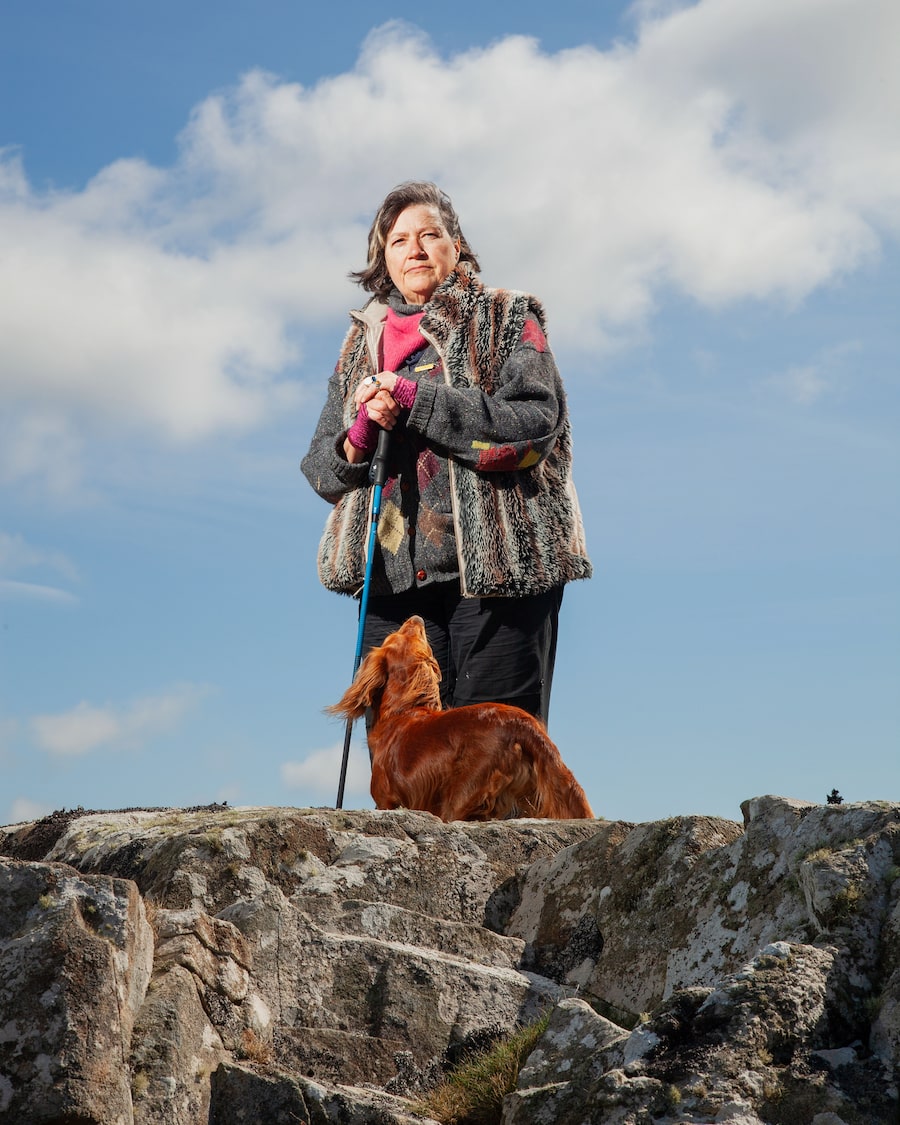
In the late afternoon, we headed out across the farm fields with Pi to her favourite spot. A recent knee surgery has forced her to use a walking stick, but she savours every step up to the cliffs.
We made our way to a rocky area overlooking the sea. It’s here where she does most of her writing – such as Wild Folk, a book of fables – and her bird watching. There’s a gannet, an osprey, a sand martin, a fulmar, a red kite.
If she could be a bird, which one would it be? “All birds, and every bird. I want to shift between all of them. I want to know what it feels like to have the wings of a buzzard and the wings of a hummingbird.”
She can’t understand why people use terms such as “bird brain” as an insult. Birds? Stupid? “I don’t know about you, but I couldn’t navigate from Africa to Pembrokeshire.”
If she does have a favourite bird, it’s the female cuckoo. She’s fascinated at how they lay their eggs in other birds’ nests and disguises them to look like the host’s. The deception leaves the rival raising a family of cuckoo chicks while the real mom flies off. The cuckoos even seem to know which species raised them, so they can do it once more.
Morris plays her own tricks on unsuspecting visitors. She collects smooth stones from a nearby beach and decorates them with golden feathers. Then she puts them back for people to find by chance.
Travelling is not something she enjoys, but she’s eager to make her first visit to Canada in October for a cross-country publicity tour. She plans to share thoughts on nature with children at a school in British Columbia. She can’t wait to see all the different bird species Canada has to offer. And if she’s really lucky, she said, maybe she’ll see a bear.