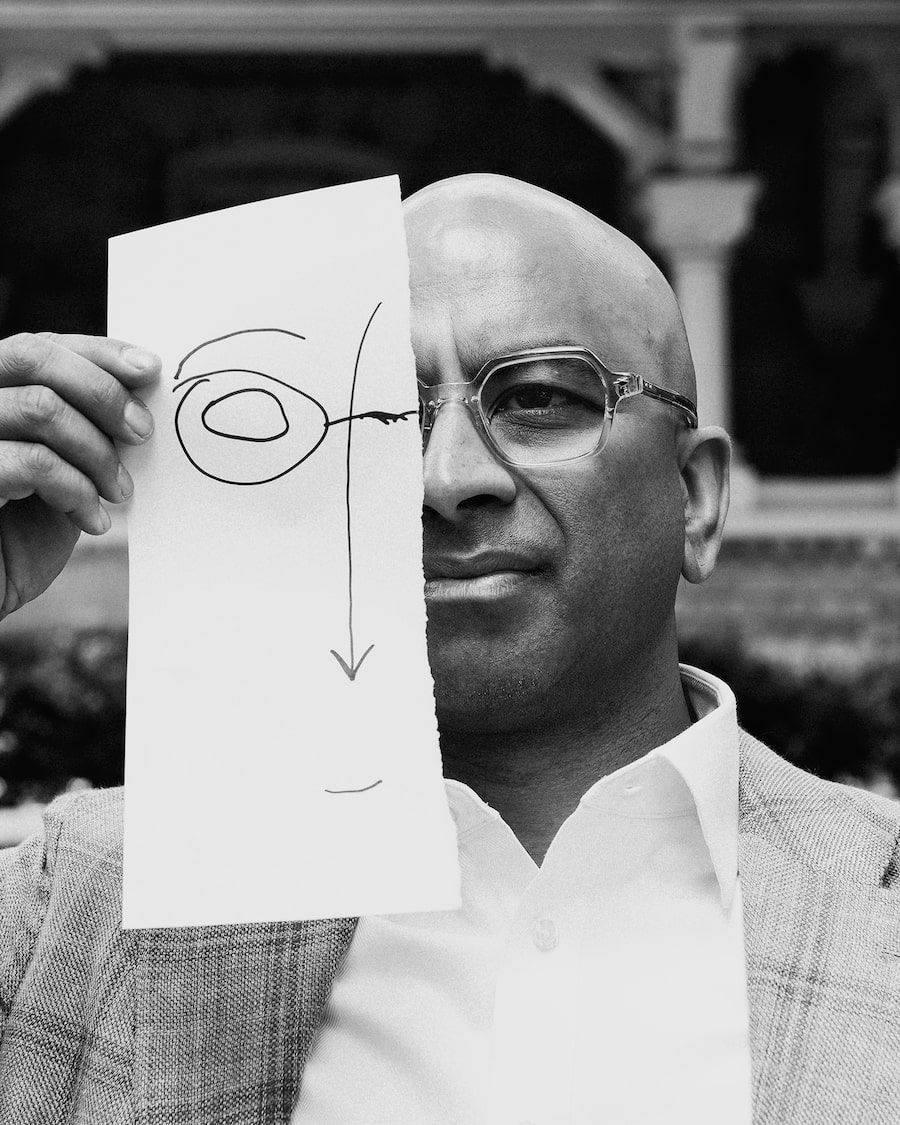
Randy Boyagoda, novelist and career academic, has satirized university life before. But in his latest, Lords of Serendipity, he takes the campus novel global.
Boyagoda is hardly an unknown quantity in Canada. His first novel, Governor of the Northern Province, was longlisted for the Giller Prize; his second, Beggar’s Feast, for the International Dublin Literary Award.
Lords of Serendipity has the makings of a breakout. It’s Boyagoda’s first international release, with simultaneous publication in Canada, the U.S. and Britain, among other countries. When I met with him at his 10th-floor office in the University of Toronto’s Jackman Humanities Institute, where he was recently appointed director, he was getting ready to leave for an Australian book tour.
Over the decade it took him to write Lords of Serendipity, the contemporary university was a moving target. But Boyagoda proved prescient in several respects. He tells me, with some pride, that encampments were in the novel well before 2024.
By the time he submitted Lords to publishers, in early 2025, reality had caught up with the novel. The war in Gaza had thrown universities into political turmoil, and the second Trump administration had just taken office. The timing was, if you will, serendipitous.

Boyagoda was born in Oshawa, Ont., in 1976, the eldest of three children of Sri Lankan parents who immigrated to Canada in the late 1960s. His father was a high-school chemistry teacher, his mother a medical secretary. He describes his upbringing as “pretty straightforward middle-class Canadian.”
Before there was Randy, there was Soharn – an identifiably Sri Lankan name that did not pass unnoticed in 1980s Oshawa. Taunted for it, he eventually traded it in for his middle name. The irony, as Boyagoda sees it, is that his father was militantly assimilationist. When the family visited Sri Lankan relatives, the latter made curries. The Boyagodas brought Shake ‘n Bake chicken and mashed potatoes.
Boyagoda might have filed the childhood ridicule under injury. Instead, he says, it taught him something about irony: how a situation can be painful or strained yet funny, double vision that would serve him well as a writer.
Books had him early. By 15, writing was already serious business. After a game of 500 Up with buddies in an Oshawa field, there was a plan to go to the mall. Boyagoda declined to go. His friends, most from families who worked at the local GM plant, couldn’t understand why. Strict immigrant parents, perhaps? The badgering continued until, finally, he cracked: “I’m writing a novel.” They howled.
Boyagoda studied English at the University of Toronto, then did a PhD at Boston University, where he met his wife, Anna, a fellow doctoral candidate from Milwaukee.
He entered academia, in part, because he knew “professor” would be a more acceptable profession to his parents than “novelist.” But he kept writing, setting himself the goal of publishing his first short story by 21, the age at which he knew Hemingway had done it. He met the deadline.
After stints at Notre Dame and Ryerson University (now Toronto Metropolitan University), Boyagoda arrived at U of T in 2016. Though he enjoys teaching, he discovered that leading and running things came naturally to him, and moved into administration at the earliest opportunity.

It’s not hard to see why. Boyagoda is warm, articulate and has a knack for putting people at ease. He also has a strong sense of what he wants to accomplish. Until recently, one of those accomplishments was pursued under the grand-sounding title of provostial adviser on civil discourse.
Doing a PhD convinced him that he didn’t want to spend his life writing for other academics. He wanted to bring books and ideas into a wider public conversation. Fiction, he believes, is uniquely suited to this: Novelists have a rare capacity to offer readers a larger vision of human experience.
Boyagoda grew up Catholic and remains devout. His two Prin novels – comic satires centred on a middle-aged Catholic English professor – are steeped in Catholic themes (the trilogy’s third book is forthcoming).
Lords of Serendipity has more in common with the Catholic tradition of Graham Greene, Evelyn Waugh (to whom Boyagoda has been compared) and Flannery O’Connor. Greene, in fact, has been strongly on Boyagoda’s mind lately. The English author’s “sense of people trying to do the good in spite of themselves and in spite of the world around them,” resonates strongly with him. For the past few years, he’s given papers at the annual Greene Festival in Berkhamsted, England.
Catholic novels, in this tradition, aren’t necessarily pious novels. They’re often populated by adulterers, drunks, hypocrites and people who are terrible at being Catholics (Exhibit A: the alcoholic “whisky priest” who fathers a child in Greene’s The Power and the Glory). What ties Boyagoda to it is precisely that ability to combine comic social observation with serious moral stakes. He describes his approach as that of a “morally minded take-no-prisoners satirist.”

His character Prin is hardly a model believer. He’s vain, professionally ambitious, frequently self-absorbed and capable of spectacular failures as a husband and father, even as he keeps trying to understand what his faith requires of him. His misadventures take him, first, to the Middle East on a quixotic mission to save his Toronto college, then to small-town Indiana, where he helps an evangelical millionaire develop an Inferno-themed (as in Dante) amusement park.
Lords of Serendipity follows a cast of characters scattered across a globalized university system. Among them is Devi, a girl from a poor Sri Lankan village whose family is staking much of its future on her getting into a Western university.
Unless you count Devi’s regular trips to the local cathedral to steal its Wi-Fi for video calls with Johannes, the tutor helping with her university applications, Lords is less overtly Catholic than the Prin books. Still, something of the same moral architecture remains. Sacrifice runs through the novel. To pay for Devi’s hoped-for university education, her father cleans hotel toilets and, with the rest of the family, works weekends as a professional mourner at a funeral home.
In the U.S., Jack, a widowed statistician, struggles to afford his daughter’s education at Haven College while teaching an overloaded schedule at Arcadia Tech, where a “Compassionate Grading Protocol” gives everyone in a class an automatic A minus after an extreme event – an active shooter, a terrorist attack or a “credible threat of class-specific violence.”
Others get by in less honourable ways. Johannes, who purports to attend “a prestigious uni overseas,” repeatedly wheedles Devi for more money. Boyagoda tends to be forgiving even of his more rapacious characters, like Johannes, who are often victims of a gig economy that has pushed them to the margins.
His Catholic sensibility may help explain one of Boyagoda’s favourite fictional manoeuvres: dropping his characters into strange, sometimes far-flung worlds where they don’t quite belong. “Ultimately it’s religious,” he tells me. “Christianity proposes to be in the world but not of the world.” He points to Saint Augustine’s distinction between the City of God and the Earthly City, which leaves the believer with an abiding sense that “this is not finally where I’m supposed to be.”
Growing up both Catholic and “a Sri Lankan kid from Oshawa” gave Boyagoda a more personal version of that experience. “I think it translates imaginatively into an interest in putting people in unexpected situations and seeing what’s going to happen,” he says.

Lords of Serendipity is ultimately a campus novel that’s less about campus life than the global market that feeds it. Here is the university reduced to a ticket, a brand, a status symbol. Devi has set her sights on getting into Ochyps (OxfordCambridgeHarvardYalePrincetonStanford). What she wants to study is beside the point. She wants to study at Harvard because she wants to go to Harvard.
The universities of Lords have effectively become borderless, drawing students from across the world even as their own substance and history are being hollowed out. Chapels become wellness centres, library stacks give way to meditation zones, a century-old Gothic quadrangle is “a beautiful front for hedge fund investments.” Employees are made to train the artificial-intelligence bots designed to replace them.
Boyagoda has, as ever, a sharp eye for the absurdities of university politics and pieties. After Jack uses the example of an eagle catching a pigeon’s wing in midair to illustrate probability, he gets reprimanded for subjecting his students to “graphic acts of animal cruelty.” Later, when he uncovers a grade-fixing scandal tied to a student suicide, however, the school is less solicitous, performative compassion giving way to damage control.
By Lords’ end, Jack finds himself in a particularly Greeneian predicament. Any which way he turns, he’s compromised. Someone will suffer, but he still has to act. In a fallen world, the best he can hope for is to do good rather than great.
When I ask if he’s worried about how students or staff might react to his novel’s skewerings, Boyagoda gives a wry smile. “I’ll be gratified if enough people read the book that they find themselves in there.”
For all his poking fun at university life, Boyagoda clearly loves it. He entered academia at 19 and never left. I ask him about the stories out there: of English students graduating without ever having read an entire book. He answers by telling me about the Intro to the Novel survey course he’ll teach this fall, whose reading list consists of just three books: George Eliot’s Middlemarch, Ralph Ellison’s Invisible Man and Kiran Desai’s The Loneliness of Sonia and Sunny, which together run to about 2,200 pages.
To keep the AI hounds at bay, he’ll administer oral exams to all 80 students. “It’s going to take me two days. And it’s going to be a conversation. All they’re going to have is a glass of water, a box of Kleenex and M&Ms. And we’re going to sit there, and I’m going to ask them about the books.
“The world says you don’t want to do this, you can’t do this, you’re not capable of this,” he continues. “But I don’t believe that. I believe that if people keep telling you that, it might be true. But come live inside the world of a novel with me.”