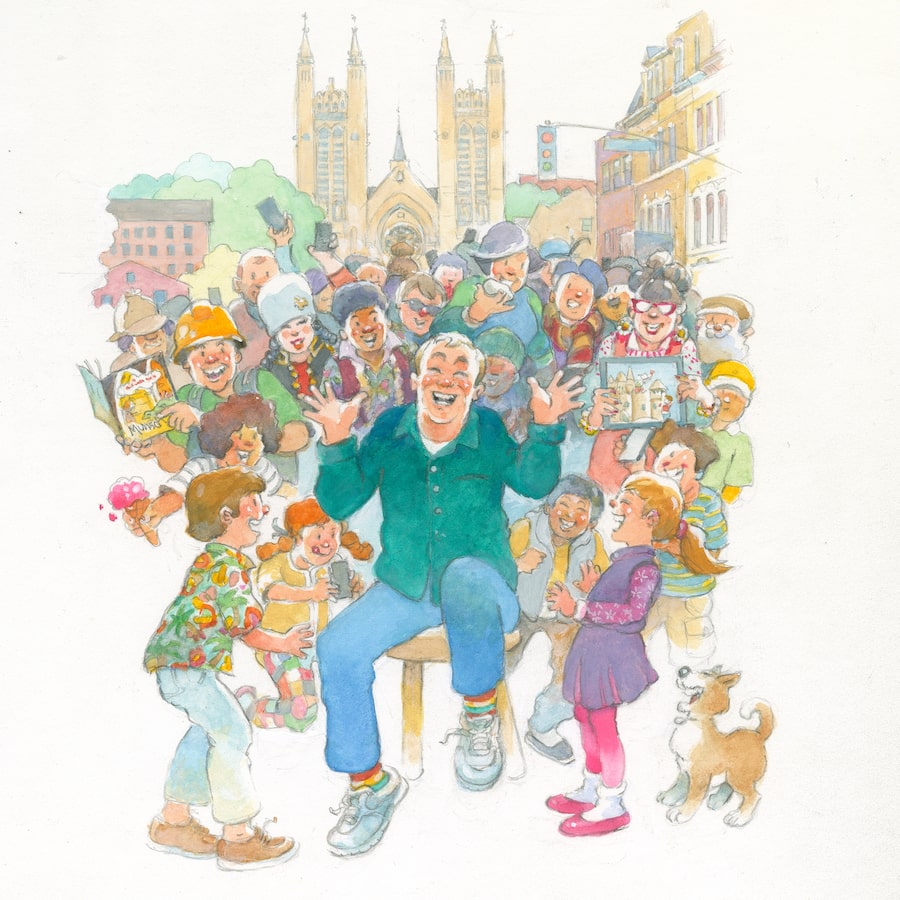
One evening last fall, something magical happened in downtown Guelph.
On the second Thursday of every month, the Guelph Guild of Storytellers hosts Tales from the Hill. The event is so named because the museum that hosts it sits just at the foot of the city’s hilltop Gothic Revival-style cathedral that towers over Guelph’s downtown.
The event takes place from October to May, and anyone can attend. Storytellers are invited by the Guild, and there’s an open-mic portion at the end. At one such event, last November, as attendees filtered in, they saw a man sitting at the back of the room. When the event began, the man came to the storytellers’ position and sat in a rocking chair in front of the microphone. And when he lifted his head, he came to life with the animated storytelling style that could only belong to one person: Robert Munsch.
Brendan Rogers attended the event for the first time that evening. A Guelph resident since 2021, it made him feel, he says, “like I’m now a real Guelph guy. When I told the story to my Guelph friends, they were like, oh yeah, that’s Robert Munsch. He just shows up.”
It’s true: Most everyone in Guelph – myself included – has a memory about a time Robert Munsch showed up, and if they don’t, they know someone who does. For more than 50 years, the children’s author has made himself a part of the city’s collective consciousness and, chances are, if you grew up there, he visited your school. You might have seen him read from his books at the Guelph Public Library. Or he may have told you a story at a public park, a Christmas party, or from his front stoop. In return, he has become a part of the city’s identity.
We want to hear from you
Share what you love about author Robert Munsch. Join our live chat next Friday Oct. 16
Last fall, Munsch made headlines for disclosing to the New York Times that he has chosen MAID, or medical assistance in dying, a decision spurred by a 2021 Parkinson’s and dementia diagnosis. His memory is now faltering, and will continue to fade. But in Guelph, encounters with Munsch have been so widespread over time, they form something of a living, breathing memory of his life as an artist, contained within the city’s borders.
Guelph, located about an hour and a half’s drive west of Toronto, may not be known for its arts and culture – though, curiously, the city has been the home of two of Canada’s most-beloved children’s authors: Jean Little, as well as Munsch. The city, with a population of about 140,000, sits at the nexus of Ontario’s major farming regions; the University of Guelph is known nationally and internationally for its agricultural college – which, among other things, produced the Yukon Gold potato. Munsch moved to Guelph in 1975 to take a teaching position at the university, in its family studies department.
That’s where Cyndi Seifried remembers encountering him. In 1984, Seifried was studying psychology at the university, and was taking a children’s theatre course. Munsch was invited as a guest lecturer. It made sense, Seifried says: storytelling is part of the same oratory tradition that includes theatre and Munsch’s specific brand is theatrical, to say the least.

Munsch tells stories to grade one students at St. Dennis School in Toronto in 1991.Fred Lum/The Globe and Mail
“He talked about being part of the audience,” Seifried recalls, “so children feel like they’re part of the experience.”
It’s a lesson Munsch was uniquely well-suited to teach. Munsch is best known for his larger-than-life in-person storytelling. Ben Robinson, 44, a Guelph Public Library branch supervisor and former children’s librarian, remembers a visit to Marden Public School. “If you look at his books, some of them, each of his books was dedicated to a real child who gave him the germ of the idea, and some of those kids are from Guelph.”
This is how it would work: Munsch would drop in to a school or library to hold court amongst a gaggle of rapt young kids, usually the under-10 set. If he was reading from his published material, he would transform printed words into a living, breathing thing. Munsch’s storytelling voice leans heavily on onomatopoeia and repetition – think: the “thump, thump, thump” of Mortimer; the train conductor’s cry of “LAST STOP! EVERYBODY OUT” printed every few pages of Jonathan Cleaned Up – Then He Heard a Sound; the titular baby’s coo of Murmel, Murmel, Murmel. Even the repeated chorus of Love You Forever, the bittersweet title Munsch wrote after his wife Ann suffered two stillbirths , carries a gentle sing-songiness.
Munsch’s actual voice, meanwhile, was madcap. He shrieked, shouted, roared and thumped through every syllable, with a cadence and pitch that was, once you heard it, inseparable from the material.
The school visits were sometimes scheduled, but sometimes spontaneous and unplanned: Munsch would, again, just show up and ask if there was time for him to do some storytelling. “No teacher or principal is going to say ‘oh, come back tomorrow’,” Robinson says.
Often, he was working on something, and telling stories to Guelph’s kids was one way Munsch figured out whether or not they worked, testing rough new material on a target audience like a standup comedian polishing a routine. This method was not just how Munsch entertained an untold number of young Guelphites; it’s also how he wrote.
During Munsch’s visit to Marden Public School, Robinson says, “he picked a kid in the audience and made up a story on the spot,” he says. “I remember wishing it was me. My memory is probably playing tricks on me, but I think it was a kid two kids down from me that got picked, so it felt like I was close.”
Tammy Stewart, 47, was in first or second grade – she’s not quite sure of the year, either 1986 or 1987 – when Munsch visited her St. Paul Catholic Elementary School. “We all knew he was coming,” she says. “We all knew his books. What I wasn’t prepared for was his energy.”
Decades after Munsch’s visit to St. Paul, Stewart’s brother, a contractor, was doing work on Munsch’s house, and asked Munsch if he would autograph a copy of The Paper Bag Princess for her. “I’ve never been so jealous of my brother, because I’ve never actually met him,” Stewart says. “I’ve seen him, but I’ve never one-on-one gotten to say ‘You changed my life, you made me love books.’ While we know, consciously, as adults, he’s a celebrity, but growing up, he was just part of my life.”
If Guelph were big enough to have a suburb, the small community of Rockwood – about 10 minutes outside of the city – would be it. Dana Riek, who grew up there, remembers Munsch visiting the local library and bringing with him a “story rock,” a whimsical, nonsensical prop, but one that he used to charm his audience. “He said if you held it and really looked at it, you could find stories inside it,” Riek recalls. “Looking at it now, it’s just a regular polished stone. But back then, it felt magical.” Even more magical still: Munsch gifted her the rock.
“It instantly became my most treasured possession,” she says. And the impact was long-lasting. “Sometimes I wonder if that moment nudged me toward studying literature in university. It feels connected somehow – like that rock represents the first time I really understood that stories come from imagination, and that imagination matters.”
In 1995, Munsch was asked by the now-shuttered Guelph Mercury to share his feelings about the city, with a population then nearing 100,000. He shared that he loved its downtown, hated a set of recently built high-rises, and swore he’d never run for local office. In an unrelated aside, he also commented on his storytelling style, characterized by the Mercury as “wildman live readings.” “I did have a shrink tell me all this performance is overcompensation for basic shyness,” Munsch said.
While Munsch has always been a fixture in Guelph, it has been on his own terms: He showed up when he wanted to, when he could. Munsch’s recent candour about his decision to choose MAID followed a career characterized by frankness about his struggles with mental health and addiction.
In the neighbourhood where he lived for nearly 25 years, Munsch kept mostly to himself, but he was no recluse. His neighbour Gabi Luttmann said while he was most comfortable when interacting with the neighbourhood’s children – he famously handed out miniature versions of his books from his stoop every Halloween – he made his presence most memorably known to the adults every year, at the annual neighbourhood Christmas party.
“His family would come, and then he’d come a little later,” she says. “But when he arrived, we knew what was going to happen. Everybody stopped.” Munsch, every year, would arrive at the party to tell a new Christmas story, written about the family hosting that year’s fete. And that was it: “He’d tell the story, he might eat a little bit, and then he would disappear.”
Luttmann’s time living near Munsch is immortalized in more than memories. One afternoon, she got a call from Munsch, who asked her sons’ ages. “He said, ‘I’m working on something, do you mind if I come over a little later this afternoon?’” Luttmann recalls. “So he came over. There were some pictures taken. And then a little bit after that, he came over again, and he had the story just in large print.” Munsch asked Matthew, Luttmann’s youngest son, to read the story, so Munsch could see his reactions. “It was in the summer, and he brought some scrolls of … the pictures that Michael Martchenko had already sketched out. So here we are. He’s watching Matthew, and I am just kind of just shaking inside, just so excited.”
That afternoon session would become The Sandcastle Contest, published in 2005; the book’s hero is named Matthew. Last year, Martchenko and Munsch were invited to a school in Guelph to talk about the book. Munsch wasn’t well enough, so Matthew – the real-life Matthew from the book – stood in.

Munsch in 1999.Fred Lum/The Globe and Mail
Robyn Cox, 37, met Munsch in 1998, when she was 9. It was at a holiday party hosted by her family, in Guelph’s Grange Hill East neighbourhood. When there, Cox encountered him at the dessert table, and encouraged him to try some of the cookies she’d made. She asked his name, and he introduced himself as “Bob Munsch,” prompting Cox to say it was too bad his name wasn’t Robert, because then he’d have the same name as the author. Munsch responded that, well, yes – that’s him.
“It was at one of the points where he didn’t have a beard, but in all of the books we had, he was pictured with facial hair,” Cox, who now regularly reads Munsch’s books to her 20-month-old daughter, says. She didn’t believe him. “I challenged him to name a bunch of his books, because I didn’t believe this strange man would know as many Robert Munsch books as I did. He obviously knew quite a few.”
The next day, Munsch returned to the family home with a copy of his book Ribbon Rescue, inscribed for Cox: “To Robyn, who didn’t think I was me.”
It’s the kind of thing Sya VanGeest, a member of the Guelph Guild of Storytellers and a former teaching librarian, says lends an air of mythology to Munsch – how could those stories, those encounters, ever disappear? “There’s nothing wrong with making it magical,” she says. “Because it is magical.”
VanGeest has enjoyed a long friendship with Munsch. Because of this she has stories of her own, but there are also stories about people telling Robert Munsch stories about his stories – layer upon layer of memory, stacked tight and impervious to loss.
VanGeest keeps in touch with Munsch and, through her connections to the Guild of Storytellers and the literary community in the city, VanGeest has facilitated some of Munsch’s more recent public appearances, and when he shows up, so do the crowds. VanGeest helped organize a storytelling gig at Guelph’s 2024 edition of Ribfest that saw more than a thousand people turn up. The year before that, she helped plan his appearance at the Enabling Garden, an accessible green space at Guelph’s Riverside Park, that saw a turnout of 700 in a space made to accommodate less than half that.
“In Guelph, we’re blessed to just have him floating around, you know?” she says, noting that, these days, he’s less likely to be recognized in public. And anyway, it doesn’t matter: He’d probably rather keep to himself, until storytime. Munsch has said that, as far as his stories are concerned, he’s still all there. “When he gets into that mental memory of his and he just comes alive,” VanGeest says. “it’s a miracle.”
Those surprise drop-ins – at schools, parties, libraries – don’t tend to happen much anymore. So when Deanne Melehes, a kindergarten teacher at Holy Trinity Catholic Elementary School, reached out to Munsch to see if he’d visit the school for Paper Bag Princess Day, which takes place the first Saturday of March, it was a bit of a Hail Mary. She didn’t hear back, and he didn’t turn up.
Until June.
Melehes’ educational assistant was on break, and found Munsch at the school’s office, saying he’d been e-mailed about Paper Bag Princess day, but didn’t remember who’d sent the e-mail. “My EA came running back into the room and said, ‘Robert Munsch is here,’” Melehes recalls.
Melehes gathered her students, brought them down to the office, explained who Munsch was, and then, everyone got down on the floor. And Munsch got right down with them. He pulled from the old playbook, asking a student her name; it was Ayla. He then told a story – completely off the cuff – all about Ayla, and her adventures being the king of the castle. He was animated, asking the children to raise their hands at certain points in the story, and raising his alongside theirs, then floating them down, all together. He was expressive, he did voices. He looked every child in the eye. It was the same magic as it has always been.
“The connection that he made in such a short time with a classroom of 28 children was unbelievable to me,” Melehes says. “That’s not easy to do. These children, some of them are three, four, five years old. He connected with them instantly. He was joyful.”
Munsch’s drop-in mirrored the drop-ins he’s always done in Guelph, but there’s a different layer of context to the Holy Trinity visit. “If he’s having a good day, he’ll take a little outing,” Melehes says. “And we were the fortunate ones.”
Last fall, after Munsch announced he had been approved for MAID, there was something of a public outcry. So beloved is the author, so timeless are his stories, so generation-spanning, that legions of Canadians simply couldn’t reconcile that someday, and someday soon, he may be gone. The reaction was so strong that Munsch’s daughter, Julie, shared a post on his official Facebook page not long after the story ran that her father is still alive and quite well. True though that may be, someday, and someday soon, he will be gone.
In early August, VanGeest invited Munsch to drop in to a storytelling event at Riverside Park called Under the Magic Ash, an event geared towards children. Munsch said he was amenable, but the morning of the event, he changed his RSVP. VanGeest says Munsch has suggested to her it might not be worth extending the invitations any longer.
But while Munsch’s absence was felt, so too was his presence. The storytelling event featured a tale from Brendan Rogers who, after seeing Munsch at the Civic Museum event the previous November, was inspired to join the Guild as a regular storyteller. Beneath the event’s titular ash, he told a story about a small raccoon seeking a comfortable home, making friends along the way, his narration woven through with a sense of play and a focus on audience participation that could only be described as Munsch-esque.
In Guelph, Munsch’s impact will outlive him in two ways. First is the physical: Not long after the profile was published, Munsch announced that he has donated his personal archives to the Guelph Public Library, in November, 2025. They will be housed in GPL’s new, $62-million downtown branch when it opens later this year – a landmark donation for a landmark civic project. In December, Guelph City Council approved plans for a Munsch tribute in the heart of the city, St. George’s Square – a plan whose most outspoken advocates included Sya VanGeest – slated for completion in 2028.
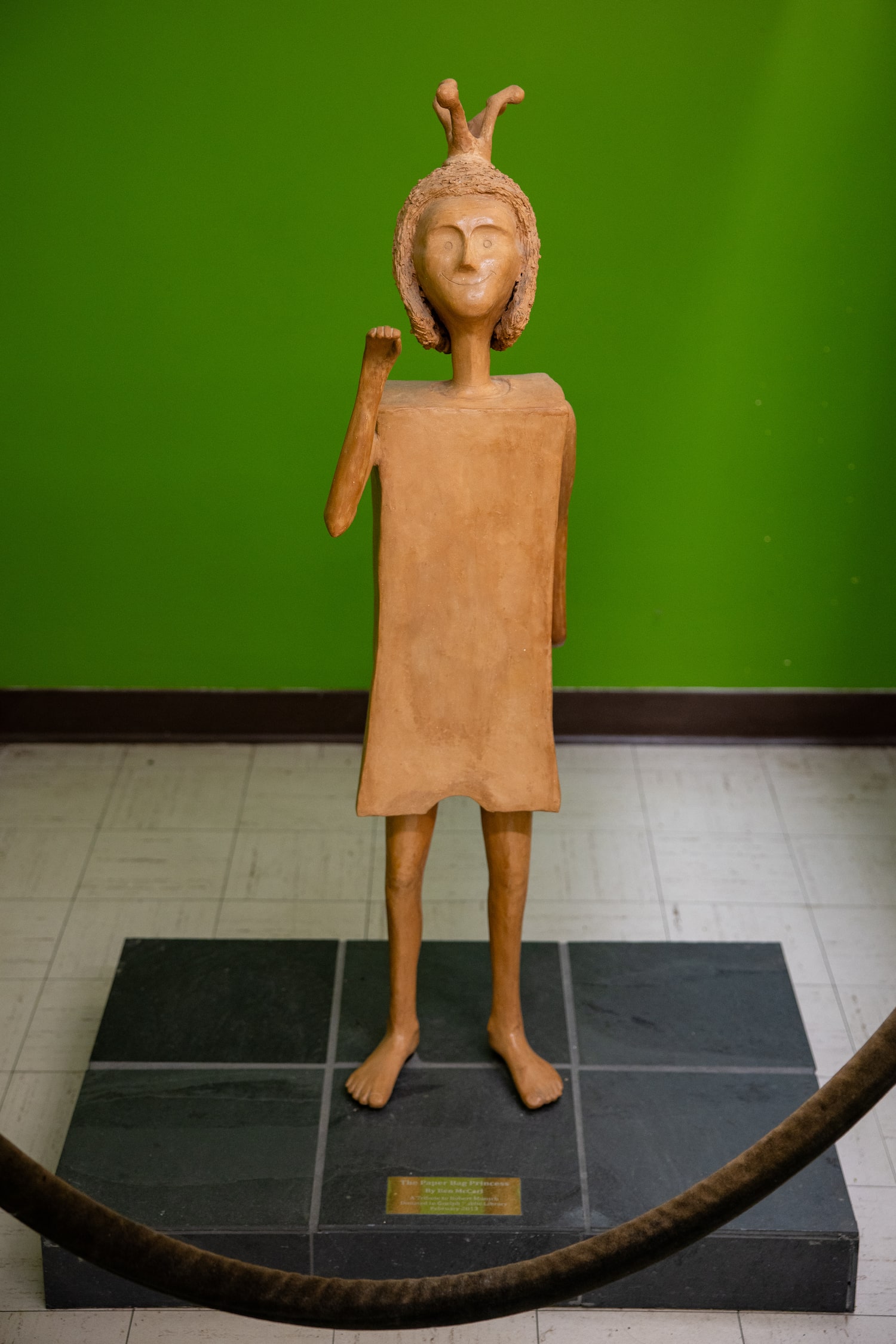
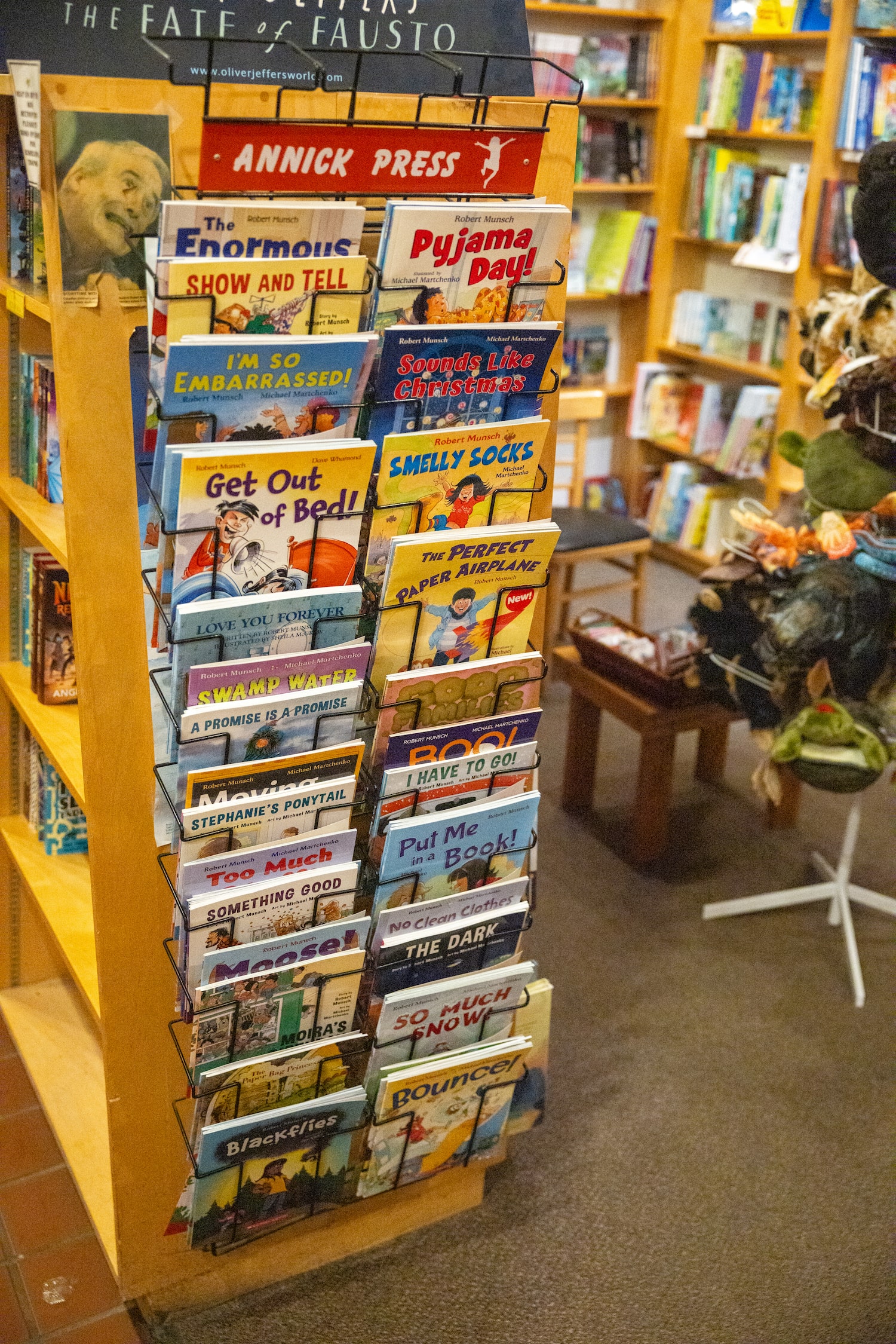
But there are already little physical artefacts of Munsch around the city. A statue of the Paper Bag Princess by local artist Ben McCarl, is currently tucked away in the Guelph Public Library’s lower level; it will get pride of place in the new building. The Bookshelf, an independent bookstore, cafe and cinema downtown, has a small corner of Munsch books in its children’s section, with a tattered and fading newspaper clipping pinned to its wall.
The second way is through the collective memory. Few authors, if any, are guaranteed to be preserved forever in the hearts and minds of a citizenry the way Munsch is guaranteed that immortality in Guelph.
I know this to be true because I’m part of that collective memory. I was born in Guelph, in 1986, lived there until I moved to Toronto to study at Toronto Metropolitan University. I returned to Guelph in early 2022. I am part of the Munsch generational cohort who had the good fortune to grow up being frequently visited by him for storytime.
My memory of it is imperfect, as memories are. But in 1998 year, Munsch appeared as a guest for families at the annual general meeting of the Guelph-Wellington Credit Union, where my mom worked. I know I was there, because a photo was published in the Guelph Mercury of my sister at the event; I know, too, because she remembers, and so do my parents. We have pieces of a memory, whose rough shape is echoed in the memories of others. Echoed enough times, over enough generations, that memory becomes harmonious and whole.
In Guelph, memories of Munsch himself are fragmented – across the city, and across generations. But the hundreds – more likely thousands – of pieces of Munsch held close to the hearts of the city’s residents build a portrait of an artist who, by placing a bit of himself within so many, has rendered himself immortal.
And the joyful compulsion each of us who holds a piece of that portrait feels to share it, to pass it on, to put our respective pieces together when offered the chance, promises Munsch a permanence, through the memories he has given us.
We’ll remember them for always. And we’ll love him forever.
Illustrator Michael Martchenko explains how he came to work with Robert Munsch, the beloved children's book author. Martchenko has since illustrated over 50 of Munsch's popular kids books.
Video by Melissa Tait and Sammy Kogan; Video editing by Deborah Baic; Visual editing by Sarah Palmer; Digital presentation by Jesse Tahirali.