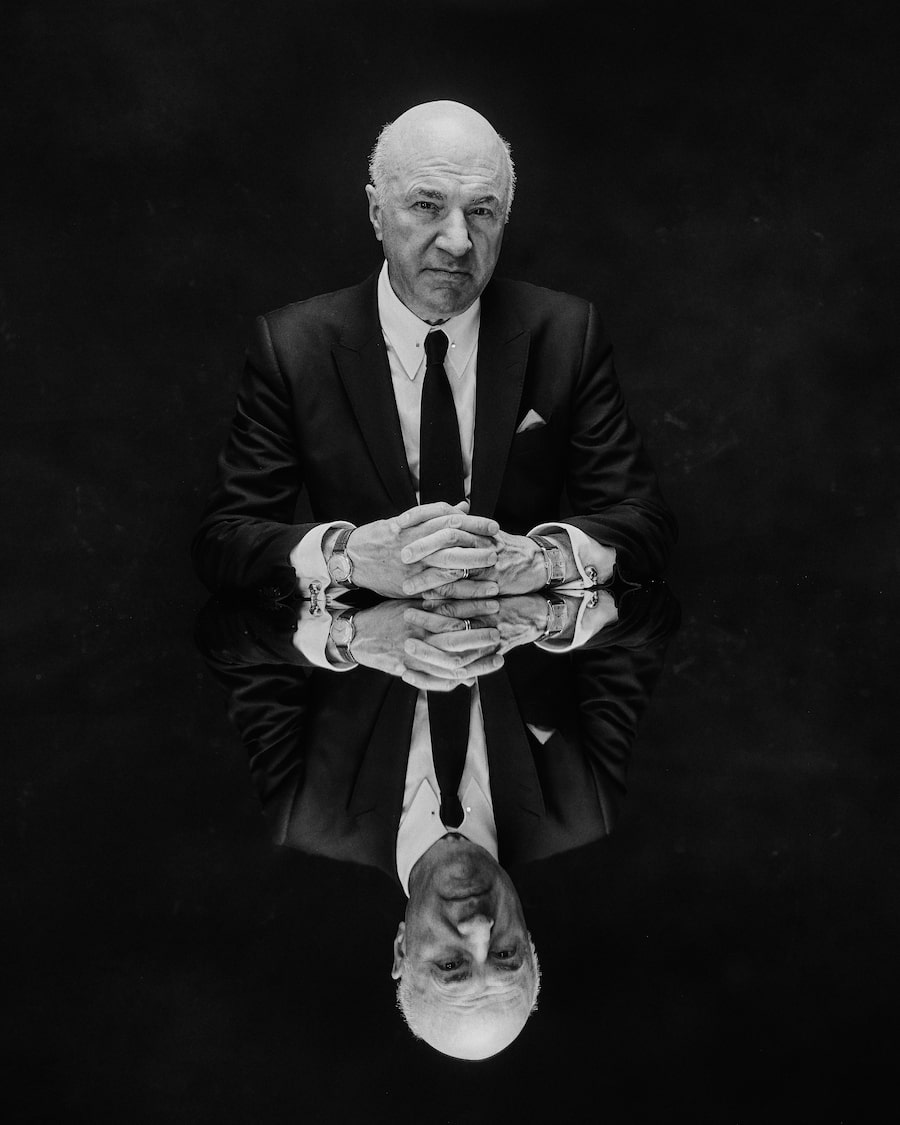
Kevin O’Leary isn’t a blood-sucking creature of the night, but he realizes that sometimes it can be hard to tell the difference.
For the past two decades, the Canadian businessman has haunted television screens via CBC’s Dragons’ Den and its ABC spinoff, Shark Tank, where, operating under the moniker “Mr. Wonderful,” he ripped into hopeful entrepreneurs with a vicious kind of glee. And when he wasn’t busy destroying everyday folks’ hard-fought dreams in front of millions of viewers, he was palling around with another reality-TV supervillain, U.S. President Donald Trump. (For what it is worth, O’Leary is fond of saying that he endorses policy over politicians – though that did not stop him from trying, and failing, to run for the Conservative Party leadership in 2017.)
Does all this make O’Leary something of a vampiric abomination? In the eyes of many, sure. But like any other natural-born showman, O’Leary knows a good role when he sees one, and has been busy lately pushing his enemy-of-the-people shtick further in a new and even more monstrous arena: Hollywood.

Kevin O'Leary as Milton Rockwell in Marty Supreme.Elevation Pictures/Supplied
In the recent big-screen hit Marty Supreme, O’Leary plays Milton Rockwell, a 1950s pen mogul who becomes the unlikely nemesis of a ping-pong-playing phenom played by Timothée Chalamet. Using his noxious public persona to play an altogether different kind of world-class jerk, O’Leary transforms Milton into the very embodiment of demonic postwar capitalism. One who, as an instantly iconic line of dialogue reveals, just might be a real-deal Dracula: “I was born in 1601, I’m a vampire – I’ve been around forever!”
It is a dynamite performance that, whatever you think of O’Leary’s real-world, very mortal existence, justifies all the eager awards-season chatter. And though he didn’t end up nabbing a best supporting actor nomination, Mr. Wonderful will still be walking the red carpet at next week’s Academy Awards, where Marty Supreme is up for nine Oscars, including best picture. (All while wearing his signature dual-arm timepieces: “I wear two watches every day, and I’m known by every watch company on Earth!” he once declared.)

“I was born in 1601, I’m a vampire – I’ve been around forever!”
In more than a few ways, O’Leary’s journey feels eerily similar to the one undertaken by the film’s title character: Marty is an unrepentant, unstoppable hustler who bare-knuckles his way into the upper echelons of power, whether you like his methods or not. He is the perfect, messy encapsulation of the promises and perils of the American Dream. Did O’Leary, who grew up in Montreal, spend his own youth yearning to pursue that same stars-and-stripes fantasy? Or was it filtered through a more Canadian lens?
“The ‘Canadian dream’ is no different than the American one. Since the Second World War, all of the wealth created in Canada was from entrepreneurs, a lot of them energy entrepreneurs: oil, gas, mining. It was all built around entrepreneurship,” O’Leary says in an interview from his Miami home, a few weeks before Hollywood’s biggest night. “Not that we want to get into politics, but the last 10 years have, by the numbers, been pretty abysmal. Canadian GDP growth has gone to zero. We’re the only of the G7 countries that has no growth any more, and maybe we should get back to our roots. Regardless of politics.”
Politics didn’t seem to be on the mind of director Josh Safdie, either, when he and his Marty Supreme co-writer Ronald Bronstein pitched the role to O’Leary.

Rockwell was written to be an entertaining businessman, so it was only natural that Mr. Wonderful play him.
“When you cast a movie, you’re bringing every life experience that the person is bringing to the soul of the movie, all the baggage that people have associated with them. If you cast Brad Pitt, you’re bringing every Brad Pitt film with it, and you have to think about how to either use that or not use it, how to destroy it or rebuild it. For Milton, I wanted to cast somebody who could bring a powerful, big CEO vibe,” Safdie says in a separate interview. “I started to think, okay, what about an entertaining businessman? We obviously have one in the White House. But then Ronnie, before I even started to talk about different actors, he goes, ‘Mr. Wonderful.’”
After an introductory meeting over Zoom – “It was full on like I was on Shark Tank, I thought at any moment he was going to say I was out,” Safdie recalls – O’Leary flew the director and Bronstein to his Ontario cottage in Muskoka to read through the script and make adjustments. (That vampire line was one of O’Leary’s contributions.)
“I think I was the last character to be cast in that movie,” O’Leary says. “I said, ‘Look, if I’m going to do this, we’re going to have to make some changes to the script, because that’s not how Milton Rockwell would have done business in 1952, because I am Milton Rockwell today.’ By the time we were shooting, I knew the story, I knew my lines, I knew everything.”
Not everything. While O’Leary subtly alters the nuances and tics of his Mr. Wonderful facade to an impressive degree in Marty Supreme – Milton is a man of quiet menace, his acts of vengeance coiled and calculated compared with the purely brash theatrics deployed on Dragons’ Den – the newbie thespian soon realized that being on a set was not the same as being in a boardroom.

Timothée Chalamet and Kevin O'Leary speak with director Josh Safdie on the set of Marty Supreme.Supplied
“I learned pretty quickly that a film set is not a democracy. After I decided that we’ve got the take we needed, I told Josh that we can move on,” he recalls. “Now that was not a good move, because he explained to me that’s not how it works, in no uncertain terms, and that I’m going to keep shooting until he says we’re done.”
That power-shift dynamic wasn’t the only thing to change O’Leary’s worldview. A long-time critic of labour unions – in 2011, he said that if he were elected prime minister, he would make unions illegal, positing that they are “born out of evil” – O’Leary is now eagerly extolling the virtues of being a member of the Screen Actors Guild (SAG).
“SAG is really important to me because many people get taken advantage of if all they ever do is the arts, they don’t have any business chops. I don’t have that problem, nobody needs to negotiate for me,” he says. “But some great artists and directors that I meet and talk to about their finances, I’m in shock. They just don’t know. And so you have a union that’s going to make sure that you have some discipline on that side that lets you flourish as an artist. SAG is in a unique place.”
As Marty Supreme wound its way through the awards conversation, O’Leary also came to appreciate that fame – which he’d previously been familiar with from his days as a news panelist, reality-TV star and even a musician (he plays a mean, but not mean-spirited, guitar) – is a multitiered illusion.

“I’ve been doing television for about 25 years in various roles, but there’s a pecking order in Hollywood,” O’Leary says. “At the triple-A layer is a movie like Marty Supreme, with a global release, it’s as good as it gets. Underneath that are the indie films, which are also important, but they don’t get the same kind of focus. Underneath that is reality TV. And at the bottom of that, the single-cell amoeba, is music. It’s cruel to see it work that way, but as a guy who’s done them all, that’s how it works.“
“I thought that I was at the highest level of fashion in terms of access to jewellery companies, fashion brands,” he continues. “But now I’m getting offered everything I want! And I’m going to take advantage of that.”
In terms of how O’Leary can further take advantage of his newly Oscar-adjacent fame, well, the entrepreneur of course has some ideas.
“I would argue to you that a good investment for me is to do one film a year. I have three offers right now, I’ve got to look at these scripts,” he says. “I’m going to stay on every level of media.”
But don’t think that O’Leary is above typecasting.
“I’ve made it very vocal that I intend to be the next bad guy in the Bond movie,” he says. “They’re simply not bad enough. I can do a much better job.”