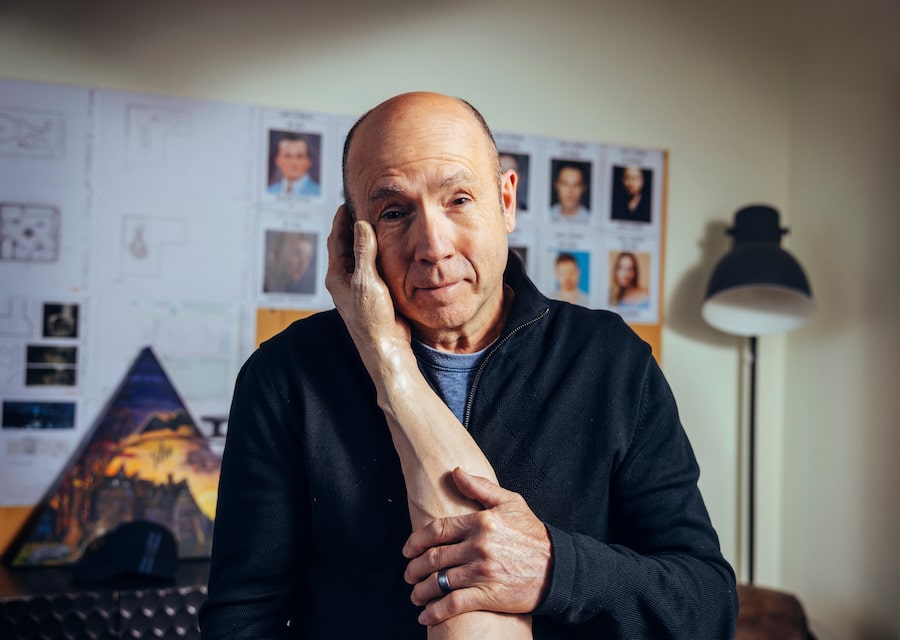
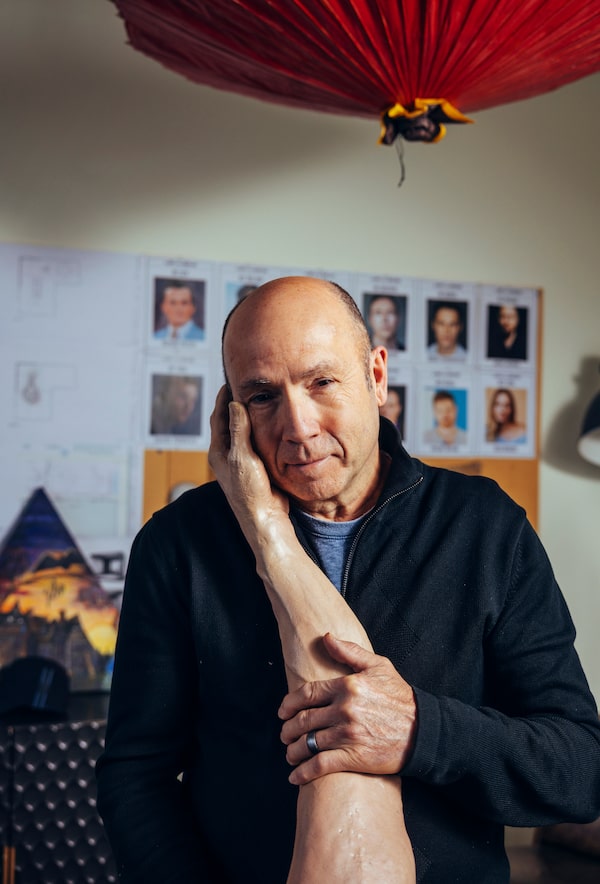
Movie producer J. Miles Dale doesn’t work in an office so much as a grotesque cabinet of curiosities.
Tucked away inside an industrial stretch of Toronto’s east-end waterfront, Dale’s work space is peppered with the stuff of big-screen nightmares: a carnival-style banner advertising “Human Freaks, Strange People, Sensational Acts,” a handful of severed faux-limbs, the decapitated heads of two demonic nuns, and enough storyboards and blueprints for dungeons, laboratories, crypts and other various chambers of horror to stage a thousand Halloweens.
But what else would you expect from the man who has, over the past decade and a half, become the most trusted collaborator of Guillermo del Toro, today’s undisputed king of monsters?
“He and I have been together for 15 years now, so you develop a shorthand together, a trust factor,” Dale says before surveying the room and conjuring an apt mad-scientist metaphor. “You know, a movie is a lot like a petri dish or a lab experiment. Does it work? Does it not? What’s the thing that makes it explode? For everyone to get along for so long, to not be afraid to make suggestions and raise the game creatively, that feels kind of unprecedented.”
2026 Oscar best-picture nominees: Where to watch in Canada

Director Guillermo del Toro, left, has wanted to make the classic monster movie since he was a child.Ken Woroner/The Associated Press
This Sunday, Dale will trade his Toronto labyrinth for the nightmare alleys of Hollywood, where Frankenstein, his latest production with Del Toro, is nominated for nine Academy Awards including best picture. The Oscar spotlight marks a crimson-coloured peak in Dale’s long creative partnership with Del Toro, which has so far produced eight Ontario-shot productions across television and film, and one best picture winner with the 2017 fantasy-drama The Shape of Water. But Frankenstein’s awards-season run also marks the culmination of two particular dreams: Del Toro’s bid to make the classic monster movie, which he has been desperate to film since first picking up a camera, and Dale’s committed desire to prove that Canada is home to the most talented and singular screen artists in the world.
While the Oscar headlines surrounding Frankenstein might skew more toward its Hollywood-friendly elements − such as the buzz behind best supporting actor contender Jacob Elordi − the bulk of its nominees are Canadian. Toronto’s Jordan Samuel and Cliona Furey are nominated for best makeup and hairstyling. The Canadian team of Greg Chapman, Nathan Robitaille, Nelson Ferreira, Christian Cooke and Brad Zoern is up for best sound. Tamara Deverell, now based in Cape Breton, N.S., and Shane Vieau, originally from Dartmouth, are in contention for best production design. And a large part of the film was shot in and around Toronto, which has become something of an adopted home for Del Toro ever since he shot Mimic, his English-language directorial debut, in the city back in 1997.
Oscars 2026: Meet the Canadian artisans who keep the country’s industry on the Hollywood map

From left: Costume designer Kate Hawley, production designer Tamara Deverell, hair and makeup artist Cliona Furey, hair and makeup artist Jordan Samuel, actor Jacob Elordi, hair and makeup artist Mike Hill celebrate wins for Frankenstein at January’s Critics Choice Awards.Amy Sussman/Getty Images
“We’ve got this family that we’ve built here for many, many years, but with this project, which Guillermo’s been dreaming about for years, everyone felt a little bit of extra responsibility. The expectations were really high,” Dale says. “But it’s wonderful to see us Canadians getting recognized. We’re kind of bashful here, but I’m like, to hell with that. You know, especially when national pride is surging for reasons that we all know.”
It is that particular streak of national pride that has kept Dale working in Canada for so many years, even though he by now has the credits, and box-office credibility, to set up shop in Hollywood.

Del Toro and Dale on the set of Frankenstein.John Wilson/Netflix
“I met Miles over a decade ago and I felt instant trust,” says Del Toro. “My goal has always been to sustain, showcase and elevate every Canadian head-of-department, talent and partnership I feel would benefit from trust, faith and ambitious madness. Through the decades I have had the joy and privilege to do so with a close group that has become like family. Miles felt like the ideal person to co-parent such a group.”
The son of the British-born Canadian jazz musician Jimmy Dale − who was a music director for CBC in the sixties before relocating his family to Los Angeles to work on such shows as The Sonny & Cher Comedy Hour − Dale grew up in a house filled to the brim with entertainers.
“One night the Osmond brothers came over, and you’re just hearing this crazy five- or six-part harmony peeling through the walls of your house,” Dale says with a laugh. “It wasn’t totally my kind of music, but I have developed a taste for what I’ll call a sort of overproduced, or highly produced, pop music, which goes back to my dad’s arranging.”
After the family returned to Toronto in the mid-seventies, Dale had his mind set on becoming a lawyer, maybe a sports agent. But after two years of higher education − one at the University of Toronto, the other at the University of British Columbia − Dale couldn’t shake the showbiz bug. So he started at the bottom, working as a production assistant on a sketch-comedy show called Bizarre, where he made coffee, ran errands – whatever was needed.

Dale grew up in a house filled to the brim with entertainers and caught the showbiz bug early on.Jennifer Roberts/The Globe and Mail
“I think it’s a healthy way to learn the business. When I was a baby producer, I was 24, doing this anthology series True Confessions, which was $40,000 an episode and shooting one show a day,” Dale recalls. “I got a great piece of advice from producer Alan Landsburg, who said you should do every job that there is. Be in the editing room, be in the hair and makeup trailer.”
Soon, he was climbing the on-set ladder, benefitting from an influx of U.S.-financed television series and movies that were setting up shop in Toronto thanks to tax incentives and a lower dollar that stretched resources further than in, say, New York or L.A.
Today, the city’s industry is a juggernaut, with Toronto boasting nearly three million square feet of studio space and the sector generating an annual direct spend as high as $2.6-billion. And that massive economic engine is in no small part powered by Del Toro, who Dale first worked with on the 2013 horror film Mama.
“His work has been hugely important in building up the industry. Typically, you have different people come to the town and these loose groups form. So an art department will be made up of people from all over. It’s very rare to have had a group like ours working for as long as they have together at such a high level,” says Dale, who once joked that Del Toro should not merely get the key to the city, which he received this past summer, but a literal “piece” of it.
Yet Dale is also aware that making films in Canada is not quite the same as making Canadian films. Frankenstein’s meticulously detailed sets (119 of them) and lavish costumes (1,373 ensembles) would have been impossible without the Canadian artisans who created them. But they also were financed by an American studio (in this case, Netflix). So much of Toronto’s film economy is underwritten by what is referred to as foreign-service production − we help make the movies, but the money arrives via Hollywood, and often the top creative players (directors, writers, actors) are from there, too.

Del Toro and Dale won Oscars for The Shape of Water in 2018.Jordan Strauss/The Canadian Press
“I haven’t done a lot of domestic stuff, I would consider myself a job creator and talent developer as opposed to a guy who is telling Canadian stories. But I want to do more of that, and I’ve got some development going on in that way,” says Dale. “Ultimately the industry has turned into a real powerhouse jobs sector, with relatively high-paying jobs, too. From that standpoint, our industry has become part of the social fabric of the city. It’s a place where any actor or director is only too happy to go. Do they want to film something in Prague or Toronto?”
Would the full force of the Online Streaming Act, which compels foreign-owned streamers to contribute to the production of homegrown film and television but is tied up in the courts after appeals by the major U.S. studios, help the situation?
“It’s frustrating because is it going to really solve anything? Not to get too political, but it’s a little bit of a hot potato. Netflix Canada is a good example. Was it born to dodge taxes or make product? It doesn’t matter, here it is and they’re making stuff,” Dale says, noting that the streaming giant recently wrapped production in Newfoundland on a high-profile, as-yet-untitled genre series from Canadian showrunner Jesse McKeown.
“That might be the biggest Canadian series, scale wise, of anything this year. If they can get serious with doing something strictly with Canadian filmmakers, whatever their rationale is, if it’s a political thing or a cultural thing, it doesn’t matter to me. How can you find a way to do this a little more systematically would be my question. These are things that bounce in my head in how we build our domestic industry, which is fighting against these forces of economic limits.”

Three heads are better than one: Dale’s Toronto office is quite unlike most.Jennifer Roberts/The Globe and Mail
Indeed, Dale knows better than most that the business is never static. Today’s production hub can turn into tomorrow’s ghost town. Look no further than what has happened to Atlanta (where production spending has fallen by almost 50 per cent in three years) and even L.A., which in 2025 suffered a 24-per-cent drop in year-over-year film and TV production as a result of high labour costs and low tax incentives. Meanwhile, London has seen a boom thanks to generous tax incentives, as has Eastern Europe, which boasts low production costs.
“At every studio, you’ve got a bean counter who has a binder on his desk, and it has every jurisdiction in the world and what their tax-credit situation is. And on any given project they’ll run three or four budgets, and go wherever it’s less expensive,” Dale says.
“For us, the stability of the tax credit is important, the stability of the U.S. dollar is a huge factor and we’re somewhat at the mercy of their currency. But also, how do we keep our studio rates and equipment rentals at a reasonable place? The government has to be cognizant of it, our industry leaders have to be in sync on that. The good news is we have the people, the infrastructure. But there’s absolutely a breakpoint, and we have to keep our eyes on the rest of the world.”
2026 Oscars predictions: Who will win, and who should win, at this year’s Academy Awards
In terms of what the rest of the world will be watching Sunday night, Dale is realistic about Frankenstein’s chances when it comes to taking home the big prize of the evening − online-betting odds have One Battle After Another winning best picture with an 80-plus-per-cent chance. But the producer believes his film’s made-in-Canada team has a genuine chance of going all the way.
“It’s great that so many of our people have been recognized, and for some of us, we go back so far. I first worked with Tamara Deverell on the movie Blizzard in 2001, and now she and everyone else are on the world stage,” says Dale. “It’s amazing to see the children leaving the nest and flourishing, because they are amongst the best in the world. This is something to be celebrated for our industry.”