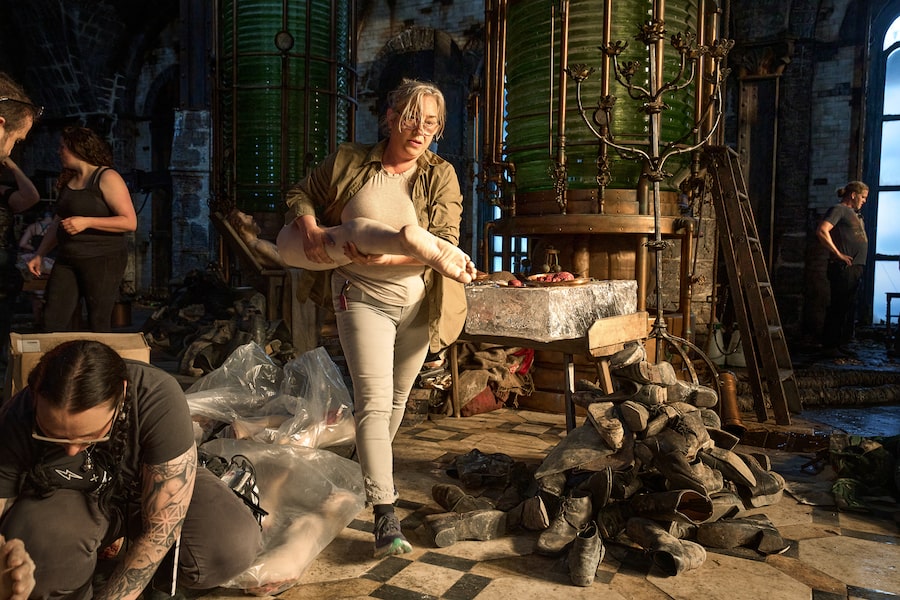
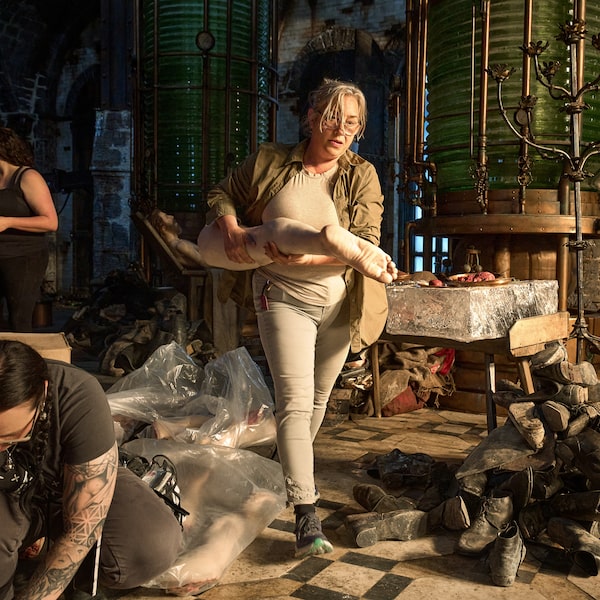
Guillermo del Toro’s Frankenstein is an epic that spans the world, from Edinburgh to the Arctic Ocean. But the globe-trotting thriller, which is up for nine Oscars at this Sunday’s Academy Awards, was a monster mash made largely in Canada, and by a cluster of homegrown artisans who have been proving for decades that blockbusters have no geographical boundaries.
Ahead of the biggest night in Hollywood, it’s time to get to know some of the Oscar-nominated Canadians who have taken Hollywood by storm – a lightning storm, that is, given we’re talking about good ol’ Frank.
Oscars 2026: How Frankenstein’s J. Miles Dale turned Toronto into a monster of a movie industry

Production designer Tamara Deverell has now worked with director Guillermo del Toro on five productions.Ken Woroner/Netflix/Supplied
Tamara Deverell, production designer, nominated for best production design
For Del Toro, making the Toronto-shot sci-fi thriller Mimic in the late nineties was one of the worst moments in his life. “Two horrible things happened in the late nineties: my father was kidnapped and I worked with the Weinsteins,” the director would later recall about his English-language directorial debut. “I know which one was worse ... the kidnapping made more sense, I knew what they wanted.”
Yet Del Toro’s first Toronto experience wasn’t all that bad given that it was when he met Canadian production designer Tamara Deverell, who has now worked with the director on five productions, including 2021’s Nightmare Alley, for which she scored her first Oscar nomination.

Tamara DeverellTamara Deverell/Supplied
“I’ve looked back on Mimic so many times, and there are still so many similarities to the kinds of design that Guillermo is interested in. Back then, we were doing this subway-tiled environment, and there was always a circular motif, which I’ve carried through on all my work with him,” recalls Deverell, who is now nominated for best production design for Frankenstein alongside Canadian set decorator Shane Vieau (more on him below).
Deverell said her relationship with Del Toro has grown over the years.
“We grew up together in a weird way, this Canadian girl and this Mexican boy. I had little kids, he had a young family. And now I’ve worked with both of his children as they’ve grown up. He’s become family in a way.”
Deverell has worked with both homegrown and Hollywood filmmakers, such as Deepa Mehta, David Cronenberg, Sofia Coppola and Danny DeVito. And she says she believes that her fellow Canadian artisans have a unique drawing power.
“People work really hard in Canada, but there’s also a kind of generosity of spirit and camaraderie. We tend to work better in groups, in teamwork,” says Deverell, who is now based near Inverness, N.S. “I’m sure there are instances of that in every country, but we do pride ourselves on our co-operative working conditions and a kind of gentleness.”
One thing that Deverell and her fellow Canadian craftspeople won’t be so gentle about, though, is the incursion of artificial intelligence. “I feel lucky in a way because I’m sort of towards the end of my career, so I don’t have to contend so much with AI. It’s a tool I would never use to design a set,” she says. “I did this as an experiment with our visual-effect supervisor, punching in something like ‘postapocalyptic staircase to heaven,’ and AI generated 300 drawings. There was maybe one that was vaguely of interest. To me, AI is without human emotion or experience. It’s not bringing anything to storytelling, and that’s what we do in film.”
2026 Oscars predictions: Who will win, and who should win, at this year’s Academy Awards

Set decorator Shane Vieau on the set of Frankenstein.Ken Woroner/Netflix/Supplied
Shane Vieau, set decorator, nominated for best production design
Growing up in Dartmouth, N.S., Shane Vieau didn’t dream of a life in the movies – he was too busy keeping his head above water. Literally, given that Vieau swam competitively from the age of 8 till 21.
“It was all-encompassing, training nine or 10 times a week. It took up my whole life,” Vieau recalls. “It wasn’t until I was in my late 20s that I was able to explore my artistic side, and not until I was 30 that I got into film.”
But when Vieau’s attention did turn to the big screen, he just kept swimming upstream, so to speak. His work as a set decorator for made-for-TV movies and the CBC series Da Vinci’s Inquest led to work with such marquee filmmakers as Jason Reitman (Juno), Terry Gilliam (The Imaginarium of Doctor Parnassus) and Tim Burton (Big Eyes).

Shane VieauShane Vieau/Supplied
“I’m extremely competitive by nature, so I always feel like it’s a blessing every time I get to do a movie,” Vieau says. “Coming from Dartmouth and going to the big markets of Los Angeles, the U.K., and stepping inside those places can be extremely intimidating. You get imposter syndrome. But as Canadians, we sort of find our place within that.”
After connecting with Del Toro on the 2015 Toronto-shot gothic horror Crimson Peak, Vieau found one of his many kindred industry spirits. The pair would reunite quickly on The Shape of Water, a film for which Vieau went on to win an Academy Award for Best Production Design.
“The Shape of Water was a film that was under $20-million, so it was very small compared to what we did here on Frankenstein,” says Vieau, who is also a regular collaborator of Denis Villeneuve, with his work on Dune: Part Two earning an Oscar nomination (alongside fellow Canadian Patrice Vermette) for best production design. “This time, the parameters were different. With Frankenstein, we were in Toronto and Northern Ontario, but also travelled to Scotland, London. It was a very logistical movie, as far as that goes. But working in film for 20 years, it gives you the scope to handle it all.”

'I feel like all my movies with Guillermo have been a rehearsal for Frankenstein,' says makeup artist Jordan Samuel.Ken Woroner/Netflix/Supplied
Jordan Samuel, makeup artist, nominated for best makeup and hairstyling
Jordan Samuel is no stranger to blood. As one of the film industry’s pre-eminent makeup artists, Samuel has been up to his elbows in the (fake) sticky red stuff on everything from Ginger Snaps to the Carrie remake to, of course, the work of Del Toro, from 2013’s Pacific Rim onward. But after all, when it comes to Del Toro’s crews, blood runs thicker than water.

Jordan SamuelJohn Wilson/Netflix/Supplied
“Jacob Elordi said something at a Q&A a little while ago that summed up the relationship perfectly, because he had that fresh perspective, having never worked with Guillermo before. Basically, Guillermo has spent years in Toronto, specifically collecting people, curating this family,” Samuel says. “There’s now an amazing creative relationship between us all. We all speak in shorthand, and can anticipate what he’s going to ask for and when. We’re always ruined for the next movie where that’s not the case.”
Samuel, who is nominated for best makeup and hairstyling alongside the American prosthetics master Mike Hill and Canadian hairstylist Cliona Furey (more on her below), feels indebted to Del Toro for bringing him aboard Frankenstein. The film is, after all, the director’s dream project, one that the filmmaker has been carrying inside his head since childhood, and it required no small amount of fake blood alongside real-deal sweat and tears. To play the title creature, Elordi spent 10 hours in the makeup chair under the watch of the hair and makeup team.
“I feel like all my movies with Guillermo have been a rehearsal for Frankenstein. There’s pressure that comes with that, but he’s our captain and we’re the team to deliver for him,” says Samuel, in between packing for the BAFTA Awards in London (where his team would go on to win the category of best makeup and hair) and prepping for his weekend at the Academy Awards.
“It’s an exciting and nerve-wracking time, but it helps to have this family that you’re travelling with,” he adds. “We’re on this journey together.”

For hairstylist Cliona Furey, Frankenstein demanded a different level of ambition and scale, including custom-designed, period-accurate hairpieces.Ken Woroner/Netflix/Supplied
Cliona Furey, hairstylist, nominated for best makeup and hairstyling
Toronto hairstylist and wig master Cliona Furey has dealt with the biggest, most intimidating heads (if not also the biggest egos) in showbiz: Elvis (for Sofia Coppola’s Priscilla), Pennywise the Clown (the HBO series It: Welcome to Derry), even RoboCop. But helping build Frankenstein was a hair-raising affair all its own.
“Guillermo pushes each time, in a good way. I always describe it as there is doing a film, and then there’s doing a film with Guillermo,” Furey says. “What can sometimes be a challenge is getting in touch with your director. Guillermo isn’t like that. I can walk right into his office or text him. Every Sunday, he walks around the sets that are being built, and you can always show up at eight in the morning if you need him alone.”

Cliona FureyCliona Furey/Supplied
Like her colleague Samuel, Furey first worked with Del Toro on the 2013 sci-fi flick Pacific Rim, which required envisioning a militarized near-future world terrorized by extradimensional monsters, and all the accompanying aesthetics that might exist within it. A similar grand amount of ambition was required to realize the film-noir atmosphere of Del Toro’s 2021 remake of Nightmare Alley. But Frankenstein demanded a different level of ambition and scale, including custom-designed, period-accurate hairpieces.
“There were different worlds for this movie. It was the ship in the Arctic, it was the ice field, it was Frankenstein’s house, the outpost. That gives us an opportunity to express ourselves in a big range,” Furey says. “But it is a lot more work. It traverses the globe.”
With Frankenstein’s success on the international awards circuit, though, Furey is also hoping that the hard, sometimes under-sung work of her fellow Canadian artists gets more traction around the globe, too.
“The thing about Canada is a lot of people don’t realize what shows and films are made here. And a lot of them work with Guillermo,” she says. “And we’re talking about thousands of people being employed, and that trickles down everywhere. The wigs I’m having made require a Canadian wigmaker who I hire. The set people are there, but then there’s the steel companies that are providing the materials. There is a massive ripple effect to our work.”
Editor’s note: A photo in a previous version of this article was incorrectly identified as Oscar nominee Shane Vieau. It has been removed.