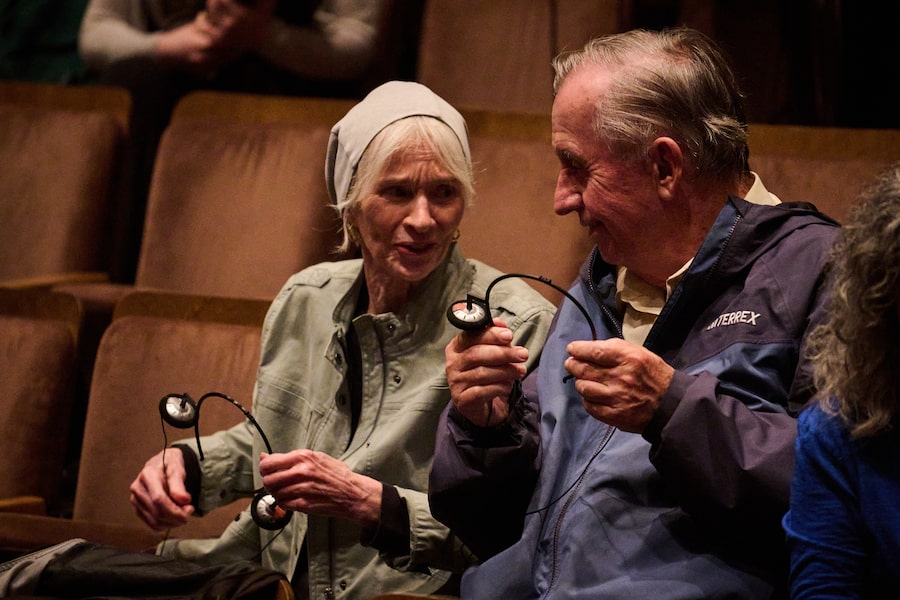
The first thing you notice is the cables.
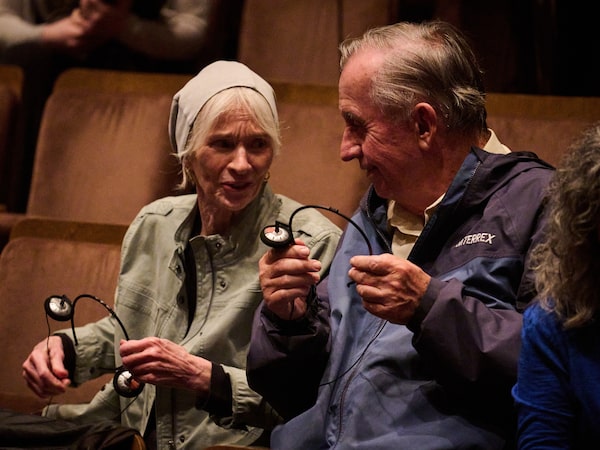
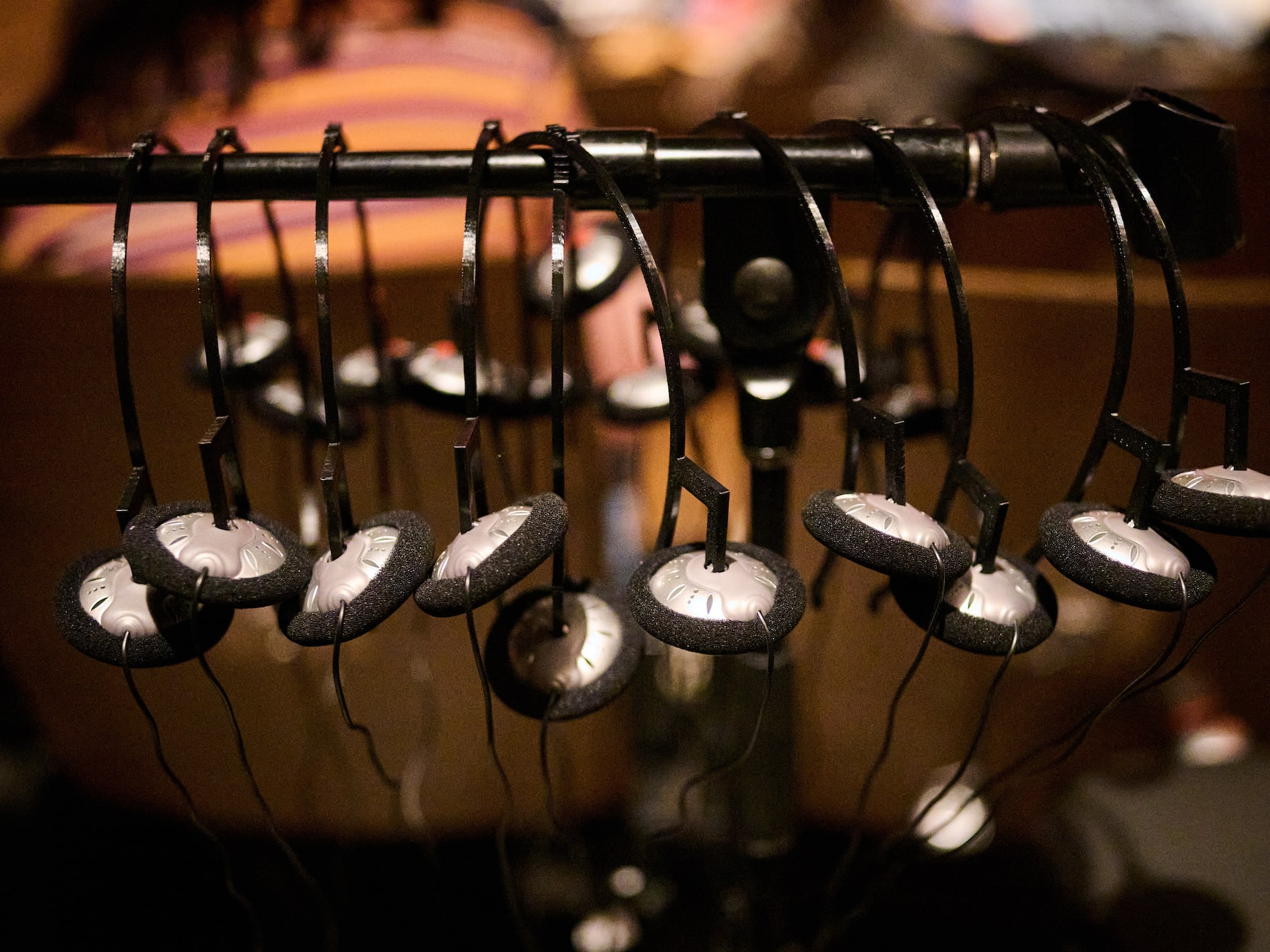
In Soulpepper’s Baillie Theatre, they are everywhere, a serpentine network of cords that terminates at hundreds of pairs of strange, wired headphones. The earpieces of these devices – ordinarily worn flush against the head to listen to music – stick out from a 3D-printed grey headband at 90 degrees, almost giving the appearance of tiny flying saucers over hundreds of pairs of ears.
When audiences arrive at their seats, they’re instructed to try the headphones on – a scrawled red line on each device indicates how to place each earpiece over the correct ear. Two actors step onto Anahita Dehbonehie’s wiry set to explain how the gadgets work.
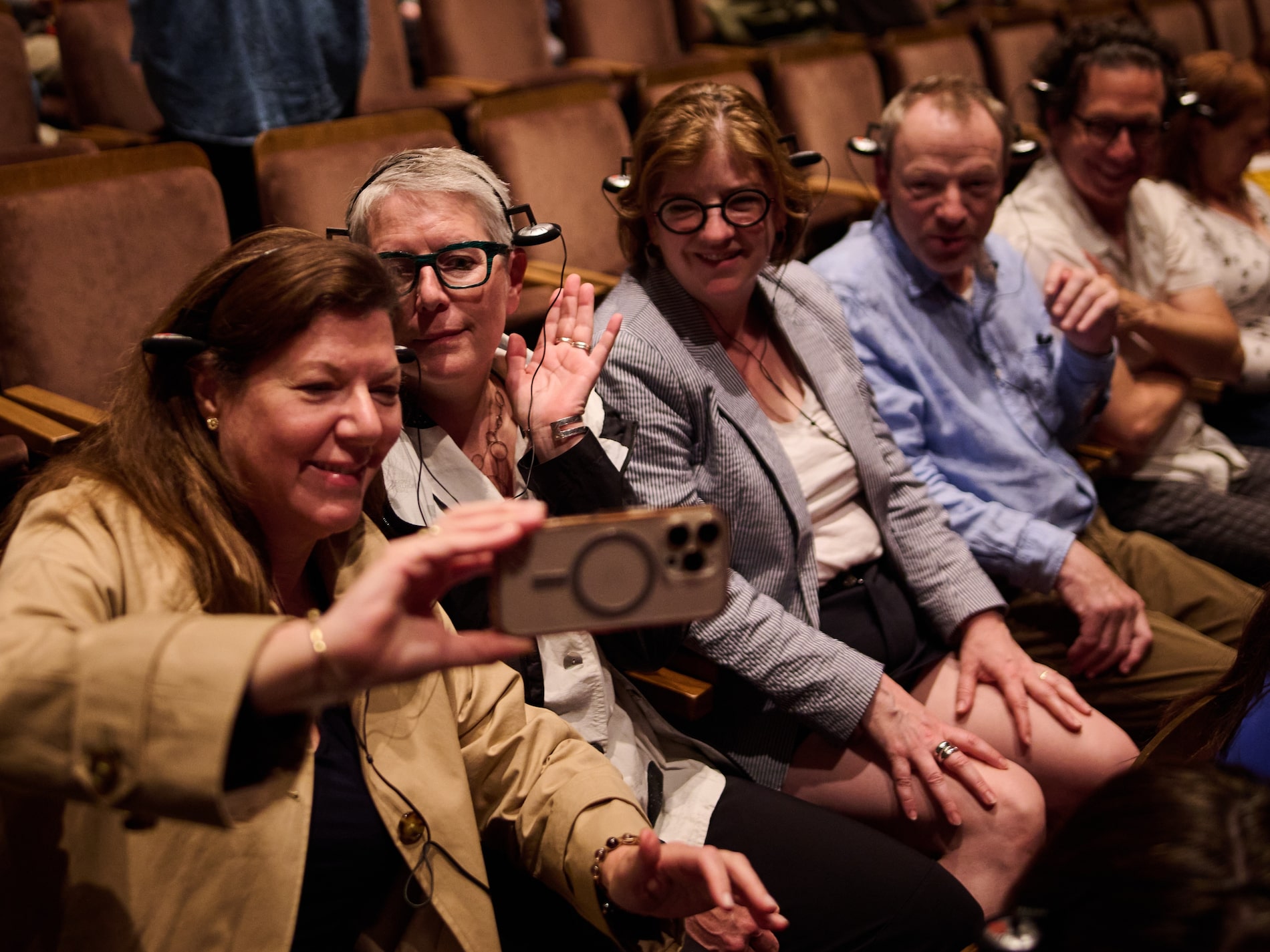
It’s a fussy prelude for a theatre show, to be sure. But Medusa, adapted for the stage by Canadian playwright du jour Erin Shields, isn’t your average play. The headphones are worn for Medusa’s sprawling first act, in which Shields offers a contemporary but largely straightforward retelling of the ancient myth.
This time, however, the story’s told by an unlikely narrator: the snakes.
As conceived by Shields, director Mitchell Cushman and sound designer Heidi Chan, the headphones offer audiences a chance to hear Medusa’s serpents for themselves, a kaleidoscopic inner monologue that responds to (and complicates) the dialogue onstage.
The effect is reminiscent of sensory ASMR videos on YouTube; the whispers are spine-tingling and unsettling, with filters that suggest Medusa’s innermost reptiles are just a few inches away from the audience’s ears. When multiple snakes speak at once, the experience feels like stepping into one of Medusa’s panic attacks, with competing, frantic hisses vying for the audience’s attention.
Audience members who don’t wish to wear the headphones don’t have to – the sound has been mixed such that the whispers are audible from others’ headsets. (That said, on opening night, I found that the experience of removing the headphones mid-act created a chaotic mishmash of hissed versus spoken dialogue – in my experience, it’s best to keep the device on.)
Ambitious? Absolutely. Overwhelming? Sometimes.

From left to right: director Mitchell Cushman, sound designer Heidi Chan, and playwright Erin Shields outside Soulpepper theatre in Toronto.Sammy Kogan/The Globe and Mail
But Outside the March, one of Medusa’s producers, has built a reputation over the years for staging high-tech, larger-than-life productions that amp up the experience of going to the theatre. Recent projects have included Rainbow on Mars, a collaboration with the National Ballet of Canada that offered blind audiences a way to experience dance; Dance Nation, a play staged in partnership with Coal Mine Theatre and Rock Bottom Movement that saw audiences migrate between two separate playing spaces during the act break; and Performance Review, a site-specific solo show staged in a working coffee shop in Toronto.
According to Cushman, artistic director of Outside the March, the company is careful about the projects it greenlights. As in Medusa, interventions to a play have to complement the work’s themes in some way: “The form has to follow the content,” he said.
“Immersivity must be led by the story,” he continued. “The proposition of Medusa is that we had to figure out how to bring the audience into a more intimate relationship with the protagonist. Audio felt like a very natural way to do that – I think even if I had come across this project in the wild, I would have had similar instincts. The script calls for it.”

Oyin Oladejo and Michelle Monteith in Medusa.Dahlia Katz/Supplied
In practice, that’s all true. As staged by Outside the March at Soulpepper, Medusa feels like embarking on a millenniums-long friendship with the misunderstood, snake-haired woman, played with stony vulnerability by Oyin Oladejo.
When we meet the young dreamer, she’s on her way to a job interview with Athena (Michelle Monteith), a powerful goddess with the ability to yank families like Medusa’s out of generational poverty. At home, Medusa lives with two sisters: a young mother ill-equipped to raise her baby (Amy Keating, lovely as always) and an anxious teen with considerable mental health concerns (Sasha Khan).
But soon enough, Medusa discovers that Athena’s “mentorship” can hurt as much as it helps. After a gruelling few months of unthanked servitude, Medusa’s relationship with the egotistical goddess disintegrates into ash – but not before Poseidon (Gord Rand) has the opportunity to rape his fellow god’s new human intern.
Shields’s script is among the most engaging in her continuing string of world premieres, combining the best of the contemporary sensibilities displayed in You, Always with the evident knowledge that’s historically made the writer’s adaptations so intellectually juicy.
The play is intermittently funny, too – spare a thought for the pun-averse when Athena calls out Poseidon’s “splashy” antics.
While Medusa’s first act consists of standard Shields fare, an unapologetically feminist subversion of an existing myth, the second marks newer territory for the writer. Medusa’s back half ditches its source material – well, kind of – and places Cushman’s ensemble in a modern-day rage room, where former serpents Keating and Danté Prince now play entry-level janitors, working for a mysterious boss. (Indeed, the second half is strikingly reminiscent of The Flick by Annie Baker, staged by Outside the March and Crow’s Theatre in 2019.)
On the whole, the script and its execution are successful – the experience is bracing, moving and genuinely novel. But it’s Chan’s sound design that ought to entice audiences to slither down to Soulpepper.
Headphones aside, Medusa’s soundscape is desolate and haunting, with Korean shamanistic music that adds further texture to Medusa’s revenge arc. (Chan approached Cushman with the idea to incorporate Korean music into the sound design, and it stuck right away: Now, both artists said, they can’t imagine Medusa’s audio environment any other way.)

A control interface displays labels for some of the snake sound effects.Sammy Kogan/The Globe and Mail
According to Cushman, Medusa’s binaural effects come from the five microphones placed at the back of the stage, each of which has been mapped to a slightly different spot in the audience’s ears.
The result isn’t just nifty, but a crucial component of how audiences come to understand Medusa’s inner turmoil: “We’re representing all the different colours of humanity that exist within her head,” said Cushman. “Rage, yes, but also passion. And the snakes have a real sense of humour.”
None of this will be surprising to those familiar with Cushman’s directorial portfolio – or Shields’s canon of plays. Medusa stress-tests the limits of live theatre to great success; the script, while pedantic in spots, corrects the record on one of mythology’s most misunderstood women. Classic Outside the March; classic Shields.
“These are the voices in Medusa’s head,” said Shields. “But they’re also the voices in all our own heads as we go about our day. As women, we’re encouraged to direct our anger inwards rather than outwards. These inner serpents give voice to that inner rage.”

Michelle Monteith, Sasha Khan, Danté Prince, Amy Keating, and Gord Rand in Medusa.Dahlia Katz/Supplied