
Ravi Jain knows how it feels to not win the top honour in Canadian theatre.
But after spending three cycles on the Siminovitch Prize’s short list in 2016, 2019 and 2022, Jain – founder and co-artistic director of Why Not Theatre in Toronto – finally took home the award at the end of 2025. The accolade comes with $100,000 in cash, as well as $25,000 for a chosen protégé – the list of laureates and protégés since the award’s inception in 2001 includes some of the most accomplished names in Canadian theatre.
“I was who I am without the award,” Jain, 45, says at a coffee shop in his hometown of Etobicoke, Ont. “I have to stay who I am with the award. It’s got to be meaningless.”

Jain with Miriam Fernandes, who he selected as his protege.Tanja Tiziana/The Canadian Press
Jain has done this before. He’s tied with designer Bretta Gerecke for the most number of times on the Siminovitch short list.
But this year, he says, awards proceedings looked a little different: For one thing, artists across different theatrical practices were eligible to be considered for the prize. (In previous years, the Siminovitch has been awarded in a three-year rotation for writers, directors and designers.)
As well, in previous awards cycles, shortlisted artists knew who had won before the celebratory gala. Jain found out he’d been chosen in real time. “I was hopeful, but I was trying to keep my expectations at bay,” he recalls.
“You kind of go through a process of disappointment, because everyone’s hopeful and wants to be recognized,” he says of being shortlisted but ultimately not winning in previous years. “But you process it and move on. I was 36 for the first nomination – and at the time, I felt like if I had won, things might have been a little bit easier. I don’t know if that’s the case, of course – I can say I feel different now.
“But it’s funny,” he continues. “This coincides with me being 45, with having two kids, with finishing Mahabharata. It’s all coming together at this really interesting point in time for me. If I were to look back to my 36-year-old self, I’d say, ‘Just wait.’”
Yes, 2025 was a landmark year for Jain. By extension, it was also a huge one for Why Not Theatre. The company’s sprawling, two-part adaptation of the Sanskrit text Mahabharata was presented by the Perth Festival in Australia, Lincoln Center in New York, Canadian Stage in Toronto and the National Arts Centre in Ottawa.
Co-created and directed by Jain, Mahabharata has been a critical hit everywhere it’s played. The six-hour epic blends storytelling, clown, dance, opera and even a communal meal in its retelling of the longest poem in history, about two warring clans in ancient India and clashing forces of free will and destiny.

Darren Kuppan, Navtej Sandhu, Sakuntala Ramanee, Harmage Singh Kalirai, Sukania Venugopal, and Shawn Ahmed in Why Not Theatre’s Mahabharata at the Shaw Festival in 2023.David Cooper/Shaw Festival/Supplied
“It was such an accomplished piece of work,” says Siminovitch jury chair Guillermo Verdecchia. “It was such an extraordinary piece of producing, and such a beautiful piece of theatre – I mean, it’s an epic in many senses. It’s an epic poem, but also an epic undertaking, and one that was so spectacularly realized.
“When we looked at Ravi’s body of work, we went, ‘This guy – he’s playing to all kinds of audiences in all sorts of different ways, and he’s always innovating,’” he continues. “He’s always challenging himself and his colleagues and his co-workers.”
While Verdecchia says Mahabharata was what made Jain stand out this year, it was Jain’s curiosity and “beautiful restlessness” that solidified his place in Siminovitch laureate history.
“He has drive, and he has passion and dynamism, but it doesn’t overwhelm or dominate others in the process,” says Verdecchia.

'I was angry at the early stage of my career,' says Jain. 'That was a great way to push myself to find something new.'Javier Lovera/The Globe and Mail
Born to Indian immigrant parents in Etobicoke, Jain graduated from Upper Canada College in 1999, before setting off for the London Academy of Music and Dramatic Art, and soon after, New York University’s Tisch School of the Arts, where he earned his bachelor of fine arts in theatre.
In 2004, Jain moved to France to study at one of the most respected theatre schools in the world: École internationale de théâtre Jacques Lecoq. While in Paris, he completed a physical theatre program that culminated in a “life-changing” master of fine arts, he says.
But when Jain returned to Toronto, he was surprised by the lack of opportunities available to artists who didn’t fit into the theatre industry’s existing boxes.
So – and this would become his company’s trademark – he built his own box.

Karen Robinson and Rick Roberts in Prince Hamlet.Bronwen Sharp/Canadian Stage/Supplied
Why Not Theatre was officially founded in 2007, and since then has premiered work across a vast spectrum of genres. The size of a project never seems to matter at Why Not – the company has tackled beasts such as Mahabharata and its more traditional new play development processes with similar levels of rigour.
“I was angry at the early stage of my career,” says Jain. “That was a great way to push myself to find something new, to say, ‘I’ll show you.’ And that’s a real part of Why Not, like, ‘You have no idea what’s possible, and you’re limited, so I’m going to break your door open, and I’ll show you there’s more.’”
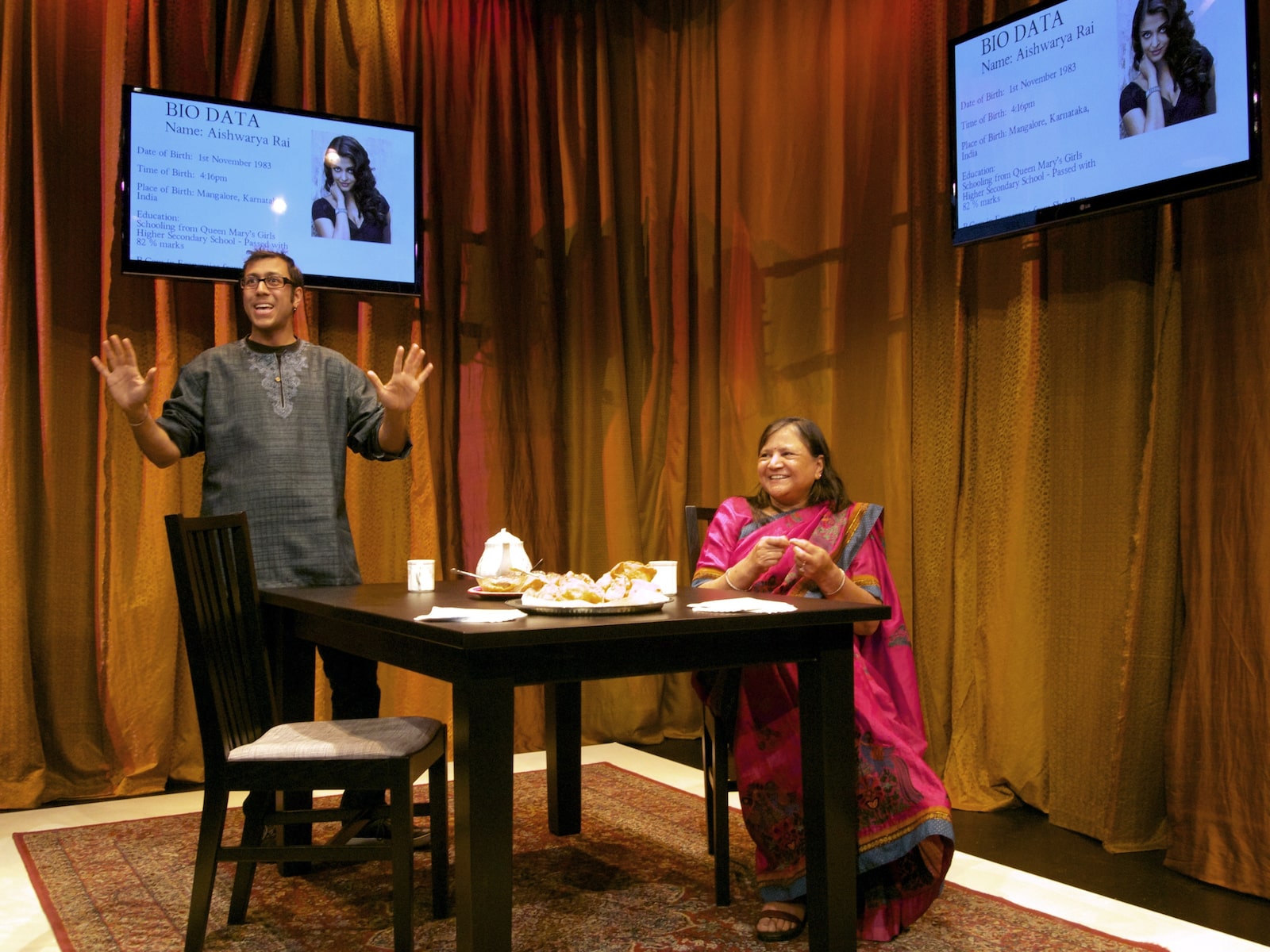
In that vein, the company’s repertoire speaks for itself: A bilingual Hamlet in English and American Sign Language, for instance. An intimate performance piece co-created by husband-and-wife environmentalists David Suzuki and Tara Cullis. A reimagined Romeo and Juliet for blind, low-vision and sighted audiences alike. An intergenerational collaboration between Jain and his non-actor mom. And, now in development, a highly physical interpretation of Samuel Beckett’s tragicomedy Endgame.
“The obsession with the work is the thing that’s always grounded me,” Jain says. “That’s where I derive meaning. Sometimes, the people around you get it wrong. Sometimes, you’re making work that’s not necessarily for the time you’re in. I have more confidence now – I can go, ‘Okay, the critics are wrong. What next?’”

Mahabharata, which had its debut at the Shaw Festival in 2023, marked a new era for Why Not – and for Jain. The project spent years in development, and as it grew, so did Jain’s commitments outside of the rehearsal hall: When Mahabharata‘s premiere rolled around, Jain’s wife was pregnant with their second child.
With a looming premiere and an increasingly busy home life, Jain leaned on Miriam Fernandes, Why Not Theatre’s co-artistic director since 2021 and 2025’s winner of the $25,000 Siminovitch Protégé Prize, to help steer Mahabharata to completion – both onstage and off.
Originally brought onto Mahabharata as an untitled collaborator, Fernandes – whose work outside of Why Not has seen her perform and direct around the world, with several credits in Norway – ultimately stepped into the show as its associate director and co-writer, as well as its narrator. Onstage, she serves as a bridge between audiences and Mahabharata’s enormous, occasionally confusing source material.

Miriam Fernandes, Anaka Maharaj-Sandhu and Neil D'Souza in Mahabharata.David Cooper/Shaw Festival/Supplied
“She just took the space,” recalls Jain. “I was like, ‘Oh, that’s it.’ We wrote her part in two or three weeks, and it just elevated the whole thing.”
Fernandes and Jain first met at a coffee shop in Toronto’s Annex neighbourhood close to two decades ago – Fernandes remembers it vividly.
“I reached out to him when he was just starting Why Not, and it was classic Ravi Jain chaos,” she recalls. “I asked how I could work with him, and he said, ‘Yeah, we’re doing five projects. We need an assistant producer and we need someone to work with a caterer to manage a VIP event and we need someone to sit in on a rehearsal and someone to pick up some library books.’
“I just said, ‘Sure,’ and I stumbled into working with him like that,” she says, laughing.
When Fernandes applied to France’s Lecoq herself in 2014, Jain was her biggest champion. Why Not – at a time before the company received annual operating funding, she recalls – “scraped together some cash,” and helped pay for her tuition when prior grants fell through.
“Nobody else would do that,” she says. “Ravi bet on me, and Lecoq changed my life. I found the way I wanted to express myself through storytelling. I worked with amazing international people that I would never have had access to in Canada, and it completely blew open what was possible for me.”
There was no expectation that Fernandes would return to Why Not – “Ravi doesn’t think in the future like that,” she jokes. But when she did come back to Canada, she went almost immediately to Why Not, beginning an artistic direction internship in 2018 and becoming the company’s associate artistic director the next year. She was then named co-artistic director two years later, in 2021.

Sturla Alvsvaag, Miriam Fernandes, David Suzuki and Tara Cullis worked together on What You Won’t Do For Love.Luminato/Supplied
“He believes you have to have the opportunity to try,” says Fernandes of Jain. “When I left, he was like, ‘Go, and don’t come back. Be free.’ And I did, and I was – but coming back was what allowed Ravi and I to collaborate in a really wholesome way on Mahabharata. In a way, now, we had the same language.”
The collaborators are strikingly similar in the ways they speak about their art. Both attended Lecoq, and both have enjoyed rich theatrical careers around the world. Interviewed separately, both say they plan to put their Siminovitch earnings in the hands of other artists rather than splurge on a personal treat.
“I have a job,” says Jain. “There are a lot of artists who don’t. I want to get that money to artists in a way that can be impactful, in the same way this experience has impacted me.” Fernandes’s answer is nearly identical.
As the pair’s Siminovitch wins settle into a more distant glow, Jain is taking a second to soak it all in. These days, he’s prioritizing peace – his acceptance speech emphasized the themes of peace that emerge from the otherwise fiery themes of Mahabharata – and in his work, he’s keen to invite audiences and other artists to join him on his journey toward inner harmony.
“In all of this, I’m still trying to figure out who I want to be,” he says. “I’m someone who’s always onto the next thing – I’ve been told for years that I need to slow down, and I never listened. I’m trying to unlearn that process – and maybe find another way.”