
Deep in the belly of Bay Street, Canada’s white-collar kingdom of finance, sits a pair of leather thrones.
The chairs, tucked into a corner of Toronto’s underground PATH system, tower over bustling crowds. They’re somehow regal against the marble walls of Canada’s largest banks, with gold footrests and thick wooden drawers built into their pedestals.
You might expect to find jewels in those compartments, but the cabinets hold a different kind of treasure: shoe polish in a rainbow of browns and blacks, dye-stained rags and spritz bottles full of vinegar.
On any given weekday, thousands of commuters might pass Penny Loafers Shoe Shine, with its three locations scattered across the innards of Toronto’s financial district and in the basement of the Fairmont Royal York Hotel.
But what those onlookers might not know is just who’s shining the shoes.
Originally founded in 1994 by Penny Simmons, the Penny Loafers employment roster consists almost entirely of theatre artists. Even its owner, Jenny Young, who purchased the business in 2021 after working there since 2003, has a parallel career on Canada’s stages and screens.

Jenny Young’s kit that she uses to clean and shine the shoes and boots of customers who visit her location underneath the Fairmont Royal York in Toronto.
It’s win-win for everyone, says Young. Scheduling is a breeze – if one shiner has a last-minute audition, another can easily take their place – and theatre artists tend to have the posture and physical strength needed to polish slushy shoes for hours on end.
Plus, the arrangement brings a certain whimsy for clients, who may well have seen their valet in a recent play or TV show. (And those clients include a surprising number of VIPs: Former prime minister Stephen Harper, for instance, is a regular.)
“Theatre has never been a stable business,” says Young as she scrubs a client’s brown leather dress shoes. “By hiring other artists – especially theatre artists, because that’s where I come from and that’s my passion – I really feel like I’m supporting the ecosystem as a whole.”
According to a 2024 study for the Cultural Human Resources Council, side jobs are the norm for Canadian artists: 77 per cent of respondents said they had a second gig in addition to their artistic work. Fifty-two per cent said they make more money doing their side hustle than they do in their main career.

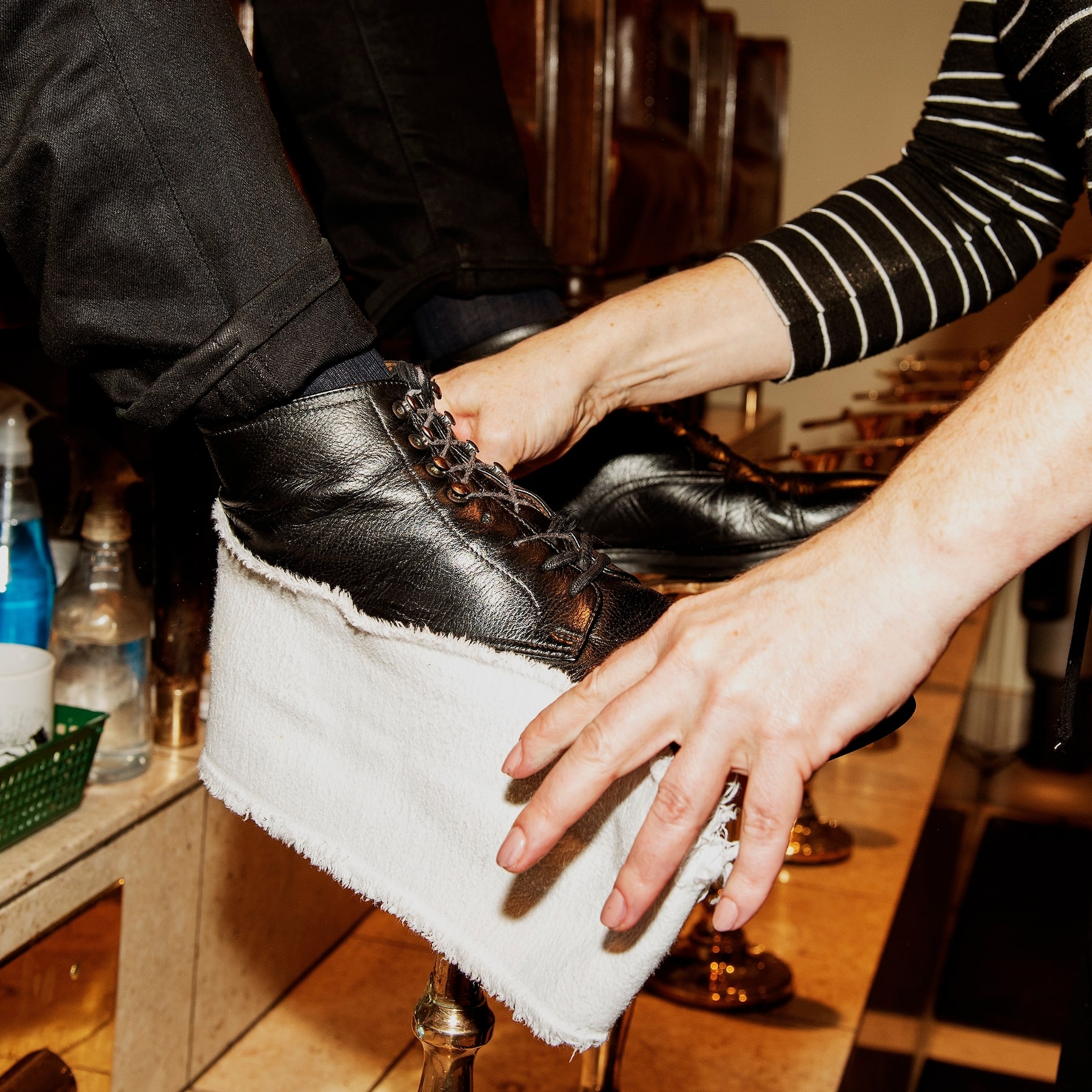
As far as second jobs go, says Young, shoe shining is ideal: The valets are independent contractors, meaning they can work as much or as little as they please, and Young will never penalize an employee for taking months off at a time – a handy perk in an industry whose dominating theatre festivals gobble up dozens of actors’ summers.
Other popular side jobs, she says – teaching, serving coffee and retail, for instance – are generally less forgiving of erratic rehearsal and callback schedules.
“It always works out,” she says of the shine. “I have a big enough pool that it’s never a problem. If somebody books a role, somebody else is usually about to finish one up, like clockwork.”
The two valets working in the PATH the day I visit are proof of that: Navtej Sandhu is a cast member in Mahabharata, Why Not Theatre’s sprawling, six-hour play that since its 2023 premiere has toured the world. (This summer, she’s in Canadian Stage’s Twelfth Night.)

Actor Navtej Sandhu has been in plays such as Mahabharata and Twelfth Night.
Romi Shraiter appears in Netflix’s Ginny & Georgia, and returned to the stage earlier this summer in legendary theatre director Joel Grey’s Yiddish production of Fiddler on the Roof.
“I thought Jenny was joking when she asked if I wanted to be a shoe shine,” recalls Sandhu. “But I’ve been doing this for eight years, and I’ve been able to come and go whenever I’ve needed to.”
Shraiter’s story is similar. A friend in the theatre industry asked if she needed to make some extra money, and, like Sandhu, Shraiter thought she was joking. A shoe shine? Really?
But the work was enjoyable enough, she soon discovered – she takes better care of her own shoes now, and, as promised, the scheduling is barely a concern. Plus, on a good day, Penny Loafers employees can pocket a few hundred dollars, plus or minus a sore neck and shoulders from looking down all day.
“People always say a theatre schedule is cool, and that they’ll be understanding, but when it comes down to it, it’s a pain in the butt,” says Shraiter. “But Jenny’s a working actor. She gets it. Even today – I have an audition this afternoon. She was able to move the schedule for me with no problem.”


Most clients, says Young, stick their nose in their phone, or in a copy of The Globe and Mail’s Report on Business, while they get their shoes done. Some, however, are chatty: The theatre artists at their feet are a curiosity, a distraction from spreadsheets and e-mails.
And for the shiners, the clients are possible audience members, or even benefactors.
“I try to talk to them about Shakespeare in the Ruff,” says actor Christine Horne, a member of that company’s leadership team and a Penny Loafers valet since 2016. “I want them to become donors.”
The pandemic was a low point. Only recently has business started to approach its pre-2020 numbers, though it’s still not quite on par.
Winter is the busiest time of year, says Young, owing to the salt on the streets of Toronto and frequent holiday parties around Christmastime.
Summer is more sporadic. The company’s PATH locations tend to get a little quieter, but Penny Loafers will occasionally set up shop at tech and finance conferences, making for long days but lots of tips for the valets on shift.
In winter, the shiners start by attacking salt stains with a vinegar mixture, a step they can usually skip in the summertime. Then, they use saddle soap to clean the leather – “like a gentle shampoo,” says Young. Next comes leather conditioner to heal any cracks or fine lines in the shoes, then a stain wax and a quick buff.
The only part of the process that’s purely cosmetic, and which has become a hallmark of a Penny Loafers shine, is a final “edge dressing,” which sees valets add a layer of water-soluble product to a shoe’s seams to finish the look. (But that “finished look” is temporary, warns Young: “If they step in a puddle, it’s all going to go away.”)

With summer being quieter for business, Young sometimes sets up shop at tech and finance conferences, where the valets on shift pocket healthy tips.
For most clients, the $16 entry-level service is enough. Bigger jobs – especially police and military boots, which require a mirror-level shine and which take much longer – cost more. Those shoes, along with salt-stained Ugg boots and other specialty pairs, tend to get left with Penny Loafers for a few hours, or, depending on the job, days.
None of this is what Young thought she’d end up doing as a young actor. It’s not even what she thought she’d end up doing as an early-career shoe shine.
She’s unsure how she feels about the term “joe job,” the theatre industry’s term of choice for non-creative work – she prefers “side hustle” – and she’s experienced her fair share of cognitive dissonance, shining the shoes of people who just days prior might have paid hundreds of dollars to see her onstage.
Even so, Young loves her kingdom. Since 2021, she’s invested in it with splashy marketing and publicity campaigns, and she’s grown more comfortable owning a business than she ever might have expected as an emerging artist.
“It’s funny, artists are the most creative people in this city, and we think so differently from the politicians and bankers of this world,” she says as she fiddles with a credit card scanner on her phone – there are cellular dead zones in the PATH which can make accepting payment tricky, a small hiccup in the otherwise elegant Penny Loafers operation.
“But we’re who they chat to every time the politicians and bankers want a break,” she continues. “We’re a novelty for them.”