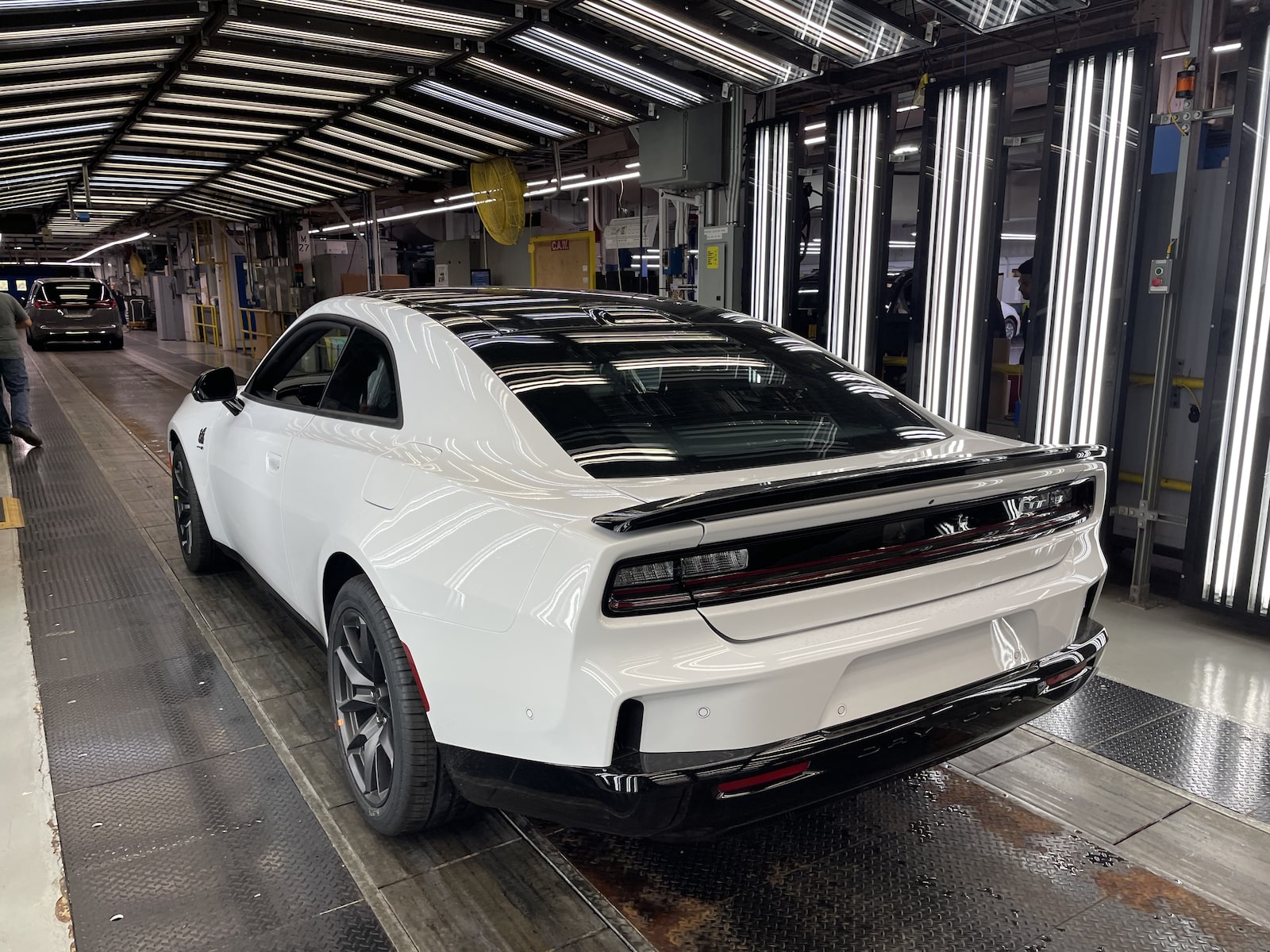
Under the bright lights of a production line, a shiny black Dodge Charger Daytona sits plugged into a charger. Then one worker unplugs the car while another in a neon vest drives it away. The loudest noise it makes is the squeak of rubber tires on the factory floor.
Millions of vehicles have rolled out of the Stellantis assembly plant in Windsor, Ont., during its 96-year history, but this car is different. It’s electric, and it marks the beginning of a new era for these workers, the city, the province, the country, the Canadian auto industry and, if all goes according to plan, our climate goals.
“It feels historic. It really does. You can feel that energy with everybody on my team, and the people we’re working with,” said Audrey Moore, chief engineer responsible for the launch of the new Charger.
Getting to this moment – the first mass-produced electric passenger car made in Canada – is the culmination of years, arguably decades, of work by governments, unions, auto workers, suppliers and car company executives, not to mention tens of billions of dollars in government subsidies for companies all along the EV supply chain.
Most of that money is intended to establish Ontario as a global electric vehicle manufacturing hub – a key part of our green future and new economy.
But that green future, and the future of autoworkers at Windsor Assembly, still face many hurdles. The new Dodge Charger is a niche vehicle – a performance-focused coupe and sedan – in a market overwhelmingly dominated by pickups and SUVs; its success is not guaranteed. And, Donald Trump’s threat of a tariff on Canadian goods and talk of scrapping U.S. regulations that compel car companies to make EVs could hurt both Canadian and American automakers.
Even without Trump throwing new hurdles in the way, the push to electrify automobiles and reduce emissions is a leap into the unknown. It presents both a massive opportunity and, perhaps, an existential threat for Canada’s auto industry, a sector that contributes $16-billion to gross domestic product and supports roughly 500,000 people, according to the federal government.
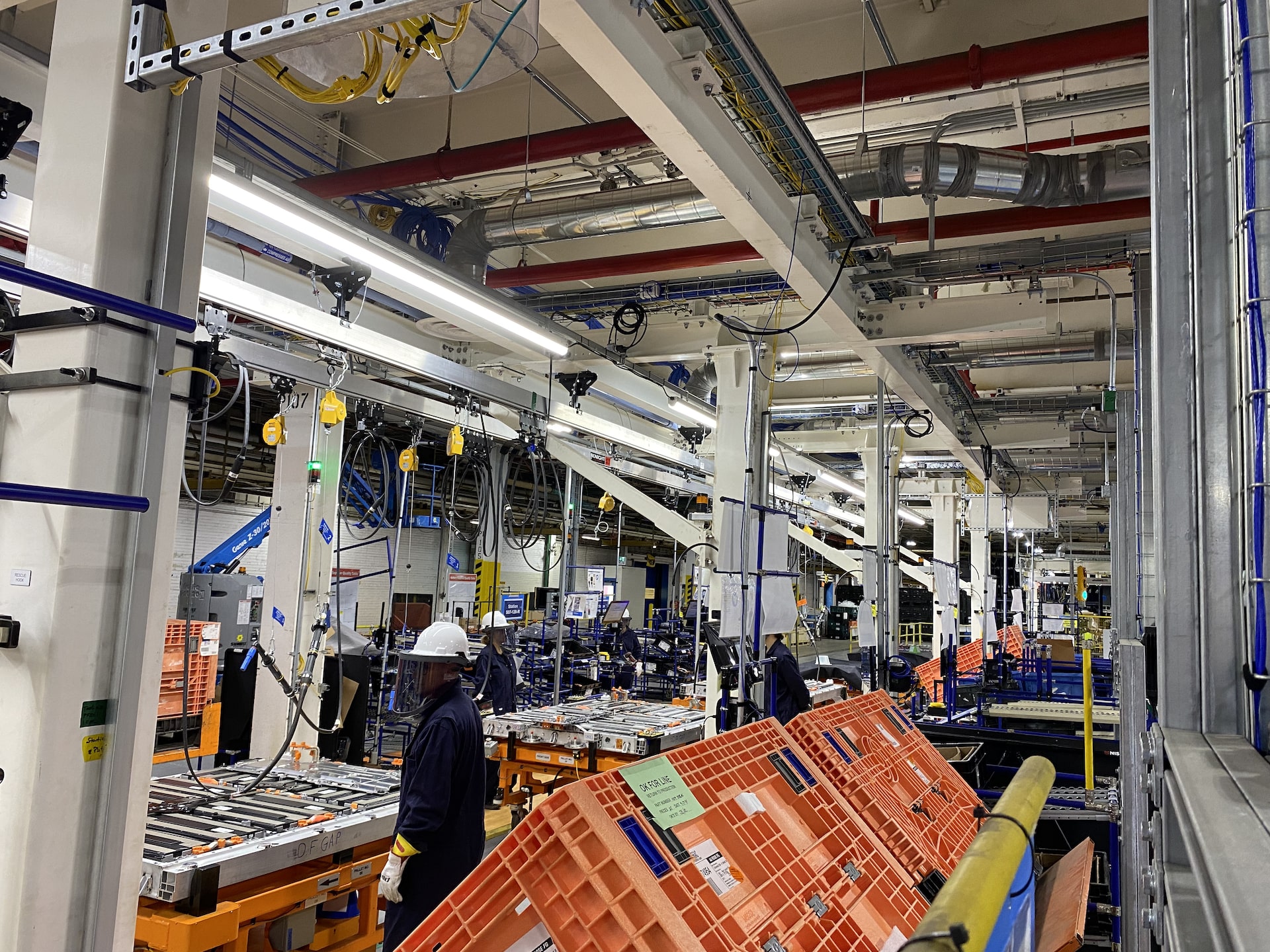
To see what the transformation looks like first-hand, we went inside the Windsor Assembly Plant for an exclusive tour of the Charger Daytona line during preproduction. We spoke to more than a dozen workers as they sorted out any last-minute kinks before cars hit the road later this year.
Dodge’s made-in-Canada EV arrives at a time when most automakers are scaling back their EV ambitions, affordable Chinese EVs are poised to undercut Western manufacturers and Stellantis in particular is in trouble. Its share price has fallen around 40 per cent this year on high inventories, slow sales and falling revenue, which recently prompted the sudden resignation of chief executive officer Carlos Tavares. The company, which includes Chrysler, Jeep, Ram, Fiat, Alfa Romeo, Maserati and Dodge, was threatened with a major strike by U.S. workers over – among other things – rumours that production of the new Durango SUV could be moved from Detroit to the Windsor Assembly Plant. Stellantis hit back by filing lawsuits against the union.
The Charger Daytona was supposed to launch in summer, but production cars will only start rolling off the line sometime this month. In certain regions of the U.S., it’s already being heavily discounted, according to reports. For the workers in Windsor and their community, however, this Charger brings fresh hope and opportunity.
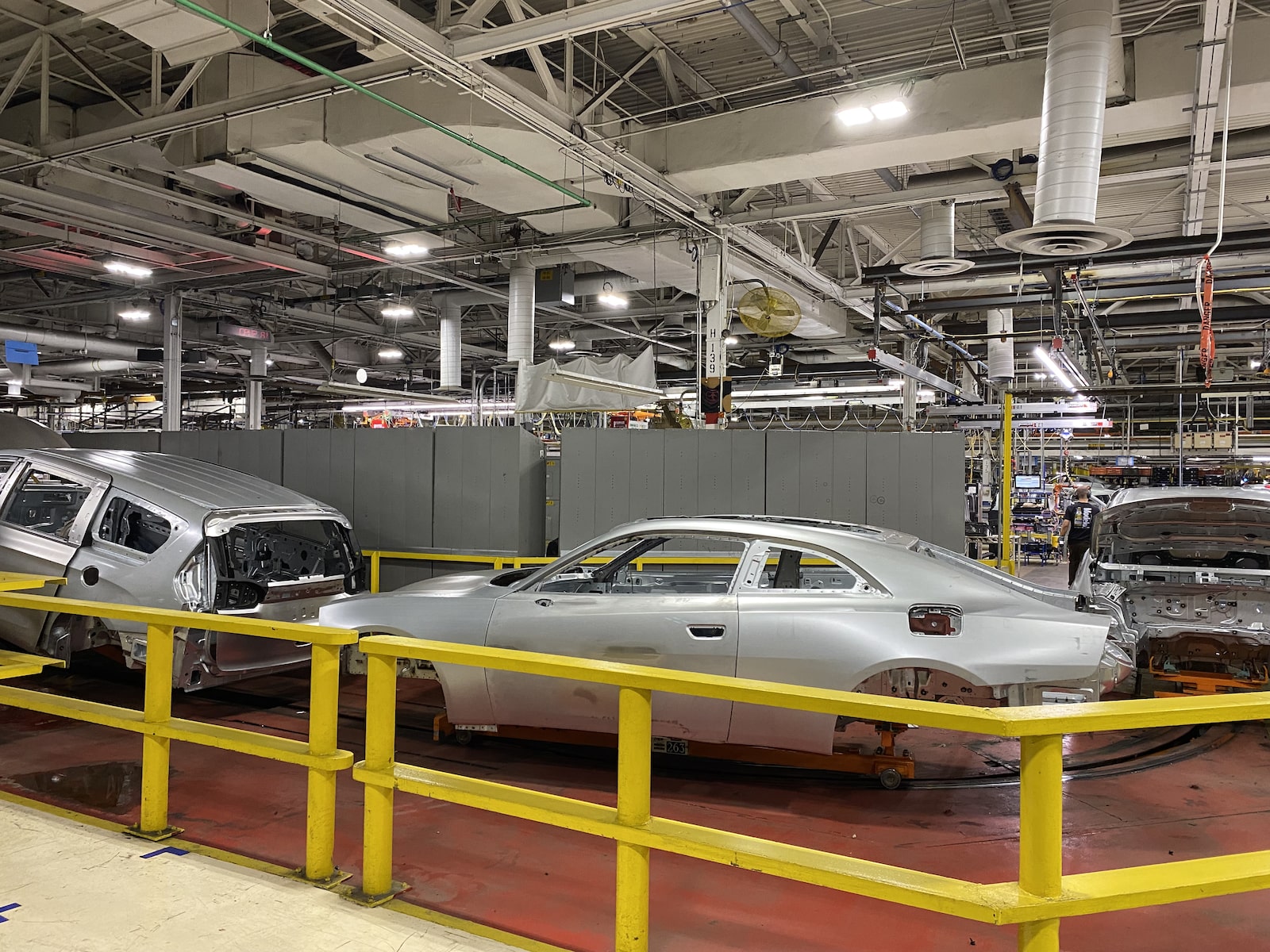

Making an EV
David Bellaire, the plant manager at Windsor Assembly, was born and raised in the city and got his first job at the plant with a friend when they were 18. “We thought we’d hit the lottery,” he said of that first summer job here in the late 1980s.
“[Windsor] was impressive. We had seven plants here in this city,” he added.
Today, there’s only one plant assembling cars, and he runs it.
The scale of Windsor Assembly is impossible to grasp when you first walk through the doors. The complex is the size of several city blocks. It’s bigger than some small towns. There’s 4.4 million square feet of floor space and 4,500 people working here, yet, like a small town, so many of them seem to know each other, waving as they pass. When it’s all running smoothly, a new vehicle rolls off the line every 59 seconds.
Before the new Charger, the plant was only producing one vehicle – the Chrysler Pacifica minivan – which put workers in a tenuous situation. In 2020, the minivan was no longer selling well enough to justify a three-shift manufacturing operation and so the company cut back to two shifts, putting about 1,500 people out of a job.
“We were hoping to get [a new vehicle],” said Mr. Bellaire. “What [type of vehicle] it was, at the end of the day I don’t think we really cared, as long as it was another product to protect our jobs and the city.
“When they announced that we were getting [the new Charger], it was like we could have had a parade,” said Mr. Bellaire, who explained that they’d had to compete with other Stellantis plants for the work.
Over the course of five weeks last year, the line stopped while the plant retooled to make both the electric and gas-burning versions of the new Dodge Charger. They’ll be made on the same flexible production line as the long-running Chrysler Pacifica minivan (both the gas and plug-in hybrid version).
Adam Mariani, one of the plant’s directors of operations, says that flexibility – the ability to make either gas or electric cars on the same production line – is critical. “Whether one sells better than the other, having the multi-energy platform, you feel secure,” he said of his job.
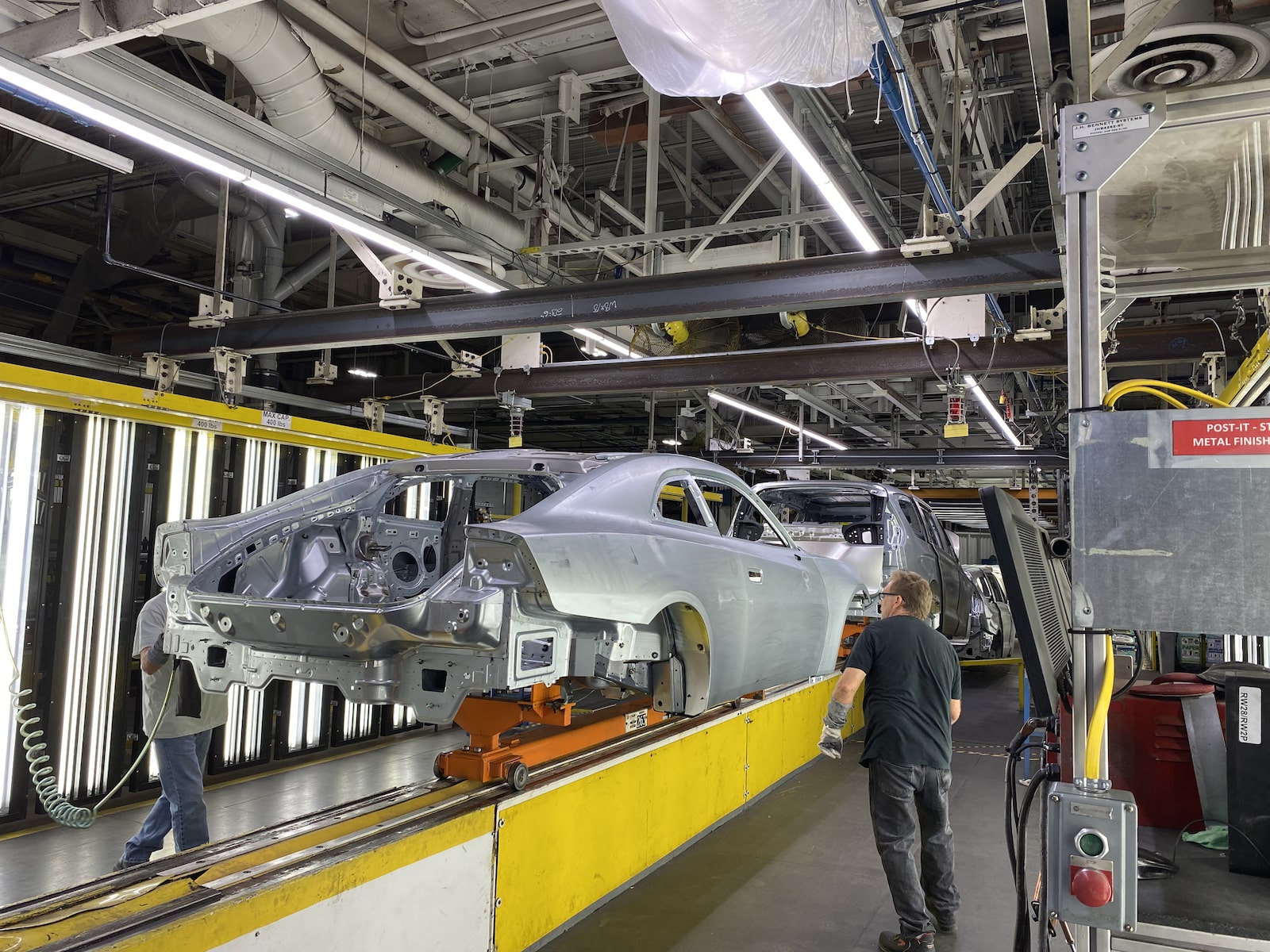
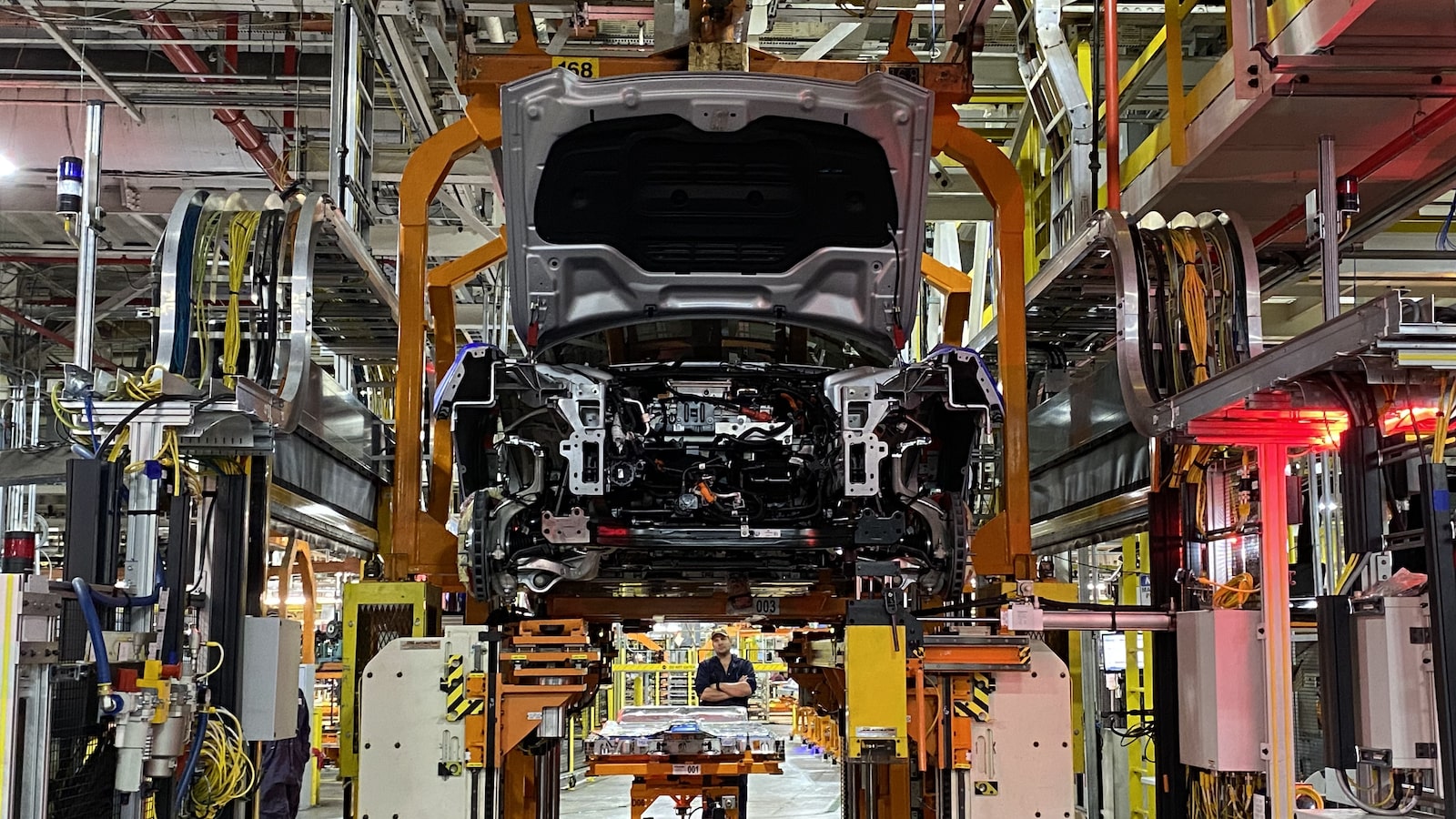
Our tour starts on an electric buggy, which makes its way through an endless maze of people and robots and car parts. Mr. Mariani stops to shows us how the car’s underbody is welded together, starting with two long metal parts that look like two branches of a big steel tree. Later, it’s someone’s job to check the welds using a kind of ultrasound machine to ensure they’re up to par.
Further along the process, at what’s known as the framing station, a terrifying-looking team of more than a dozen giant yellow robotic arms makes 183 welds in 64 seconds, attaching the car’s sides to its underbody.
We run into Adam’s brother, Steve. “We all have to move forward with it; electrification is where it’s going to be,” he says. “We’re depending on this, for my bread and butter, for my family. When these cars go out the door, I get to come in another day.”
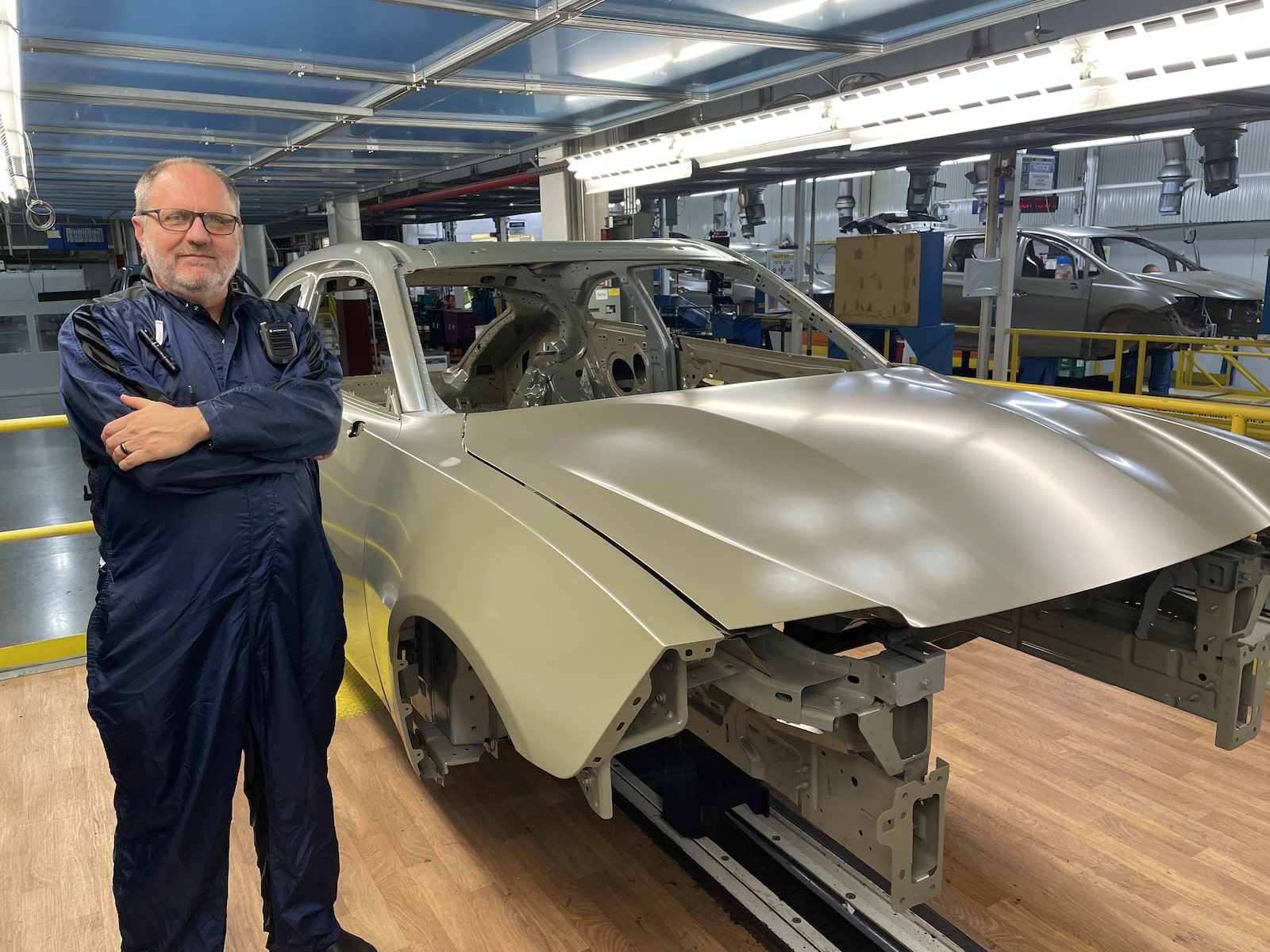
The completed metal vehicle shells then move on a giant conveyor belt. They travel up and through a covered bridge several stories above the ground before entering the paint shop.
George Barisas, paint shop director of operations, is hopeful about the future. “We’re at a point we don’t have anybody on layoff. We’re actually hiring,” he said.
After the paint shop, the cars go to a brand new battery-building area. Here, workers – each of whom undergoes six days of specialized training – take battery modules made by Samsung SDI in Hungary and assemble them into packs. From there, the battery pack is fixed to the underside of the car from below, using a dozen or so enormous bolts. A robot screws them into the car in a matter of seconds. (Non-EVs, like the Chrysler Pacifica, simply pass over the battery-installation station and continue along the production line.)
Jaswinder Bhullar, the battery manager for the afternoon shift, says that when the first production EV rolls off the line here, it will be a proud moment. “When we go down the line in 10, 20 years, we can actually say we were the first ones,” Mr. Bhullar says.
What it took
It’s been a long road to get here. Tesla has already built three million EVs at its assembly plants in the United States, but here in Canada, EV production is just getting started. Toyota made a small number of RAV4 EVs in Ontario more than a decade ago, and since late 2022, General Motors has been building electric commercial vans in Ingersoll, Ont.,
The introduction of the Dodge Charger Daytona, however, finally ushers in the beginning of mass-production for electric passenger cars in this country.
The decision to build that car in Windsor goes back to the 2020 round of bargaining between automakers and Canadian auto workers, represented by Unifor.
James Stewart was a key player in those negotiations as chair of Unifor’s national FCA/Stellantis bargaining committee. Today he’s also president of Unifor Local 444, which represents workers at Windsor Assembly. Prior to 2020, Mr. Stewart said, there was zero direct investment in EV manufacturing in Canada by automakers, or by the government. The union’s goal during bargaining was, in part, to ensure Canada was a part of the EV revolution.
“EV investment was happening everywhere else, except for Canada,” Mr. Stewart said. “We knew that if you’re left too far behind, you’ll find yourself in a position where other countries have all the technology they need, have all the investment dollars they need, and you’re sitting on the outside.”
As a result of that bargaining, Stellantis agreed to retool Windsor Assembly with a flexible production line that could produce both electric and gas-powered vehicles, and bring a new, as-yet unnamed, vehicle to the plant.
“We knew we were bargaining for something that was three to five years down the road. It wasn’t great, but had we not done it, we didn’t know where our plants would be in the future,” Mr. Stewart said.
For its part, the company invested a total of $1.9-billion in the Windsor plant, while the federal and provincial governments committed up to $1-billion in total funding for the retooling of Stellantis plants in Windsor and Brampton, Ont.
The decision to make that investment came down to several factors, including the high quality of work at those plants, the work ethic of Canadian employees, as well as the government’s $1-billion investment, explained Jeff Hines, president of Stellantis Canada.
“This is just step No. 1 of a lot of planned investments and products that we expect to come to Brampton and Windsor collectively,” Mr. Hines added.
The amounts invested in Windsor Assembly are just a drop in the bucket compared to Canada’s larger EV investments.
The Parliamentary Budget Officer recently estimated that federal and provincial investments in Canada’s EV supply chain have amounted to as much as $52.5-billion since 2020. In return, Canada has attracted more than $46-billion of investment in the sector, from Stellantis, Volkswagen, General Motors, Honda, Ford and several EV battery manufacturers.
In addition, the federal government has given out more than $1.3-billion in rebates to consumers for purchasing certain EVs. That’s the consumer carrot; the industry stick is the federal government’s Electric Vehicle Availability Standard. It pushes automakers to sell an increasing percentage of new electric and plug-in hybrid cars: 20 per cent in 2026, ratcheting up to 100 per cent in 2035. If they don’t, automakers can buy credits from rivals that hit the targets, or face a monetary penalty.
There’s a range of opinion on whether this spending by both the federal and provincial governments is necessary, but proponents argue it’s the only way to compete with hefty U.S. incentives and build a Canadian EV manufacturing industry.
It’s all part of an effort to meet Canada’s climate targets and grab a slice of the estimated US$1.2-trillion automakers will be investing in EVs by 2030.

The Windsor Assembly plant has been making cars for 96 years.
Boom and bust
Since 1904, people have been making cars in the Windsor area. Stellantis is not, in fact, even the first company to build EVs here; from 1912 until 1915, a company called Tate Electric Ltd. built a small range of electric cars with prices starting from $2,700, or about $85,000 in today’s dollars.
By 1926, the city was home to 55 of Canada’s 70 automotive and auto-parts plants, according to a history by the Windsor Public Library. When Chrysler built the Windsor Assembly Plant in 1928, the area was already the hub of Canada’s young auto industry.
Canadian vehicle production peaked in 1999 at 3.06 million units and has been in a fairly steady decline ever since, according to data from Canadian industry analysts DesRosiers Automotive Consultants.
“At that point, Canada (and Ontario specifically) was one of the major auto producing jurisdictions in the world,” Andrew King, managing partner at DAC, wrote in an e-mail. Vehicle production later fell to just 1.11 million units during the semi-conductor shortages of 2021, but have since climbed back to 1.53 million units in 2023.
David Bellaire has seen many assembly plants in his hometown shut down. “I was here when they shut down plant six, which was [DaimlerChrysler’s] big van plant,” Mr. Bellaire said. “And then the GM trim plant, and then the Ford plant. … You just saw it dwindling, dwindling down,” he added, “and now we have one plant.”
Between 2001 and 2019, the number of jobs in Windsor for assemblers in manufacturing dropped to 5,500 from 11,300, according to Statistics Canada. The city’s median household income dropped to 33rd highest in Canada from 11th between 2005 and 2019 as car production declined.
“For the industry to not decline further and to just hold its share of global production will require massive investments and commitment from vehicle companies, unions and government,” said Mr. King.
Brandon Groen, one of the launch supervisors for the Charger said: “This plant’s been in my family for five generations now. My grandfather was a centre manager here, my parents worked on the floor. To get this new product, even for my children, it’s great. It’s good news. It shows a future for this organization.”
Mr. Groen thinks electric cars are the way forward. “It’s definitely better for the environment. I’m pretty stoked to get myself an electric car eventually.”
The sound of the future
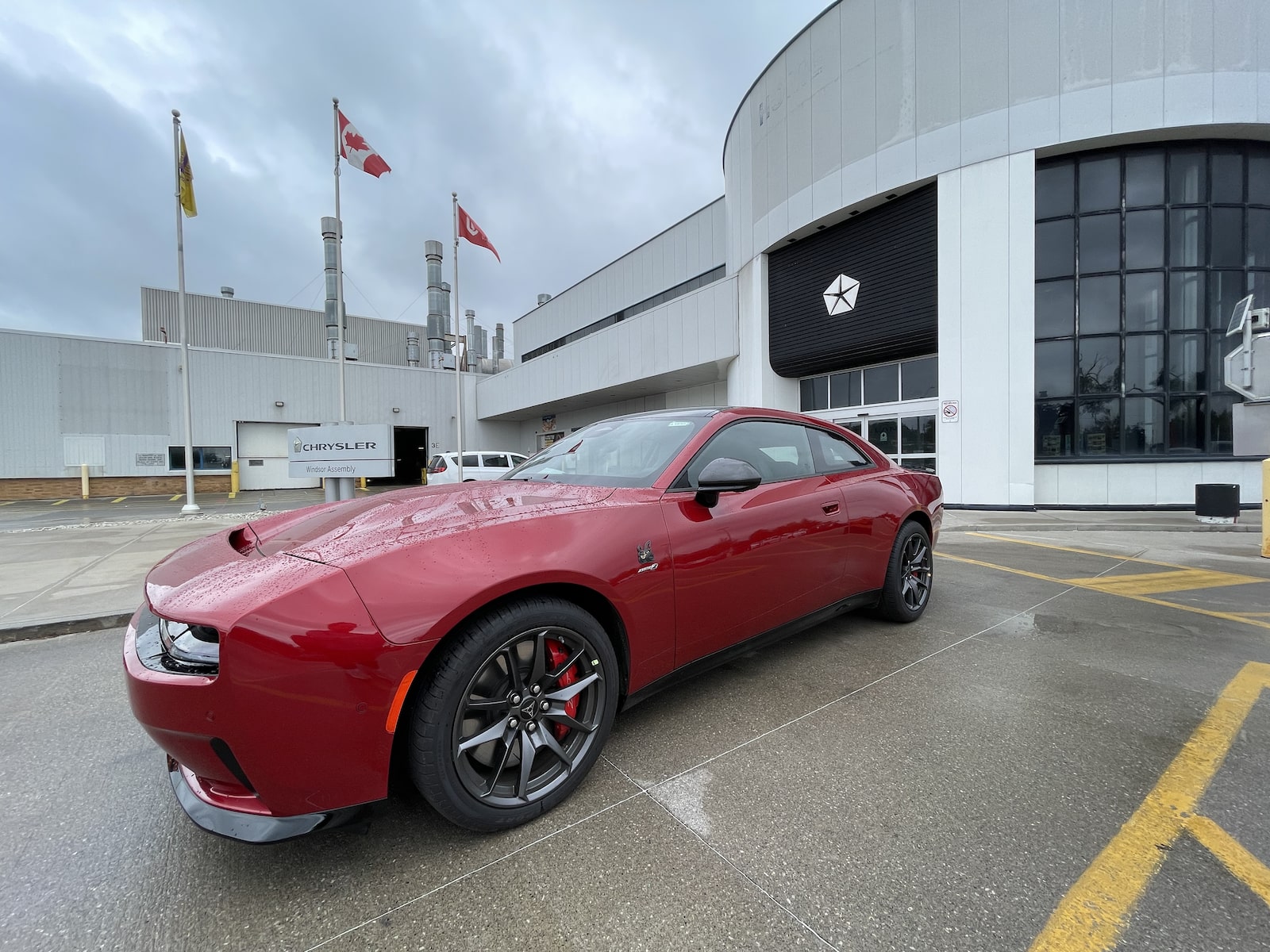
Outside the factory, Audrey Moore, the chief engineer responsible for the launch of the new Charger, shows us this EV can make noise. She sits in a red preproduction model and revs its electric motors to show off the car’s faux-exhaust sound, which is pumped through speakers near where the tailpipe would be. (Drivers can adjust the volume, or turn the faux-exhaust off completely.) It’s loud, sounding something like a V8 engine trapped underwater.
Despite the noise and the fact the new car has up to 670 horsepower, a battery-powered muscle car with prices ranging from $57,790 to $89,790 may be a tough sell to some of Dodge’s diehard V8-engine-loving fans.
Matt McAlear, chief executive officer of Dodge, said the brand’s existing consumer base won’t be won over as easily as if the company had just put another V8 engine in the new Charger.
“But as this technology evolves, as they see one down the street, as they see one of their friend’s [Charger EVs], as they get in, as they finally test drive one, they’ll be like, this is legit,” Mr. McAlear said.
The other difficulty may be that muscle cars are a niche vehicle to begin with. SUVs and pickups make up more than 80 per cent of Canada’s new-vehicle market. Where Ram sold more than 75,000 pickups last year in Canada and Jeep moved 19,102 Wrangler SUVs, Dodge sold just 6,193 units of the Charger and Challenger muscle cars combined.
Workers at Windsor Assembly are counting on the success of the new Charger; theirs is the only plant in the world making this car. If there’s enough demand for it and the minivans made here, it could mean the return of a third-shift at the Windsor Plant, something Stellantis executives have repeatedly talked about.

Antonio Bartucca, a metal finisher in body-in-white at the Stellantis Windsor Assembly Plant.Matt Bubbers/The Globe and Mail
“We’re all putting our heart into it, because we want Windsor Assembly to do very well,” said Antonio Bartucca, a metal finisher who has worked at the plant for more than 25 years. “I also invest in the company. A lot of us do,” he added, “and we’re backing the company up 100 per cent.”
The start of EV production in Windsor represents an important milestone for Canada’s auto industry, DesRosiers’ Mr. King said. “More needs to be done if Canada decides that it wants an auto industry of scale in the future,” he added.
For the production-ready Dodge Charger Daytona EVs to start rolling out of the Windsor factory and into dealerships late this year, millions of things have had to go right – from the design, to the tooling, to the parts, to the people and more – said plant manager Mr. Bellaire. Getting to this point has been a long road.
“It means a lot to me,” said Mr. Bellaire, “that I can go look in the eyes of the people here when I go to restaurants or hockey arenas, I can look them in the eye and they know that we’ve done as much as we can do to get the work here.”