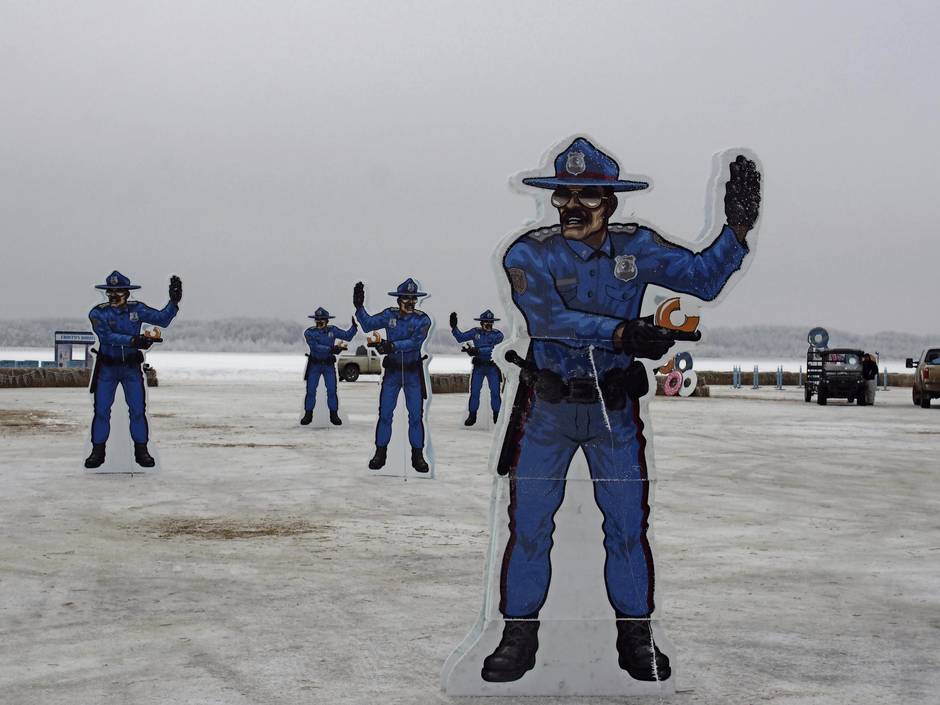
The lurch in the pit of my stomach signalled it was show time. Driver Jorge Dascollas accelerated in reverse and deftly did a 180-degree turn, passed a yeti throwing snowballs at the car, threaded a row of pylons and narrowly missed a lineup of two-metre-high cardboard cops before doing three full-circle turns – all before coming to a fishtailing stop beside a row of hay bales.

Dascollas is one of Canada’s top rally drivers. The Buenos Aires-born racer, who runs a rally driving school in Calgary, practically grew up on a Formula One track, and has three regional championships and a national rally title to his name.
Today, he is on a frozen lake in the middle of Alberta, teamed up with world champion skeleton racer Michelle Kelly, as a judge for the TV series, Ice Racer Showdown. The host is singer Clayton Bellamy of The Road Hammers.
The series, on CMT, involves 60 contestants – five in each show – competing in two elimination challenges over 12 episodes. The contestants run the gamut of ordinary folks – from a long-haul trucker to a road-tripping sister musical duo – who think their winter driving skills are better than the rest. The goal is to see what these drivers can handle on courses, under timed pressure, on frozen Red Deer Lake.
“Some are impressive,” says one of the judges, Edmonton comedian Donovan Workun, “and some are impressively bad,” like the young woman, who tells Bellamy after completing her first challenge: “I just started freaking out and hit the gas.”
Acceleration works in the hands of someone who understands the finer points of driving in icy conditions, Dascollas says. In designing the courses, Dascollas wants drivers to understand what happens when they carry too much speed, the consequence of over-steering, and the weight of the car. “Those are the things that usually create trouble for drivers in the city, but it gets multiplied in harsh conditions,” he says.
The series of on-ice challenges includes drifting, pulling the e-brake, hairpin and 180-degree turns and speed drills. Rally cult-favourite 2001-2004 Dodge Neons were stripped of their usual electronics, but kitted out with eight GoPro cameras, studded tires, a kill switch, roll bars and a stick shift, just to add to the challenge. Each episode has two elimination challenges and a race to determine the winner.

Watching from the sidelines, it’s easy to judge people, like the contestant who lurch out of the starting gate, slam the brakes during a turn and end up straddling a two-metre snowbank. In moments of danger, a driver’s instinct is to slow down, Dascollas says. “In rally driving, you power around the problems; that’s hard to convince people to do, and very often people go to brake, the wheels lock and the momentum will put the car in a straight line, and that’s not usually where you want to go.”
The solution is to use the handbrake and increase power. But the challenges that most tripped up drivers was having no concept of the car’s 3,000-pound-plus weight, Dascollas says. The other knowledge gap is that when you’re on asphalt, the tires have high adhesion; on ice or gravel, adhesion is low.
“The moment you start pushing too hard, [the car] will start sliding. People don’t seem to have a grasp of that and they try to adjust their speed; they need to lower it by 25 per cent, not just 10 per cent,” he says.
Like us on Facebook
Add us to your circles
Sign up for our weekly newsletter.