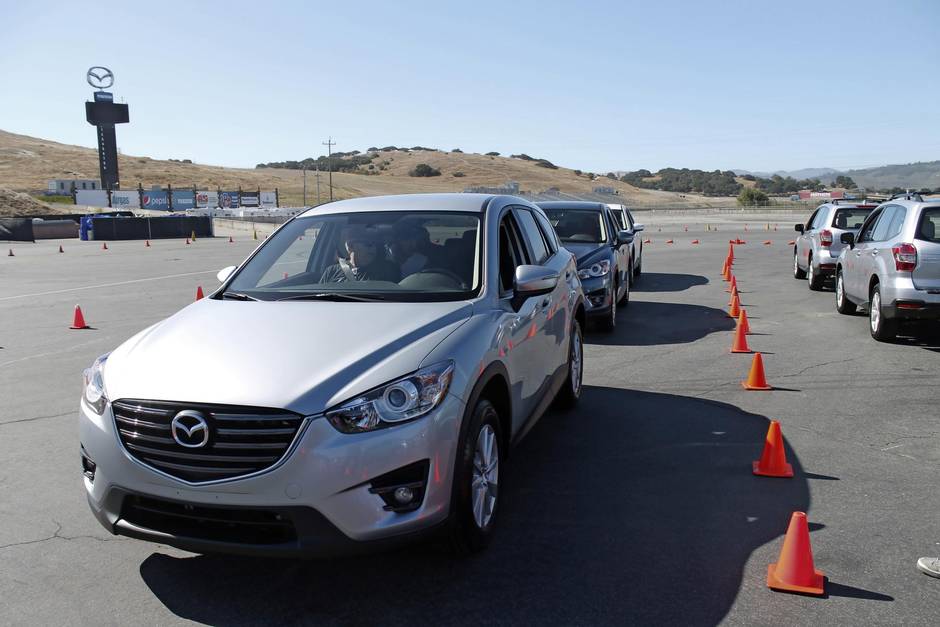
It’s disconcerting to have a Japanese engineer in the back seat, studying your driving with a laptop. It’s also frustrating to go to a racetrack to turn laps in the parking lot at 10 and 20 km/h.
The engineer didn’t want me to drive any faster. The aim was for precision and consistency, because the squiggly lines on his screen were very subtle.
The graph’s blue line showed my driving inputs with Mazda’s new G-Vectoring Control (GVC) switched on in the CX-3, while the red line showed when it was switched off. The blue line was a little smoother, with fewer peaks and troughs. The back-seat engineer looked happy with this, and another engineer in the passenger seat explained it.
“Steering precision, and response, and stability – that’s what the system is all about,” said Kelvin Hiraishi. “You can feel it very subtly in the drive, but you can see it on these graphs.”
GVC is nothing if not subtle. It’s a system that will be embedded in the engineering of new Mazdas to help smooth out your drive, without you really noticing. The company says its hope is drivers will appreciate it without really thinking about it, and it’ll help them love their cars. Maybe they’ll stay with the brand without really knowing why.
It’s best illustrated by a little band of tape at the top of the steering wheel. When you drive, you constantly correct to keep the car going in the direction you want, and you can see the tape jiggle left and right. With GVC, the car handles the constant tiny corrections automatically, with no change to the feel of the steering, and the tape jiggles less.
There’s a video I was shown of a model, slightly puzzled in the passenger seat of a Mazda6, not really knowing why she was being filmed driving along a Japanese road. It’s a split-screen video: the left side has her in a car with GVC active and the right side is without GVC. Her forehead jiggles less on the left-side screen.
Mazda says it achieved this by studying the way people walk, and recognizing that we dip our heads a little when taking strides. Following this, it tweaked the suspension on GVC-equipped cars to allow the front of the vehicle to dip a little to one side in a corner while the rear remains flat.
The clever stuff comes with the speed at which this happens. For it to be truly discreet, the automatic corrections need to take place more quickly than the driver can react, otherwise the driver will just do it and override the process. Most people have a reaction time of about a quarter of a second. For years, it wasn’t possible to beat that time mechanically. The application of individual brakes in traditional torque-vectoring, for example, still needs the fluid to move in the lines and press against the calipers, and that just takes too long.
The breakthrough came when Mazda started work on an electric car. The instant response possible from the motor and circuitry provided the reaction needed to beat the human driver. Engineers developed a system that used the torque of the gas engine to regulate the speed of the car; response time now from input to result can be as quick as 50 milliseconds, or one-twentieth of a second.
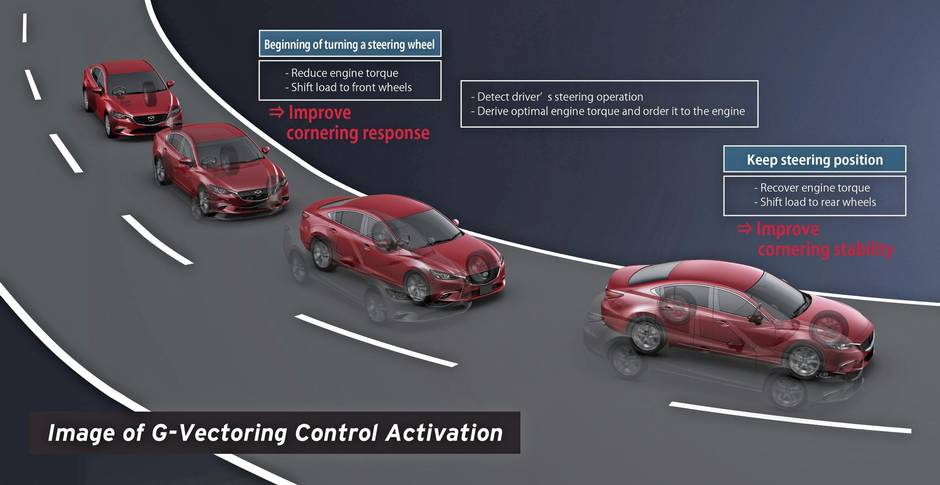
Now, the SkyActiv system uses the gas engine to create deceleration G-forces, which will compress the front suspension, or acceleration G-forces, which will compress the rear. When it senses the steering wheel being turned, it will shift weight to the front to dig the turning tires in more firmly. If the driver maintains a constant steering angle, it’ll move that weight to the back to dig in the rear tires and improve stability.
The idea is you don’t even know it’s happening – you just feel more confident in the vehicle, and it responds more predictably. The engine itself feels no different.
I was happy with the handling of Mazdas before GVC. Out on the open road, with an engineer turning the system on and off, I could see the little band of tape did seem to jiggle less, both on curves and straights. Did I feel more confident? No, but Mazda reckons this will be a subliminal thing.
The first car to get GVC will be the 2017 Mazda6, followed by the 2017 Mazda3. It’ll be fitted as standard and there won’t be an engineer to switch it off and on, so it will always be on. Apparently, it won’t cost extra. Chances are, you’ll never notice it, but Mazda hopes you’ll appreciate it.