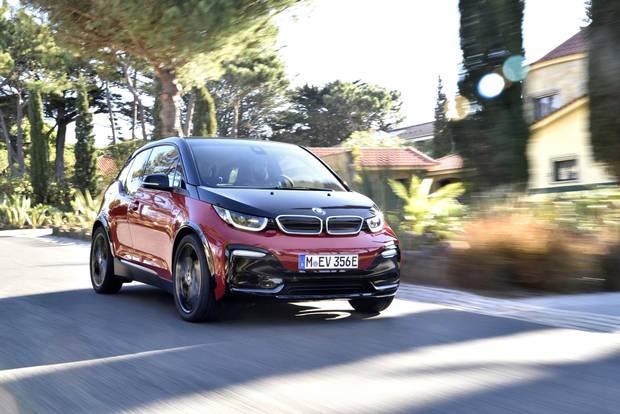
If there's one thing that gives me hope about the future of cars – the future of driving – it's that nearly every electric vehicle I've driven has accelerated like a frightened cat. EVs are laugh-out-loud quick, a fact only exaggerated by the goofy "weeeEEEE" sound they make as they take off. It's the nature of electric motors: you get all the torque, instantly. There's no tease; nothing is left to the imagination. So, whatever the future may hold for the automobile, there's a good chance it'll be fun to drive.
As the few people who ever took BMW's electric i3 for a test drive will know, it wasn't slow. From 0-30 km/h – the sort of acceleration you do all the time in cities and in traffic – the i3 was quicker than BMW's V-8 powered M3. It's curious BMW would feel the need to make a sportier version, but that's exactly what the new-for-2018 i3s is meant to be. Could this be the Volkswagen Golf GTI of electric cars? It's a tantalizing prospect.
"The major feedback we got was customers wanted it to be sportier," says Daniel Wechner, the designer responsible for the refreshed range of i3 models. "BMW is a sporty brand."
The i3 is a great platform, but the changes for the S are fairly minor. It rides on 10 milimetre lower suspension with a 40 mm wider track, which necessitates some stick-on wheel arch extensions. Minor motor tweaks add 14 horsepower and 15 lb-ft of torque, bringing the totals up to 184 and 199, respectively. The 0-100 km/h time drops from 7.2 seconds in the base i3 to 6.8 in the S.
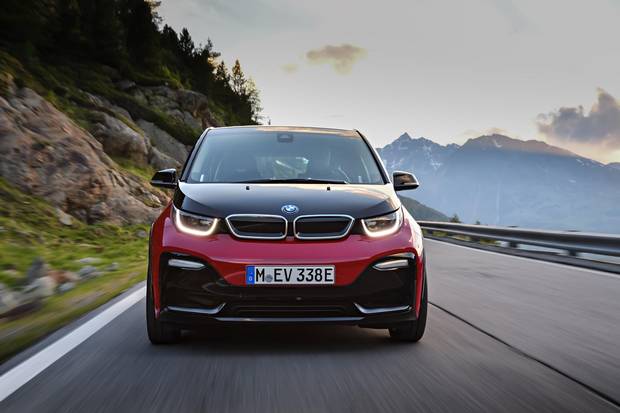
A new less-restrictive traction control setting allows the rear-drive i3s to power out of corners with new-found authority.
BMW
Those numbers don't do justice to how quick the i3s feels. It's strange to be sitting in that airy cabin – with its futuristic living-room vibe and tall windscreen – and have your breath taken away by a sudden burst of acceleration. But it was roughly the same in the older version. On the highway, the i3s feels as if it has more mid-range torque, providing a more assertive boost when overtaking.
A new less-restrictive traction control setting allows the rear-drive i3s to power out of corners with new-found authority. There's the slightest whiff of over-steer. The handling is indeed better than it was. These changes don't turn the car into a drift machine like the M5, but it allows for more spirited driving without the electronics completely shutting down the party. The suspension tweaks and wider wheels mean less body roll and more grip, but they do necessarily sacrifice a smidgen of ride comfort.
From the outside, the lowered, wider stance does makes the S look sportier, like it's changed into its gym clothes.
"Our assignment for the [original] i3 was a sustainable car … and this is what we did. What we've done now is put a little bit more emotion on top," Wechner says. "I think this car is so far ahead of its time that we'll see more sales at the end of its life cycle than the beginning."
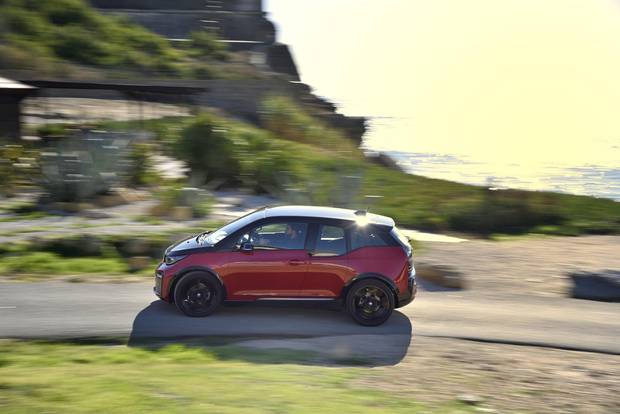
BMW incorporated feedback from customers, who said they wanted the i3 to be sportier.
BERNHARD LIMBERGER
That's entirely accurate, but the S still feels like a missed opportunity. If anything, BMW hasn't gone far enough. Some wider tires up front and improved steering feel could turn the i3 into a genuine hot hatch to rival the GTI or even the M240i. It'd be a riot, a practical, zero-emissions rocket ship for the real world. Alas, the market – and infrastructure required to give a car like that mass appeal – isn't here yet.
This mildly sportified styling exercise is probably what BMW was going for. The 2018 i3 will still be a niche vehicle. The S is more fun to drive while giving a slight boost to the model's curbside appeal, for a price and ride-comfort penalty. At $52,350, the i3s is $4,000 more than the base model. They will arrive in Canada in early 2018.
One day in the not-too-distance future, there will be some spectacularly good electric sports cars. This isn't quite one, but it's a harbinger of things to come.
Tech specs
- Price: $52,350 (i3s EV); $56,950 (i3s REX)
- Engine: 94 ampere-hour (Ah) battery, electric motor, optional gas range extender
- Transmissions: Single speed
- Fuel economy (litres/100 km): TBD
- Drive: Rear-wheel
- Alternatives: Chevrolet Bolt, Nissan Leaf, Tesla Model 3
Looks
You either love it or hate it; I love it because it's a total re-imagining of car design. The mid-life styling updates are subtle. LED lights are now standard equipment and there are a couple new paint colours. The i3 gets a silver stripe (a sticker) along the side of its roof. The S has an all-black roof, wheel arch extensions, blacked-out trim and some exclusive 20-inch rims.
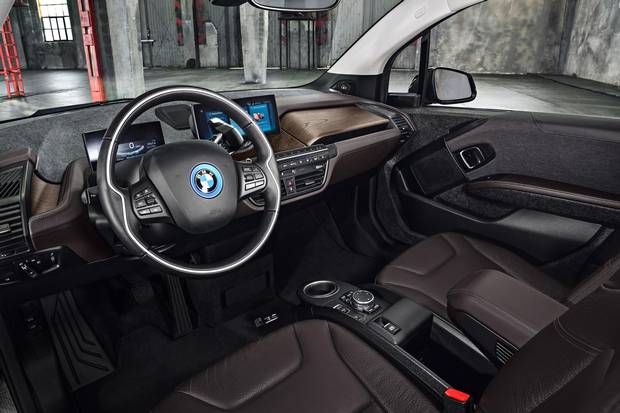
The surprisingly roomy cabin has some new trim options, but is otherwise unchanged from last year’s model.
BMW
Interior
The cabin is largely unchanged from 2017, save for some new trim options. There's a higher-resolution main screen, with the latest version of BMW's iDrive infotainment software. The driver's display, behind the steering wheel, still has a big black frame around it that looks a bit cheap.
Performance
Range for the base 2018 i3 EV is unchanged from 2017, rated at 201 km/h on the EPA test cycle. Assuming the REX is also the same as last year, it should do 290 km. A rating for the i3s models aren't available yet, but could be slightly less as a result of the added rolling resistance of its wider wheels. All versions use the same 94 ampere-hour (Ah) battery.
Technology
For 2018 the i3 will come in two flavours, i3 and i3s, and both will be available as a pure electric vehicle (EV) or optionally as a plug-in hybrid range-extended vehicle (REX). The later uses a small gas engine – a scooter motor sourced from Kymco – to recharge the batteries as you drive.
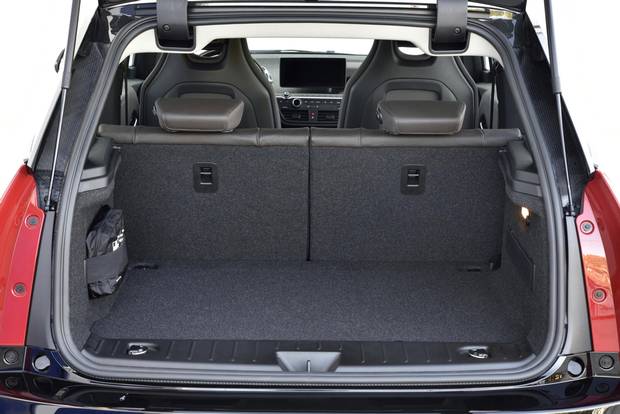
The cargo volume is 1,099 litres with the back seats folded down.
BERNHARD LIMBERGER
Cargo
The fully carbon-fibre reinforced plastic body creates a surprisingly roomy cabin with seating for four. Cargo volume, which is 1,099 litres with the rear seats folded, is identical in both EV and REX versions.
The Verdict
7.5
Still a great design, now more fun to drive, but not the cheapest or longest-range option.
The writer was a guest of the auto maker. Content was not subject to approval.
Shopping for a new car? Check out the new Globe Drive Build and Price Tool to see the latest discounts, rebates and rates on new cars, trucks and SUVs. Click here to get your price.