The U.S. Thanksgiving holiday offers unique investment opportunities for Canadian and U.S. investors, both on the buy side and the sell side. The holiday this year occurs on Thursday November 27.
Two of the strongest days of the year for U.S. equity markets are the day before and the day after U.S. Thanksgiving Day. Thackray's 2014 Investor's Guide notes that, "The day before Thanksgiving and the day after have had an average cumulative return by the S&P 500 Index of 0.7 per cent per period". During the past 63 periods, the Index gained in 52 periods, was unchanged in three periods and slipped in eight periods.
Performance of the S&P/TSX Composite Index during the U.S. Thanksgiving rally period also has been positive. The TSX Composite Index since its re-launch in March 2000 has advanced in ten of the past thirteen periods.
Strength during the period is influenced by a difference in sentiment between institutional and individual investors. Most institutional investors and market makers have a diminished impact on equity markets because they close their books at midday on Wednesday, the day before Thanksgiving. They take an extended long weekend including a holiday on Friday, the day after Thanksgiving. Individual investors have a greater impact on equity markets. They are in a buoyant pre-Christmas mood. Thanksgiving Day in the U.S. is the start of the Christmas shopping season. The day after Thanksgiving Day is known as "Black Friday" and traditionally has been the busiest shopping day of the Christmas season. It became known as "Black Friday" because historically that is the date when retailers finally turn a profit for the year. Their profit and loss statement literally turns from red to black.
What about this year? Once again, Black Friday will be an important day for retail sales in the U.S. Canadian retailers also have caught the wave. In order to encourage Canadians to buy their Christmas gifts in Canada instead of buying them during a quick trip to the U.S., Canadian retailers frequently offer discount prices during the U.S. Thanksgiving holiday. Bargains in Canada will be less frequent this year due to recent weakness in the Canadian Dollar relative to the U.S. Dollar.
The significance of Black Friday on U.S. retail sales has been diluted slightly in recent years. Several major U.S. retailers began their Christmas marketing program this year on November 1. In addition, bargain prices on merchandise are expected to appear earlier than previous. A recent study found that the best day to buy Christmas merchandise last year was not Black Friday. It was the day before Thanksgiving. Other bargain days included the two weekend days prior to Black Friday.
Several investment opportunities arrive each year around the U.S. Thanksgiving holiday. The easiest opportunity is to avoid selling U.S. and Canadian equities the day before and day after the U.S. Thanksgiving holiday when equity prices have a high probability of moving higher.
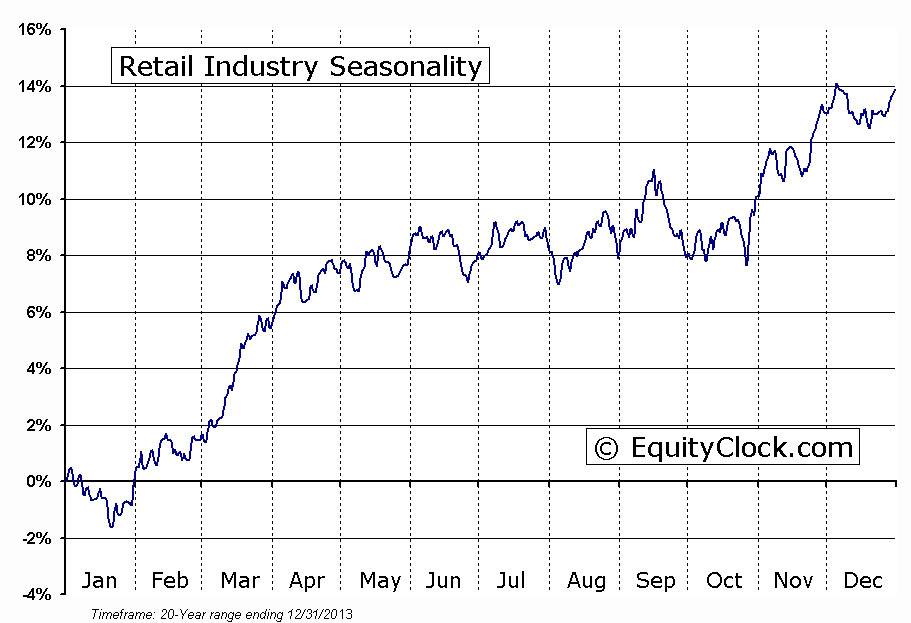
Other investment opportunities are less obvious. Retail merchandiser equities and related Exchange Traded Funds have a history of moving higher from October 28 to Black Friday in anticipation of Christmas sales. The best way to track the U.S. retail merchandising sector using an actively traded ETF is through SPDR S&P Retail Index (XRT). Recent strength by the ETF during the past month implies that year-over-year gains in Christmas sales will be above average this year. Late last week, the ETF broke resistance at $90 on higher than average volume to reach an all-time high.
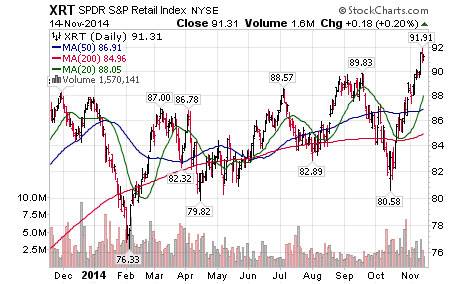
And now a curiosity! Seasonal studies show that the best day to take seasonal profits in the retail merchandising sector is on Black Friday. Traders take profits on news. Preferred strategy is to hold retail merchandiser stocks and related ETFs for now, but be prepared to take profits on Black Friday.
Black Friday also is a special day for Canadian investors. That is the day when Canadian equity markets historically enter into a period of outperformance relative to U.S. equity markets. The period of outperformance is from the first week in December to the first week in March. More on this strategy will be offered in a later column.
Disclaimer: Comments, charts and opinions offered in this report by TimingTheMarket.ca and EquityClock.com are for information only. They should not be considered as advice to purchase or to sell mentioned securities. Data offered in this report is believed to be accurate, but is not guaranteed. Don and Jon Vialoux are Research Analysts with Horizons ETFs Management (Canada) Inc. All of the views expressed herein are the personal views of the authors and are not necessarily the views of Horizons ETFs Investment Management (Canada) Inc., although any of the recommendations found herein may be reflected in positions or transactions in the various client portfolios managed by Horizons ETFs Investment Management (Canada) Inc.