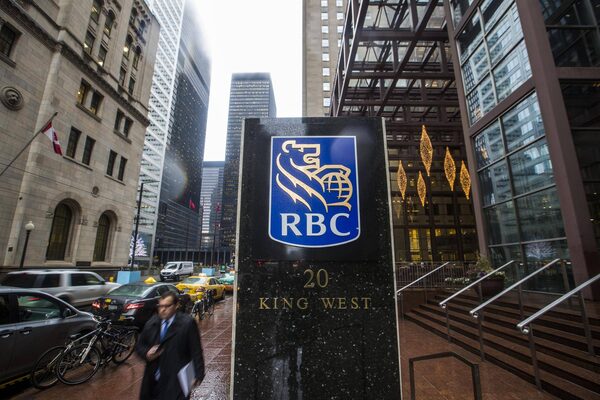
A man walks by an RBC sign near Bay and King in Toronto’s financial district in this file photo.Mark Blinch/The Globe and Mail
Royal Bank of Canada will open its robo-adviser platform to all existing RBC clients in Ontario in the new year and will be offering no management fees for the first six months.
Last month, The Globe and Mail reported RBC launched an automated online-portfolio platform for a select group of employees to pilot test under the RBC InvestEase brand.
An RBC spokesperson confirmed a wider launch for all Ontario clients is set for the new year but declined to comment on further details. According to the RBC InvestEase website, the platform will offer RBC clients in Ontario the opportunity to open accounts with a $1,000 minimum balance. Subsequent contributions can be made in any amount.
Robo-adviser platforms offer clients an online risk-assessment tool, which quickly calculates an appropriate asset allocation based on age, financial goals and risk tolerance. The results provide clients with a recommended investment portfolio predominantly made up of exchange-traded funds – all for lower fees than those usually offered by traditional financial advisers.
According to the RBC InvestEase pilot website, which was first reported on by the youngandthrifty.ca website, investors who sign up for the online platform will pay no management fees during the pilot phase and for six months thereafter. A weighted average management-expense ratio between 0.12 per cent and 0.14 per cent will still apply to the ETFs held in the investment portfolios.
RBC has not confirmed how long the pilot phase will be open for, but at the end of the six-month grace period, RBC InvestEase will notify clients that an annual management fee of 0.50 per cent plus HST will be charged, based on average assets under management. In addition, a fee of $135 will be levied to transfer money from an RBC InvestEase account to another financial institution.
The platform will house half a dozen investment portfolios made up of proprietary index ETFs developed by RBC Global Asset Management, and may include a combination of the following: RBC Canadian Short Term Bond Index ETF, RBC Canadian Bond Index ETF, RBC Global Government Bond (CAD Hedged) Index ETF, RBC Canadian Equity Index ETF, RBC US Equity Index ETF, RBC International Equity Index ETF and RBC Emerging Market Equity Index ETF.
RBC's entrance makes it the second Canadian bank to build an in-house online portfolio-management platform. Bank of Montreal was the first to enter the robo-adviser market in 2016, with the launch of SmartFolio. BMO also launched its online platform with portfolios comprised of only the bank's proprietary ETFs. The majority of the independent online portfolio managers in Canada include a mix of ETF products from various providers.
Launching into the online digital space for both RBC and BMO is a difficult balancing act, as robo-advisers are typically considered an alternative option to the traditional financial adviser – a division within the banks that are key to wealth-management growth.
During the pilot phase, RBC InvestEase will only accept money transferred from Royal Bank chequing and savings accounts; and clients can only choose to open an individual non-registered investment account, a registered retirement savings plan or a tax-free savings account.
The website also states RBC has plans to expand the platform to include registered education savings plans (RESPs), registered retirement income funds (RRIFs), locked-in retirement accounts (LIRA), restricted locked-in registered retirement savings plans and joint accounts.
Last June, bank rival BMO Smartfolio added RRIF accounts to its platform because of client demand. The platform included RESP accounts in 2016, and the bank is looking to add LIRA accounts at a future date.
BMO also appears to be gearing up for greater competition in the marketplace. While BMO has not announced any plans for changes to its management fee of 0.70 per cent, on Tuesday, BMO Smartfolio lowered the minimum amount required to open an online account to $1,000 from $5,000, stating it was hoping to entice the "new-to-investing crowd" with a lower threshold.
"We heard from people who were new to investing that the $5,000 threshold was quite high for them to start off with," said Silvio Stroescu, head of digital investing for BMO. "We noticed that we don't have a lot of clients who are new to investing, and we want to shift down a path for those Canadians who haven't started to invest yet to begin to invest with Smartfolio."