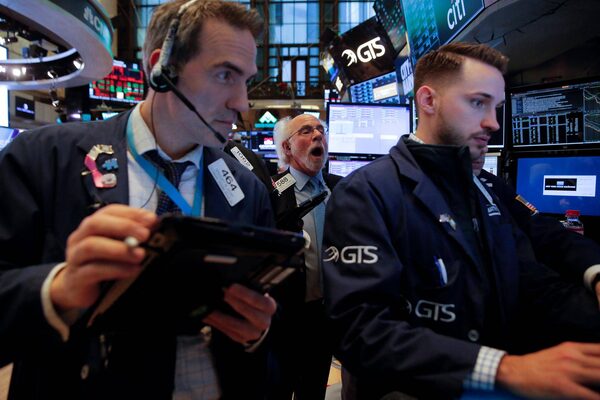
Traders work on the floor at the New York Stock Exchange (NYSE) on Dec. 28.Andrew Kelly/Reuters
Canada's main stock index added on Thursday to the previous session's record high as gains for the shares of energy, technology and marijuana companies offset losses for industrials and gold miners.
The Toronto Stock Exchange's S&P/TSX composite index unofficially closed up 18.82 points, or 0.12 per cent, at 16,221.95. Six of the index's 10 main groups ended higher.
The largest percentage gainer on the TSX was Canopy Growth Co, which rose 9.5 per cent to $30.41. The stock was adding to gains it made on Wednesday after a ruling by regulators that boosted the shares of marijuana companies.
Rival Aphria Inc. increased 6.5 per cent to $18.00.
Open Text, rose 6.9 per cent to $44.66 after S&P Dow Jones Indices announced after the bell on Wednesday that the stock will be added to the S&P/TSX 60, 60 Capped and 60 Equal Weight Indices to replace Agrium Inc.
One of the biggest drags on the index was Brookfield Infrastructure Partners LP, which fell 2 per cent to $56.69 after rallying on Wednesday. Earlier in the week the company announced an agreement to sell its Chilean regulated transmission business for $1.3-billion.
Other stocks to decline included: Shopify Inc, down 2.7 per cent to $128.62; Valeant Pharmaceuticals International Inc., which fell 2.1 per cent to $26.62 and Centerra Gold Inc., which dropped 2.8 per cent to $6.32.
U.S. stocks edged higher in light trading on Thursday, buoyed by gains in financial stocks and as technology stocks continued to slowly recover from a losing skid.
Tech stocks added 0.1 per cent and notched their second straight gain on the heels of a five-session losing skid. The index has struggled somewhat to close out the year but remains the best-performing sector in 2017, up more than 37 per cent.
"This needs to and has been an earnings-driven market and that is where you've seen a tremendous amount of the earnings momentum and visibility, we would expect that to continue into next year," said Bill Northey, senior vice president, U.S. Bank Wealth Management, in Helena, Mon.
Apple shares closed 0.3 per cent higher after relinquishing earlier gains and Amazon edged up 0.3 per cent after Reuters reported the companies are in licensing discussions with Riyadh on investing in Saudi Arabia.
Volumes remained thin due to the holiday week between Christmas and New Year's Day. The prior two sessions showed the lowest full-day trading volumes of the year.
"Clearly light volume, low volatility has been the flavour of the week, post holiday, and don't expect that to change going into the close tomorrow," Northey said.
A 0.6-per-cent gain in copper prices helped lift the materials sector 0.4 per cent, led by a 3.1-per-cent gain in Freeport-McMoRan.
The benchmark S&P 500 has climbed nearly 20 percent this year, on track to record its biggest annual gains since 2013, boosted by robust economic growth and solid corporate earnings.
The rally is widely expected to extend into 2018, boosted by gains from a new law that lowers the tax burden on U.S. corporations.
The Dow Jones Industrial Average rose 63.21 points, or 0.26 per cent, to 24,837.51, the S&P 500 gained 4.92 points, or 0.18 per cent, to 2,687.54 and the Nasdaq Composite added 10.82 points, or 0.16 per cent, to 6,950.16.
The number of Americans filing for unemployment benefits was unchanged last week at 245,000, slightly above the 240,000 forecast, but the underlying trend remained consistent with a tightening labour market.
Oil prices edged up on Thursday, remaining near 2-1/2-year highs after data showed strong demand for crude imports in China and on increased U.S. refining activity that drew more crude from inventories.
Trading was typically thin at year end, with many traders on vacation.
The U.S. Energy Department said crude stocks fell 4.6 million barrels in the latest week. Inventories excluding the nation's strategic reserve have declined more than 11 percent in the last year.
U.S. refining runs increased, pushing capacity use to 95.7 per cent, the highest in December dating to 1998. Refiners have profited in recent months as the spread widened between U.S. crude and Brent futures prices.
"In the week past, strong demand for refined products, especially distillates, continued to incent refiners to process crude oil at increasing rates," said David Thompson, executive vice president at Powerhouse, an energy-specialized commodities broker in Washington.
U.S. West Texas Intermediate (WTI) crude futures rose 20 cents to $59.84 a barrel. Brent crude futures settled up 28 cents at $66.72 a barrel.
This week, WTI broke above $60 a barrel for the first time since June 2015, while Brent breached $67 for the first time since May 2015.
Oil markets have tightened after a year of production cuts led by Middle East-dominated Organization of the Petroleum Exporting Countries (OPEC) and Russia. OPEC cuts kicked off last January and are scheduled to continue throughout 2018.
Countering those cutbacks, U.S. oil production has soared more than 16 perc ent since mid-2016 and is approaching 10 million barrels per day, trailing only OPEC kingpin Saudi Arabia and Russia.
In the most recent week, U.S. production dipped modestly to 9.75 million bpd from 9.79 mln bpd the previous week.
Prices were supported in early trade by China's release of strong import quotas for 2018. China's crude inventories in November hit a seven-year low of 26.15 million tonnes, Xinhua data showed.
Gold extended a nine-day rally on Thursday and hit a one-month high on a strong technical outlook and a U.S. dollar at a four-week low, as palladium prices reversed earlier losses to touch fresh 17-year highs.
Gold benefited from technically-driven momentum after closing above its 100-day moving average on Wednesday for the first time since late November, analysts said.
Spot gold was up 0.61 per cent at $1,294.84 per ounce by 3:37 p.m. EST after hitting its highest since Nov. 29 at $1,295.21 an ounce. Spot prices have risen for nine straight sessions, not including the Christmas holiday. That is the longest string of daily gains since July 2011.
U.S. gold futures for February delivery settled up 0.45 per cent at $1,297.20 per ounce.
Higher lows have bullion's chart looking strong, said Eli Tesfaye, senior market strategist for brokerage RJO Futures in Chicago.
"The technicals favor the upside. The gravitational force is trying to break through the (key) psychological level of $1,300," he said.
Palladium touched its highest since February 2001 at $1,072 and was up 0.71 per cent at $1,068, continuing its climb on expectations of short supplies and strong demand.
Silver was up 0.88 per cent at $16.83 an ounce after hitting a one-month high of $16.887. Holdings of silver exchange-traded funds tracked by Reuters rose to their highest since early September, with Thursday's data showing a 62-tonne inflow.
Platinum was up 0.95 per cent at $925.70 an ounce.