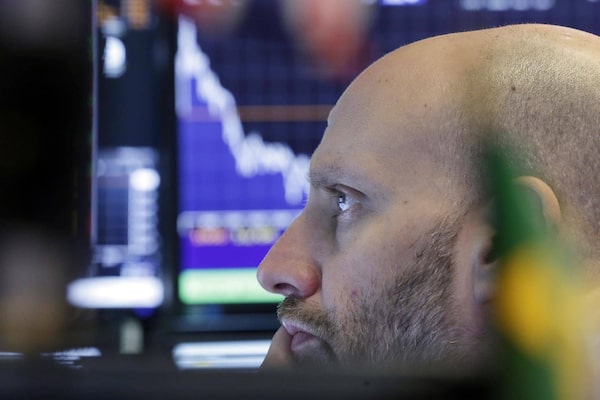
Specialist Meric Greenbaum studies his screens on the floor of the New York Stock Exchange.Richard Drew/The Associated Press
This is the bull market nobody believes in, but everyone keeps investing in.
A survey this week underlines an odd fact – few people, including the folks who are making money from rising share prices, think Wall Street can keep defying gravity.
Yet, even fewer people appear willing to take the next step and duck away from a money-making machine that just might deliver one last burst of gains.
The result? An apparently calm market that is being driven, up or down, by wisps of news. Investors aren't complacent; they're merely waiting for signs of what is to come.
Widespread retreats by global stock markets on Wednesday reflected a number of concerns – signs that Chinese growth is fading, worries about whether U.S. tax reform will ever become reality and anxiety about stretched valuations. The FTSE all-world index declined for the fifth straight day, while in Toronto the S&P/TSX composite slid for a sixth consecutive session.
But there were few signs of true anxiety, probably because there's no obvious catalyst for a broader sell-off. Corporate earnings have come in strong across the developed world, while unemployment continues to fall and most economic indicators are sending positive signals.
The co-ordinated upswing in global economic growth would ordinarily be a positive for stocks, but valuations are already so high that it's difficult to assume additional gains.
Merrill Lynch's latest Global Fund Manager Survey showed wariness among professional investors is at its highest level on record. The net proportion of respondents who said stocks were overvalued was larger than at any time since the monthly survey began in 1998.
Oddly, though, a record number of fund managers said they were responding by taking greater than normal levels of risk. Among other things, the pros had reduced their cash buffers to the lowest level in four years.
In short, money managers are skeptical of today's expensive stocks but are doubling down on the insanity in search for further gains. "This is a sign of irrational exuberance," Merrill's chief investment strategist, Michael Hartnett, wrote.
The Federal Reserve Bank of San Francisco appears to share some of the same worries. In an economic letter this week, it crunched numbers in an attempt to justify current stock market valuations, but came to a less than encouraging conclusion. "Investors who expect high stock returns in the coming years based on recent market experience may end up being disappointed," it cautioned.
Even optimists are sounding dubious. For instance, Oliver Jones of Capital Economics argues there's no need to worry about a large stock-market correction until the world encounters an economic slowdown, which will probably not happen until 2019. Still, his projection is for the S&P 500 to fall slightly by year end and barely budge in 2018 – all of which raises the question of why investors should stick around for what sounds to be an uninspiring patch of results.
The best answer is that there's no obvious place to run to. Many bonds are now priced to deliver negative returns after inflation.
As behavioural economists will tell you, humans confronted by the prospect of a likely loss show a surprising willingness to gamble in hopes of escaping the damage. The desire to avoid defeat is what drives many rogue traders to make wilder and wilder bets on the faint chance they can make back the money they've already lost. It's also what seems to be propelling many investors to evade modest but certain losses on bonds by raising their gambles on an already expensive stock market.
For now, this unhealthy dynamic is being disguised by low volatility. The Chicago Board Options Exchange volatility index, known as VIX, is everyone's favourite measure of market fear. It has been inching up in recent days, but continues to hover at low levels, leading many analysts to conclude that investors have become united in complacency.
That interpretation could be dead wrong.
Chris Dillow, the resident economist at Investors Chronicle in Britain, says low market volatility is actually a sign that investors disagree. Share prices "are relatively stable because buyers can find sellers and vice versa without prices moving much," he says.
Prices begin to jump around when consensus grows and everyone wants to jump in or out at the same time. With few people willing to take the other end of the trade, prices have to move by large amounts to get a deal done.
If Mr. Dillow is right, today's steady-as-she-goes market could quickly spasm if attitudes shift. Any news, good or bad, could do it. Either way, the future course of the market is likely to be considerably choppier than its present.