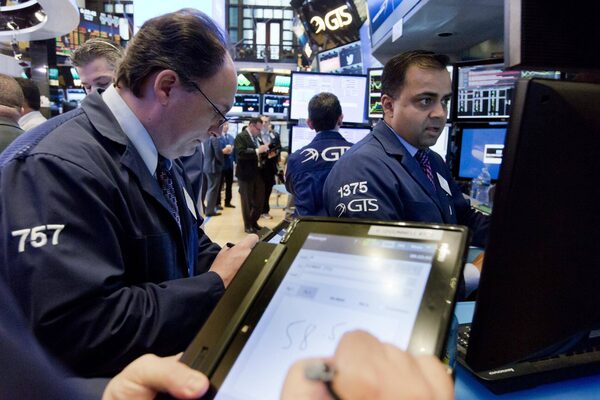
Specialist Dilip Patel, right, works with traders on the floor of the New York Stock Exchange, Tuesday, May 23.Richard Drew/The Associated Press
Low volatility is great, but it doesn't mean investors should pay more for stocks.
It's been an unusually quiet time for U.S. equity markets. Stock watchers' favorite barometer of volatility, the CBOE Volatility Index, or VIX, has averaged just 11.1 so far in 2017 through Monday, making it the calmest year on record. (The lower the VIX, the lower the volatility, and vice versa.) The gauge has averaged 19.4 since its inception in 1990.
The VIX is a quick and convenient measure of the market's mood, but it has an unfortunate side effect: It conditions investors to associate low volatility with rich stock prices. It's easy to see why. When the VIX declines, stock prices tend to rise. The correlation between the VIX and the S&P 500 has been negative 0.63 since 1990.
And when stock prices rise, valuations tend to rise, too. Consider just the most recent example. The S&P 500 has soared 233 per cent from Mar. 31, 2009 through Monday. During the same period, its price-to-earnings ratio has grown to 22.5 from 14.4, based on trailing 12-month earnings from continuing operations. The index's ballooning valuation is even more pronounced when those earnings are cyclically adjusted. The P/E ratio jumps to 28.2 from 13.1 using an average of trailing 10-year earnings.
Price and valuation are closely linked because stock prices often get ahead of fundamentals. The S&P 500's earnings rose 157 per cent from the first quarter of 2009 through the third quarter of this year -- an impressive jump, but well short of the index's price gain during the period. Cyclically adjusted earnings rose a mere 54 per cent.
Intuitively, therefore, it seems reasonable to expect lofty stock prices when volatility is muted. But reality hasn't conformed to that notion.
The disconnect is that the VIX is a gauge of expected short-term swings, not actual longer-term volatility. In the short run, the VIX has been shockingly predictive. The correlation between the VIX and the S&P 500's subsequent 30-day standard deviation has been 0.79 since 1990. (Standard deviation reflects the performance volatility of an investment.)
Few investors hold stocks for such a short time, however. Over longer periods, the relationship between the VIX and volatility breaks down. The correlation between the VIX and subsequent five-year standard deviation has been negative 0.02. And the correlation with subsequent 10-year standard deviation has been 0.2. In other words, no reliable correlation.
Nor, for that matter, has there been any reliable relationship between longer-term volatility and valuations. The correlation between the S&P 500's rolling five-year average standard deviation and 12-month trailing P/E ratio has been negative 0.09 since 1876, based on my calculations using stock market data compiled by Yale professor Robert Shiller. Similarly, the correlation between the index's rolling 10-year average standard deviation and 12-month trailing P/E ratio has been negative 0.08 since 1881.
The result is the same using cyclically-adjusted earnings. The correlation between the S&P 500's rolling five-year average standard deviation and the cyclically-adjusted P/E, or CAPE, ratio -- which uses an average of trailing 10-year real earnings -- has been 0.02 since 1885. And the correlation between the rolling 10-year average standard deviation and CAPE ratio has been zero since 1890.
Investors have a knack for inventing reasons to bid up stock prices, but a muted VIX shouldn't be one of them.
---
Nir Kaissar is a Bloomberg Gadfly columnist covering the markets. He is the founder of Unison Advisors, an asset management firm. He has worked as a lawyer at Sullivan & Cromwell and a consultant at Ernst & Young.