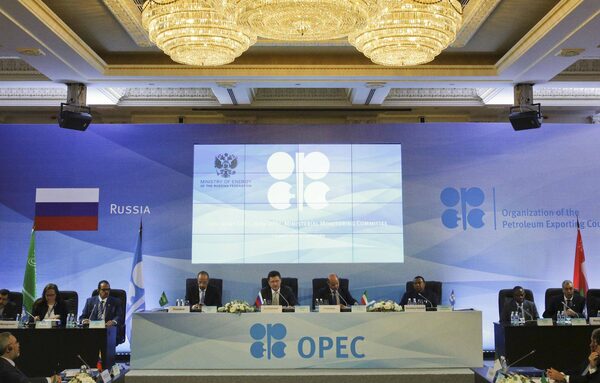
Saudi Arabian Energy Minister Khalid al-Falih, Russian Energy Minister Alexander Novak, Kuwaiti Oil Minister Essam al-Marzouq and OPEC Secretary-General Mohammad Barkindo attend a meeting in St. Petersburg on Monday. OPEC has promised to balance global supply and demand in its member countries.Anton Vaganov/Reuters
Oil optimists are back. They're just not betting the ranch on a rally yet.
Hedge funds added the most weekly wagers on rising West Texas intermediate crude prices since February, with short-sellers on a steady retreat. Whether the improving mood sticks will depend largely on OPEC, whose members are gathered in St. Petersburg.
"Everybody is still operating off of OPEC's mantra that it will do whatever it takes to get global inventories down," Rob Thummel, managing director and portfolio manager at Tortoise Capital Advisors LLC, which manages $16-billion (U.S.) in energy-related assets, said by telephone.
Oil has rebounded from a funk in June – one timid, fleeting rally at a time – as U.S. stockpiles decline and the summer boosts demand for gasoline. But doubts still abound that the Organization of Petroleum Exporting Countries and its allies have a grip on the global supply and demand balance.
Output has risen from Libya to U.S. shale fields. Ecuador, an OPEC member, stirred up uncertainties last week when its Oil Minister said the country can no longer comply with production curbs agreed on in November.
OPEC's supply in July will be the highest this year, according to tanker-tracker Petro-Logistics SA. The group's compliance with the November deal dropped to 92 per cent in June from 110 per cent in May, according to a person familiar with the data.
Several OPEC countries and other leading oil-exporting countries gathered in St. Petersburg for a technical meeting on Saturday before a summit of oil ministers on Monday.
OPEC Secretary-General Mohammad Barkindo said the technical meeting was "very productive" and compliance with production cuts has been "excellent."
Limiting oil output from Nigeria and Libya has been ruled out for now, with both African countries saying they'll need to keep pumping at a higher level before they can join the global effort to stem the supply glut, according to two people familiar with the matter.
Declining stockpiles
Meantime, the U.S. market appears to be starting to shape up. Nationwide crude inventories are at the lowest level since January, and gasoline supplies have declined for five straight weeks, the latest Energy Information Administration data showed. The agency has lowered its U.S. crude output forecast for next year to 9.9 million barrels a day, from a 10.01 million estimate in June.
Hedge funds increased their WTI net-long position – the difference between bets on a price increase and wagers on a drop – by 21 per cent to 215,488 futures and options over the week ended July 18, data from the U.S. Commodity Futures Trading Commission show. That was the most bullish stance in six weeks. Shorts slipped by 17 per cent, a third week of declines, while longs climbed 4.6 per cent to the highest level since April.
The net-bullish position on the benchmark U.S. gasoline contract rose for a fourth week to the most bullish stance since April. The bearish net-position on diesel increased by 13 per cent.
Net-long positions in Brent rose. Speculators' wagers on the grade, the global benchmark traded in London, climbed by 29,517 contracts to 261,652, data from ICE Futures Europe showed.
WTI for September delivery settled at $46.34 a barrel in New York on Monday. The rebound from last month's doldrums may have encouraged investors to cut back on short positions, according to Tim Evans, an analyst at Citi Futures Perspective in New York.
"We are seeing a little bit of fresh buying, but not really a confident flow that would reflect an expectation that prices will continue to work higher," he said.
Meanwhile, Saudi Arabia promised deep cuts to crude exports next month, emphasizing its commitment to eliminating a global oil-supply glut. Shipments from the producer will be capped at 6.6 million barrels a day in August, one million lower than a year earlier, Saudi Arabia's Energy and Industry Minister Khalid Al-Falih said on Monday.
"People are still leaning a little bearish," Bill O'Grady, chief market strategist at Confluence Investment Management in St. Louis, said by telephone. "Anything OPEC does to cut production probably gets offset by the shale boys anyway."