How to Control Portfolio Risk Using Market Groups and Sub-Group Caps
Dual Edge Research publishes two powerful newsletters that work great individually — and even better together. The Bull Strangle Newsletter focuses on stocks and options, combining stock ownership with premium-selling strategies to generate consistent income and market-beating returns. The Smart Spreads Newsletter specializes in seasonal commodity futures spreads, offering a diversified approach with low correlation to equities. Together, they deliver a complete investment perspective — one focused on income, the other on diversification — all under one simple subscription.
Introduction
One of the most overlooked drivers of portfolio risk is concentration—not just within a single market, but across markets that respond to the same underlying forces. What appears to be diversification often isn’t. A portfolio holding positions across energy, grains, meats, and softs may look balanced on the surface. But within each of these groups are tightly connected sub-groups that tend to move together—especially when it matters most.
To make this interaction observable, the following analysis examines correlation across major commodity groups using weekly price changes over five years. The objective is not precision, but awareness. Portfolio strain emerges from these clusters, not from individual trades.
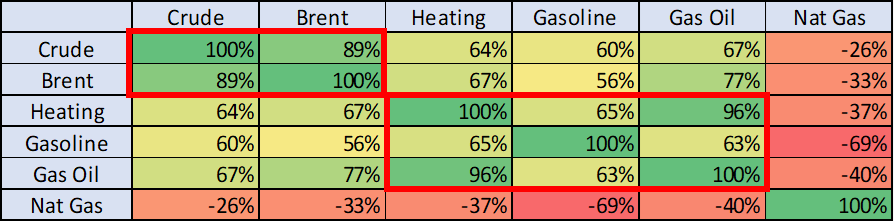
Energy: Correlation Reveals Structure
- Crude Complex
- Crude / Brent (~89% correlation)
- Refined Products
- Heating Oil / Gas Oil (~96%)
- Gasoline linked across the group (~63–65% with others)
- Natural Gas
- Low to negative correlation vs. rest of energy (−26% to −69%)
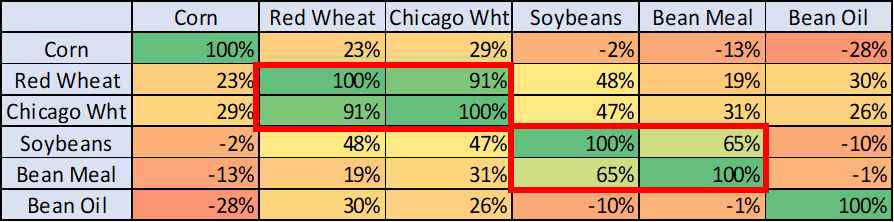
Grains: Two Distinct Clusters + One Outlier
- Wheat Complex
- Chicago Wheat / Red Wheat (~91%)
- Soybean Complex
- Soybeans / Bean Meal (~65%)
- Bean Oil weakly linked to beans and meal (−10% to −1%)
- Corn
- Low or negative correlation to all other grains (−28% to +29%)
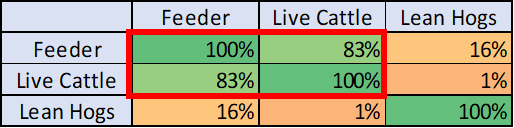
Meats: Production Chain Defines the Group
- Cattle Complex
- Feeder Cattle / Live Cattle (~83%)
- Hogs
- Lean Hogs largely independent (1%–16% correlation)
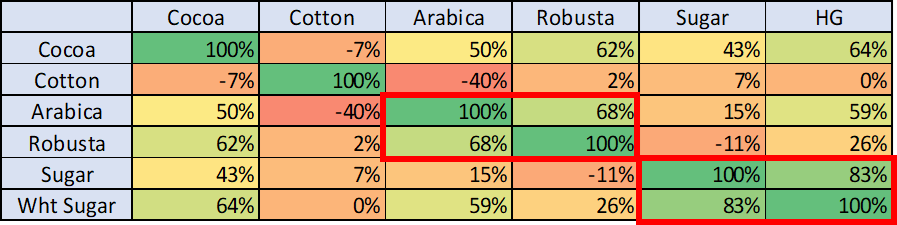
Softs: Hidden Clustering Within a Diverse Group
- Coffee Complex
- Arabica / Robusta (~68%)
- Sugar Complex
- Raw Sugar / White Sugar (~83%)
- Cocoa
- Moderately correlated across multiple markets (43%–64%)
- Cotton
- Low or negative correlation vs. others (−40% to +7%)
Why This Matters
Correlation is not static—it increases under stress. When volatility rises:
- Markets within the same sub-group move together
- Multiple trades behave as a single position
- Portfolio drawdowns accelerate
Sub-group caps address this directly. They force selection within clusters—reducing redundancy while maintaining exposure across truly independent drivers.
Final Thought
Diversification is not achieved by adding more trades. It is achieved by separating exposure across independent structures. Market groups organize the portfolio. Sub-groups define the risk. Managing both is what keeps portfolios stable when conditions change.
Smart Spreads Newsletter
Understanding correlation is one thing. Applying it consistently is another. The Smart Spreads newsletter is built around this exact framework—identifying high-quality seasonal opportunities, structuring trades correctly, and managing portfolio exposure across market groups and sub-groups. Each week focuses not just on what to trade, but how each position fits within the broader portfolio—ensuring diversification is real, not assumed.
If your goal is to build a more stable, structurally aligned portfolio of commodity spreads, Smart Spreads provides a disciplined, data-driven approach to doing exactly that.
More Information
Now you can get two powerful newsletters — for one simple price!
- For stocks and options, the Bull Strangle Newsletter shows you how to combine stock ownership with dual option selling — a disciplined strategy that has consistently outperformed the S&P 500.
- For commodity futures, the Smart Spreads Newsletter focuses on seasonal commodity spreads — a proven, low-correlation approach that thrives in all types of markets.
Each newsletter is designed to deliver consistent income on its own — but when used together, they create a complete, diversified trading approach that works in any market environment.
Visit BullStrangle.com to subscribe for just $1 for the first month.
For a video overview of the Bull Strangle Newsletter
For a video overview of the Smart Spreads Newsletter
Darren Carlat
Dual Edge Research
(214) 636-3133
DualEdgeResearch@gamil.com
Disclaimer
This information is for informational purposes only and should not be considered as investment advice. Past performance is not indicative of future results, and all investments carry inherent risk. Consult with a financial advisor before making any investment decisions.