

Canadian Prime Minister Justin Trudeau delivers a statement after meeting with the National Association of Manufacturers President and CEO in Washington, on Jan. 9.Marko Djurica/Reuters
Here is how things go with Canadian prime ministers: We welcome them in a warm haze of high hopes. We watch them struggle. We realize they don’t have all the answers. We then expel them in an explosion of outrage and disgust.
It happened that way with the unloved Stephen Harper in 2015. Now, a decade later, it is happening with his successor, the equally unloved – for opposite reasons – Justin Trudeau.
Maybe, just maybe, we should ponder whether the real problem isn’t with our leaders but with ourselves.
For nearly a generation now, Canada has struggled to address key challenges such as unaffordable housing, lagging productivity growth and global warming. Both major parties have come up short on these issues in different ways – and that is, at least in part, because of some unchanging political realities.
We should keep that in mind when we review Mr. Trudeau’s record. Sure, he made blunders. But he wasn’t to blame for every cloud in the sky.

Uh-oh, Canada
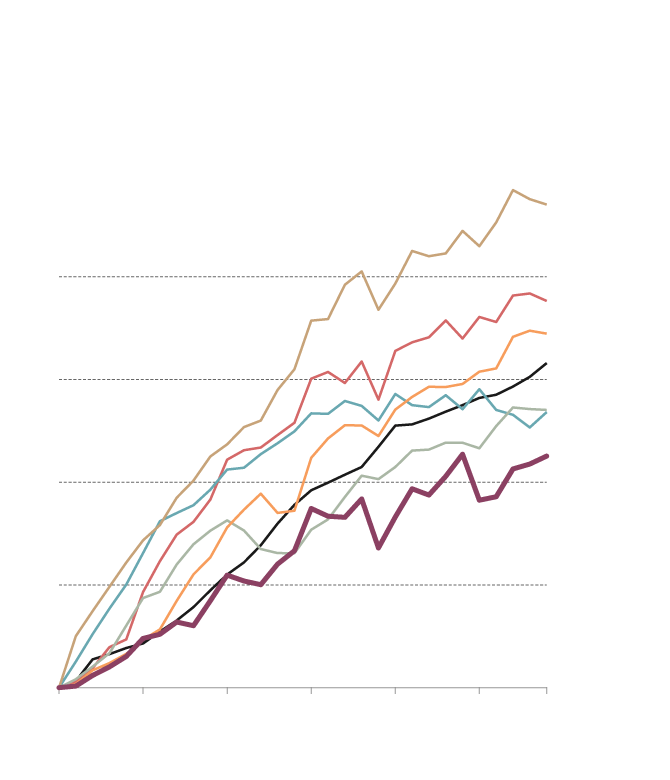
Productivity growth was dismal during the Trudeau years. The bigger
problem? It was also dismal for decades before Trudeau. (Percentage
change in gross domestic product per hour worked, adjusted for
inflation and differences in the cost of living among countries)
Germany
+80%
Britain
France
U.S.
+60%
Italy
Japan
Canada
+40%
+20%
+0%
1990
1995
2000
2005
2010
2015
2019
the globe and mail, Source: our world in data
Uh-oh, Canada
Productivity growth was dismal during the Trudeau years. The bigger
problem? It was also dismal for decades before Trudeau. (Percentage
change in gross domestic product per hour worked, adjusted for
inflation and differences in the cost of living among countries)
Germany
+80%
Britain
France
U.S.
+60%
Italy
Japan
Canada
+40%
+20%
+0%
1990
1995
2000
2005
2010
2015
2019
the globe and mail, Source: our world in data

Uh-oh, Canada
Productivity growth was dismal during the Trudeau years. The bigger problem? It was also dismal for
decades before Trudeau. (Percentage change in gross domestic product per hour worked, adjusted for
inflation and differences in the cost of living among countries)
Germany
+80%
Britain
France
U.S.
+60%
Italy
Japan
Canada
+40%
+20%
+0%
1990
1995
2000
2005
2010
2015
2019
the globe and mail, Source: our world in data
Let’s start with the obvious: The Liberal Leader didn’t cause the wave of inflation that engulfed the world between 2021 and 2023. If anything, Canada’s inflationary crisis was slightly less severe than that in other advanced countries.
And, no, Mr. Trudeau wasn’t responsible for plunging oil prices a decade ago. That, too, was a global affair and one that happened mostly before the Liberals took power in October, 2015. By then, the benchmark price for North American crude oil had already tumbled from more than US$100 a barrel in mid-2014 to below US$50.
How about Mr. Trudeau’s free-spending ways? It’s true he never met a social program he didn’t like, but it’s also true that Canada still boasts an AAA credit rating – the best there is and something the United States and most other G7 countries conspicuously lack.
If you think Canadians suffered under Mr. Trudeau’s rule, ponder this: The median net worth of Canadian households jumped by 44 per cent in real terms during the Trudeau era, according to Statistics Canada’s Survey of Financial Security.
To be sure, none of this means Mr. Trudeau will go down in history as a great prime minister. He committed blunders, the most obvious being his evisceration of Canada’s once-admirable immigration system.
For reasons that remain murky, he tore down a thoughtful framework that focused on recruiting moderate numbers of high-skilled newcomers. He turned it into a free-for-all that allowed an unprecedented torrent of recent arrivals – many of them lower-skilled temporary workers and foreign students – to flood into the job market, displace local workers and send rents soaring.
To make matters worse, he never put forward a coherent plan for addressing Canada’s dysfunctional housing market. He kept saying he wanted to make homes affordable for young buyers while simultaneously insisting that home prices had to remain high to ensure the net worth of older Canadians wasn’t hurt. His equivocating blather impressed no one.
He was equally gormless when it came to devising ways to improve Canada’s dismal record on economic productivity. True, he cut the effective tax rate on business profits, but he did little else to encourage business or improve the government’s scandal-ridden procurement processes.
Will a new prime minister be better at dealing with such problems? Optimists (and partisans) will say yes. More likely the answer is no.
The sad reality is that two diametrically opposed leaders – the skinflint, fossil-fuel-loving, pro-business Mr. Harper and the free-spending, environment-protecting, pro-government Mr. Trudeau – took turns managing the country for nearly 20 years and yet neither was notably effective at making homes affordable or boosting economic productivity.
Why the bipartisan failure? Part of it stems from the fact that voters simply don’t want to face unpleasant realities. Making homes more affordable, for instance, means bringing down the prices of existing homes – something homeowners who are sitting on big capital gains on their primary residences aren’t eager to contemplate.
No astute politician is rushing to antagonize the two-thirds of Canadians who already own a home by engineering a big decline in house prices. So we remain stuck. No matter how much our leaders talk up the need to make homes more affordable, the political calculations lean entirely in the other direction.
Prime ministers also face political challenges when it comes to cutting red tape and boosting productivity. The most obvious way to achieve those praiseworthy goals is to sweep away interprovincial trade barriers and harmonize inconsistent provincial regulations so that entrepreneurs no longer have to navigate a labyrinth of petty, local obstacles to sell their products across Canada.
Unfortunately, achieving free trade within Canada’s own borders is a daunting challenge. It means facing down Canada’s princelings – the premiers – who guard their jurisdictions jealously. Both Mr. Harper and Mr. Trudeau took a crack at reforming Canada’s internal trade (most recently with the 2017 Canadian Free Trade Agreement) “but progress is slow and lists of exemptions to free trade across provinces are long,” according to a recent Royal Bank of Canada report. That’s putting it rather politely.
Given the impediments to change, it’s now reasonable to ask whether any prime minister can truly succeed. That would require an electorate that is willing to embrace real change in areas such as home prices and provincial autonomy. So far, those willing voters seem to be missing in action.