Microsoft's Data Center Footprint Reflects AI Demand: What's Ahead?
Microsoft MSFT is expanding its data center footprint in response to the rising compute intensity of AI workloads. Unlike traditional cloud demand, AI use cases, particularly training and inference, require higher compute density, advanced cooling systems and continuous infrastructure scaling. This shift is driving sustained investment in large-scale data center capacity, with available capacity increasingly becoming a constraint in capturing AI-driven demand at scale.
Microsoft added a GW of data center capacity in the fiscal second quarter, with capital expenditures for the first half of fiscal 2026 totaling $72.4 billion. The expansion is visible in how these data centers are being built and deployed. Facilities are increasingly optimized for GPU-heavy workloads, with interconnected systems designed to improve throughput and reduce latency. The buildout has continued into the third quarter, MSFT planning to acquire approximately 3,200 acres in Cheyenne, WY, for a new facility and separately agreeing to rent 30,000 additional Nvidia Vera Rubin chips from Nscale at a campus in Narvik, Norway, building on a prior $6.2 billion commitment at the same site. These moves reflect a footprint strategy that is both geographically diversified and forward planned, addressing scale requirements while also aligning with data sovereignty needs. Azure grew 39% year over year in the previous quarter, yet demand continued to outpace supply across regions and customer segments.
The Zacks Consensus Estimate for the fiscal third quarter Intelligent Cloud revenues is pegged at $34.2 billion, implying 28.1% year-over-year growth. As AI workloads continue to reshape infrastructure requirements, Microsoft’s expanding data center footprint is expected to remain a key catalyst for effectively converting constrained demand into revenue-generating capacity.
How Amazon and Alphabet Are Approaching the Same Race
Amazon AMZN and Alphabet GOOGL are expanding data center infrastructure at a pace that mirrors Microsoft's buildout urgency, each responding to AI workload demand that continues to outpace available supply. Amazon has committed $200 billion in capital expenditures for 2026, predominantly toward AWS data center capacity, adding nearly four gigawatts of capacity over the past year. Alphabet expects 2026 capital expenditures to be between $175 billion and $185 billion, with Google Cloud redesigning its data center network around GPU-heavy workloads and proprietary TPU infrastructure.
Like Microsoft, both Amazon and Alphabet have flagged persistent supply constraints while expanding geographically to meet sovereignty-driven demand. Against this backdrop, Microsoft’s data center footprint reflects more immediate capacity pressure, with demand already exceeding available supply and expansion focused on closing that gap.
MSFT’s Share Price Performance, Valuation & Estimates
MSFT shares have increased 14.2% in the year-to-date period, while the Zacks Computer – Software industry has returned 12.9% and the Zacks Computer and Technology sector has appreciated 15.2%.
MSFT’s YTD Price Performance
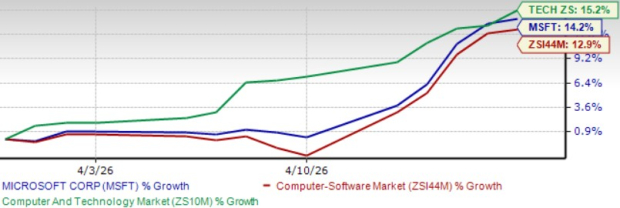
Image Source: Zacks Investment Research
From a valuation standpoint, MSFT stock is currently trading at a forward 12-month Price/Sales ratio of 8.59X compared with the industry’s 7.16X. MSFT has a Value Score of D.
MSFT’s Valuation
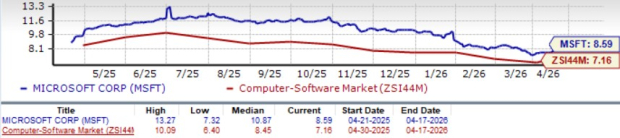
Image Source: Zacks Investment Research
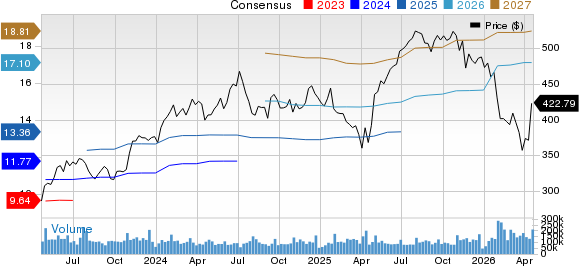
The Zacks Consensus Estimate for MSFT’s fiscal 2026 earnings is pegged at $17.10 per share. The estimate indicates 25.37% year-over-year growth.
Microsoft Corporation Price and Consensus
Microsoft Corporation price-consensus-chart | Microsoft Corporation Quote
Microsoft currently carries a Zacks Rank #3 (Hold). You can see the complete list of today’s Zacks #1 Rank (Strong Buy) stocks here.
Radical New Technology Could Hand Investors Huge Gains
Quantum Computing is the next technological revolution, and it could be even more advanced than AI.
While some believed the technology was years away, it is already present and moving fast. Large hyperscalers, such as Microsoft, Google, Amazon, Oracle, and even Meta and Tesla, are scrambling to integrate quantum computing into their infrastructure.
Senior Stock Strategist Kevin Cook reveals 7 carefully selected stocks poised to dominate the quantum computing landscape in his report, Beyond AI: The Quantum Leap in Computing Power.
Kevin was among the early experts who recognized NVIDIA's enormous potential back in 2016. Now, he has keyed in on what could be "the next big thing" in quantum computing supremacy. Today, you have a rare chance to position your portfolio at the forefront of this opportunity.
See Top Quantum Stocks Now >>This article originally published on Zacks Investment Research (zacks.com).
