Private Credit Squeeze: Billions Trapped as Investors Rush for Exit

The global private credit market, once praised for generating strong yields in a low-interest-rate environment, is now facing a critical stress test. A sharp rise in investor withdrawal requests has brought into focus a core structural tension within the industry, the mismatch between inherently illiquid assets and the promise of periodic liquidity.
According to Bloomberg estimates and data from Robert A Stanger & Co, which was published on Yahoo Finance, investors have attempted to pull roughly $13 billion from private credit funds so far this quarter. However, due to structural limits, only a portion of that capital has been returned, leaving more than $4.6 billion effectively “trapped” inside funds.
This growing backlog of redemption requests is raising fresh concerns about whether private credit funds can meet investor expectations during periods of stress. Hence, shares of several players in the private credit market, including Ares Management Corp. ARES, Apollo Global Management Inc. APO, BlackRock BLK, Blackstone BX and Blue Owl CapitalOWL are trading in the red this year.
Price Performance
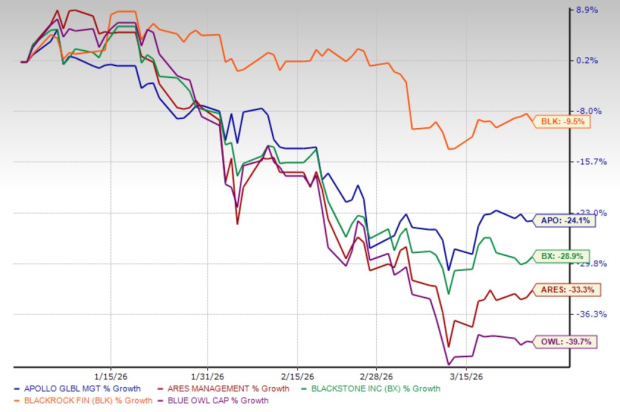 Image Source: Zacks Investment Research
From Boom to Strain: Private Credit Faces a Turning Point
For years, private credit has been one of the fastest-growing and most attractive corners of global finance. Built on the promise of higher returns and flexibility, it stepped in where traditional banks pulled back after the 2008 financial crisis. But today, that same market is beginning to show cracks, which are getting harder to ignore.
At its core, private credit refers to lending done outside the traditional banking system. These lenders, often large asset managers, effectively act like banks, but without the same regulatory constraints. That freedom has allowed the market to balloon to roughly $2 trillion in size, making it a significant, though still somewhat opaque, part of the financial system.
One of the biggest issues now emerging is liquidity concern. Unlike publicly traded assets, private credit investments are not easily sold. This becomes a problem when investors want their money back. Recently, several funds have been hit with rising redemption requests, forcing some to impose withdrawal limits just to maintain stability.
At the same time, there are growing doubts about how these assets are valued. Because private credit loans are not actively traded, pricing them involves estimation rather than real-time market signals. That creates uncertainty, especially during periods of economic uncertainty like higher interest rates, inflation and a geopolitical tension. Many private credit loans are tied to sectors like technology and software, which are now facing disruption from artificial intelligence and shifting demand patterns. If these borrowers begin to struggle, defaults could rise, putting further strain on lenders and investors alike.
The recent developments have reignited debate over whether private credit could pose broader financial risks. Regulators and analysts are increasingly scrutinizing the sector, pointing to opaque valuations, complex structures and rapid growth.
Redemption Wave and Rising Investor Anxiety
Given the concern, investors are heading for the exits. Withdrawal requests from private funds accelerated in the current quarter. This week, MSN reported, citing Bloomberg, that two of the biggest names in private credit, Ares Management and Apollo Global Management, have put a withdrawal cap on their funds. The $10.7 billion Ares Strategic Income Fund capped investor withdrawals at 5% of shares after receiving redemption requests totaling 11.6%. This move came shortly after the $15.1 billion Apollo Debt Solutions fund implemented a similar restriction, following withdrawal requests amounting to 11.2%. When combining APO and ARES funds, the redemption caps will prevent about $1.5 billion from being withdrawn, keeping that capital invested in the funds.
The pressure is also spreading across the alternative-asset spectrum, including BlackRock and Blackstone. Earlier this month, BLK limited withdrawals from a flagship private-credit fund after redemptions surged. BX announced a rise in its redemption cap from 5% to 7% after facing a jump in investor requests.
The world’s largest alternative asset managers, long at the forefront of the private credit boom, are now contending with increasingly cautious investors concerns. The uptick in redemption requests has also sparked fresh debate over whether direct lending is appropriate for investors seeking periodic liquidity, with expectations that these pressures will persist in the coming quarters.
However, major industry figures have pushed back against crisis narratives, emphasizing that default rates remain low and redemption limits are functioning as designed. Blue Owl Capital for instance, has not observed any uptick in defaults across its loan portfolio, according to co-chief executive officer Doug Ostrover.
Speaking at the Asia Pacific Financial and Innovation Symposium in Melbourne, Ostrover stated that OWL is “not seeing an increase in defaults” or “any signs of trouble.” Ostrover also added that he remains cautiously optimistic about the near-term outlook despite growing market concerns.
Final Words on Mounting Private Credit Concerns
The private credit market is at a turning point, as rising redemption pressures expose the trade-off between high returns and limited liquidity. Withdrawal caps by private credit players highlight the strain and the current stress is testing investor confidence. Whether this remains a temporary liquidity challenge or evolves into a deeper issue will depend on how redemption pressures and economic conditions unfold.
Just Released: Zacks Top 10 Stocks for 2026
Hurry – you can still get in early on our 10 top tickers for 2026. Handpicked by Zacks Director of Research Sheraz Mian, this portfolio has been stunningly and consistently successful.
From inception in 2012 through November, 2025, the Zacks Top 10 Stocks gained +2,530.8%, more than QUADRUPLING the S&P 500’s +570.3%.
Sheraz has combed through 4,400 companies covered by the Zacks Rank and handpicked the best 10 to buy and hold in 2026. You can still be among the first to see these just-released stocks with enormous potential.
See New Top 10 Stocks >>Want the latest recommendations from Zacks Investment Research? Today, you can download 7 Best Stocks for the Next 30 Days. Click to get this free report
Blackstone Inc. (BX): Free Stock Analysis Report
BlackRock (BLK): Free Stock Analysis Report
Apollo Global Management Inc. (APO): Free Stock Analysis Report
Ares Management Corporation (ARES): Free Stock Analysis Report
Blue Owl Capital Inc. (OWL): Free Stock Analysis Report
This article originally published on Zacks Investment Research (zacks.com).
