Should You Sell OWL Stock at 9.24X Earnings and a 22.5-Cent Dividend?

Blue Owl CapitalOWL has slid sharply over the past year, putting valuation and cash returns in the spotlight. The stock now trades at a discounted earnings multiple, while management continues to emphasize fundraising, deployment, and capital return.
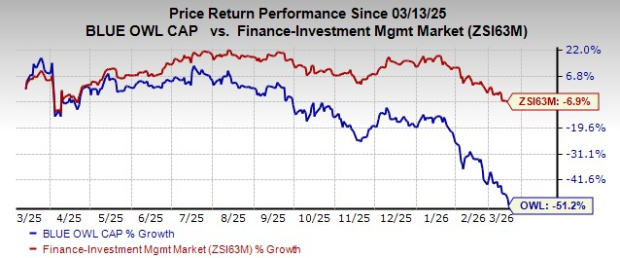
Image Source: Zacks Investment Research
The key question for investors is whether the low multiple is a mispricing or a warning sign tied to private credit sentiment and redemption dynamics.
OWL’s Valuation
Blue Owl is currently valued at 9.24X forward 12-month earnings, which is below the industry average of 12.58X.
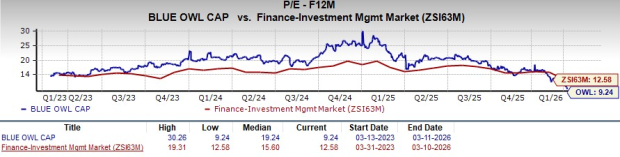
Image Source: Zacks Investment Research
The discount looks even starker against the stock’s own history. Over the past three years, OWL shares have traded as high as 30.26X and as low as 9.24X, with a five-year median of 19.24X.
Blue Owl is often compared with larger alternative asset managers like Blackstone BX and Ares ManagementARES when thinking about fee durability and cycle risk, even if business mixes differ. At present, Blackstone and Ares Management are trading at 16.05X and 15.25X forward 12-month earnings, respectively.
Blue Owl’s Rating Signals and Style Scores Snapshot
The short-term signal for OWL is decisively negative: Zacks Rank 5 (Strong Sell).
You can see the complete list of today’s Zacks #1 Rank (Strong Buy) stocks here.
Blue Owl’s style scores add nuance. The stock carries a VGM score of B, with Value D, Growth B, and Momentum C.
This blend fits the broader setup. Blue Owl shows growth attributes in the way the platform is scaling, but the Value score is not confirming bargain appeal in the current tape. Meanwhile, Momentum is middling, which can be consistent with a stock that looks statistically inexpensive yet struggles to attract incremental buyers until the fundamental debate clears.
Blue Owl’s Dividend, Buybacks, and Cash Returns
Income investors have a clear datapoint. Blue Owl declared a quarterly dividend of 22.5 cents per Class A share on Feb. 5, 2026, and it was paid on March 2 to shareholders of record as of Feb. 20.
The company has also used buybacks. In the fourth quarter, Blue Owl repurchased 3.6 million shares for $52 million. Together, dividends and repurchases can support a total-return narrative, especially when the stock is under pressure. The counterweight is that cash returns do not eliminate the need for steady fundraising, clean credit performance, and timely deployment to sustain longer-run earnings power.
OWL Earnings Mix Shows Where Fees Are Growing
For 2025, Blue Owl reported GAAP revenue of $2.87 billion, up 25% year over year. GAAP diluted earnings per share were 10 cents, down from 20 cents in 2024. On profitability measures tied to management fees, Fee-Related Earnings (FRE) were $1.50 billion, up 19%, with a 58.3% margin. Distributable Earnings reached $1.31 billion, up 16%.
Management fees were the primary growth engine, with GAAP management fees rising to $2.52 billion. This was linked to higher fee-paying assets across Credit, Real Assets, and GP Strategic Capital.
On the platform view, FRE revenues rose 19% to $1.62 billion in Credit, while Real Assets FRE revenue more than doubled to $394 million, and GP Strategic Capital FRE revenue increased to $645 million.
Blue Owl’s Catalysts and Deal Breakers for 2026
Several potential catalysts stand out. Management expects 2026 fundraising to look broadly similar to 2025, with Digital Infrastructure Fund IV returning to market, and continued scaling of evergreen wealth products as another growth lane. These initiatives are expected to translate into steadier inflows and more consistent fee-paying asset growth.
The risks are equally clear. Near-term headwinds center on private credit liquidity and sentiment risk, including elevated redemption requests in retail-oriented vehicles and the potential for spillover across the sector. The risk list also includes delayed deployment timing, borrower-quality concerns, and elevated expenses.
For investors weighing whether to sell or hold, the practical framework is flow-driven. A more constructive case depends on improving net flows and cleaner deployment execution, reinforcing the fee engine. A more defensive stance becomes easier to justify if redemptions intensify or credit quality worries rise, keeping sentiment fragile and limiting the stock’s ability to re-rate.
Research Chief Names "Single Best Pick to Double"
From thousands of stocks, 5 Zacks experts each have chosen their favorite to skyrocket +100% or more in months to come. From those 5, Director of Research Sheraz Mian hand-picks one to have the most explosive upside of all.
This company targets millennial and Gen Z audiences, generating nearly $1 billion in revenue last quarter alone. A recent pullback makes now an ideal time to jump aboard. Of course, all our elite picks aren’t winners but this one could far surpass earlier Zacks’ Stocks Set to Double like Nano-X Imaging which shot up +129.6% in little more than 9 months.
Free: See Our Top Stock And 4 Runners UpWant the latest recommendations from Zacks Investment Research? Today, you can download 7 Best Stocks for the Next 30 Days. Click to get this free report
Blackstone Inc. (BX): Free Stock Analysis Report
Ares Management Corporation (ARES): Free Stock Analysis Report
Blue Owl Capital Inc. (OWL): Free Stock Analysis Report
This article originally published on Zacks Investment Research (zacks.com).
