MRK Surpasses 50- & 200-Day SMAs: Buy, Hold or Sell at Current Levels?

Merck’s MRK stock is trading above its 50-day and 200-day simple moving averages (SMAs), a positive technical signal that points to strengthening investor sentiment. While it has been trading above the 200-day SMA since October last year, it has started trading above the 50-day SMA since mid-June.
The 200-day SMA is widely regarded as a measure of the stock’s long-term trend, and sustained trading above this level typically indicates continued institutional buying and confidence in the company’s long-term earnings outlook. Meanwhile, the stock has also reclaimed its 50-day SMA, reflecting improving short-term momentum, driven by a series of positive business developments and renewed optimism around its growth prospects.
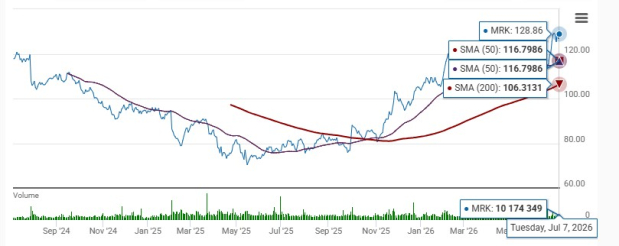 Image Source: Zacks Investment Research
That said, bullish technical indicators alone do not guarantee further upside. A stock’s long-term performance ultimately depends on the strength of its underlying fundamentals, including earnings growth, product portfolio, pipeline execution and valuation.
To make an investment decision, it is important to weigh the company’s key strengths against the risks that could influence its future performance. Let’s take a closer look.
Keytruda: Merck’s Biggest Strength
Merck boasts more than six blockbuster drugs in its portfolio, with Keytruda being the key top-line driver. Keytruda, approved for several types of cancer, alone accounts for around 55% of the company’s pharmaceutical sales. Keytruda now holds 44 FDA-approved indications spanning 19 tumor types, along with two tumor-agnostic approvals.
The drug has played an instrumental role in driving Merck’s steady revenue growth over the past few years. Keytruda sales are gaining from continued strong momentum in metastatic indications and rapid uptake across earlier-stage launches. The company expects the growth to continue till it loses patent exclusivity in 2028. Moreover, more than 2,800 clinical studies are currently evaluating Keytruda across multiple cancer types and treatment settings.
Merck is working on different strategies to drive Keytruda's long-term growth. These include innovative immuno-oncology combinations, including Keytruda with LAG3 and CTLA-4 inhibitors. In partnership with ModernaMRNA, Merck is developing a personalized mRNA therapeutic cancer vaccine called intismeran autogene (V940/mRNA-4157) in combination with Keytruda in pivotal phase III studiesfor earlier-stage and adjuvant NSCLC and adjuvant melanoma.
Merck expects Keytruda to achieve peak sales of $35 billion by 2028. Merck’s other oncology drugs, Welireg, AstraZeneca AZN-partnered Lynparza and Eisai-partnered Lenvima, are also contributing to top-line growth.
Merck’s Animal Health business is also a key contributor to its top-line growth, with sales expected to more than double by mid-2030s.
MRK’s Pipeline Progress & Recent M&A Spree
Merck’s expanding drug pipeline and potential new blockbuster drugs beyond Keytruda look encouraging.
Its phase III pipeline has almost tripled since 2021, supported by in-house progress as well as the addition of candidates through M&A deals. Merck expects to launch 20 new drugs by 2030, with many already launched.
Its new products, pulmonary arterial hypertension drug, Winrevair, cancer drug, Welireg and 21-valent pneumococcal conjugate vaccine, Capvaxive, have begun to contribute significantly to top-line growth.
Merck’s RSV antibody, Enflonsia (clesrovimab), was approved in the United States in June 2025 and in the EU in April 2026. A once-daily, single-tablet two-drug regimen of doravirine and islatravir, Idvynso, was approved in the United States for virologically suppressed HIV-1 in April 2026.
The company has other promising candidates in its late-stage pipeline, such as enlicitide decanoate/MK-0616, an oral PCSK9 inhibitor for hypercholesterolemia, tulisokibart, a TL1A inhibitor for ulcerative colitis and Daiichi-Sankyo-partnered antibody-drug conjugates.
Merck has been actively pursuing acquisitions as it prepares for the 2028 patent expiration of Keytruda. Its 2025 acquisition of Verona Pharma added Ohtuvayre, a first-in-class maintenance therapy for chronic obstructive pulmonary disease with multibillion-dollar sales potential that has enjoyed a strong commercial launch. In 2026, Merck further strengthened its pipeline by acquiring Cidara Therapeutics, adding the late-stage influenza candidate MK-1406, and Terns Pharmaceuticals, bringing in TERN-701, a promising chronic myeloid leukemia therapy with blockbuster potential.
Declining Sales of MRK’s Gardasil & Other Vaccines
Sales of Merck’s second-largest product, its HPV vaccine, Gardasil, are declining due to continued weak sales performance in China. Sales of Gardasil are declining in China due to weak demand trends amid an economic slowdown. The company is also seeing lower demand for the vaccine in Japan. Gardasil sales are not expected to improve in 2026.
Sales of some other Merck vaccines, like Proquad, M-M-R II, Varivax, Rotateq and Vaxneuvance, also declined in the first quarter.
MRK’s Keytruda Faces Patent Expiration in 2028
Merck is heavily reliant on Keytruda. Though Keytruda may be Merck’s biggest strength and a solid reason to own the stock, the company is excessively dependent on the drug. Keytruda’s core U.S. patent is expected to expire around 2028, with additional patents expiring slightly after that. Keytruda is expected to face significant biosimilar competition around 2028-2029. Once biosimilars enter, Keytruda’s sales are likely to decline sharply.
Also, competitive pressure might increase for Keytruda in the near future from dual PD-1/VEGF inhibitors that inhibit both the PD-1 pathway and the VEGF pathway at once. They are designed to overcome the limitations of single-target therapies like Keytruda.
MRK’s Generic Headwinds in 2026
MRK is seeing declining demand for its diabetes products (Januvia/Janumet) and the generic erosion of some drugs like Isentress/Isentress HD and Bridion in the European Union and Dificid in the United States. Bridion is expected to lose patent exclusivity in the United States in July 2026, and sales are expected to significantly decline thereafter. Sales of Januvia/Janumet are expected to decline steeply from 2026 onward due to government price setting, an anticipated patent expiry in 2026 and ongoing competitive pressure.
In 2026, Merck expects generic competition for Januvia/Janumet, Bridion and Dificid to hurt revenues by approximately $2.5 billion.
MRK Share Price, Valuation & Estimates
Merck’s shares have risen 24.2% so far this year compared with an increase of 13.3% for the industry. The stock has also outperformed the sector as well as the S&P 500 index, as seen in the chart below.
Merck Stock Outperforms Industry, Sector & S&P 500
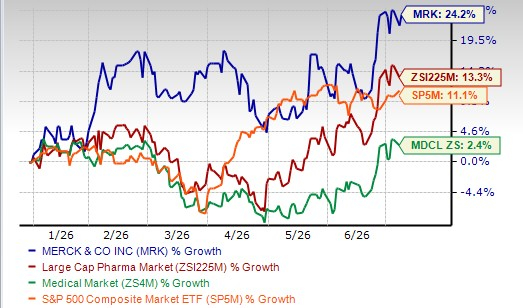 Image Source: Zacks Investment Research
From a valuation standpoint, Merck looks reasonably priced. Going by the price/earnings ratio, the company’s shares currently trade at 16.92 forward earnings, lower than 18.78 for the industry. However, the stock is trading above its 5-year mean of 12.81.
MRK Stock Valuation
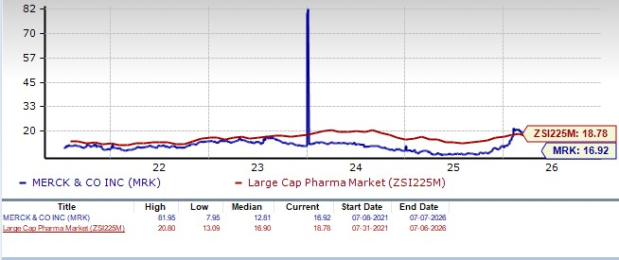 Image Source: Zacks Investment Research
Estimates for MRK’s 2026 earnings have risen from $4.76 to $5.19 per share over the past 60 days, while those for 2027 have risen from $9.80 per share to $9.89 per share.
MRK Estimate Movement
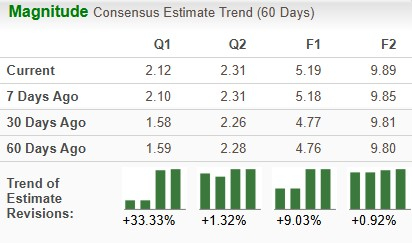 Image Source: Zacks Investment Research
Stay Invested in MRK Stock
Merck has one of the world’s best-selling drugs in its portfolio, generating billions of dollars in revenues. Though Keytruda will lose patent exclusivity in 2028, its sales are expected to remain strong until then.
Merck expects over $70 billion of potential non-risk-adjusted commercial opportunity for the current pipeline by the mid-2030s. This estimate is more than double the peak consensus sales estimate for Keytruda of $35 billion in 2028.
Merckfaces several near-term challenges, including persistent challenges for Gardasil in China, potential competition for Keytruda, and rising competitive and generic pressure on some of its drugs. However, itsnew products, strong progress in its pipeline, and business development and acquisitions have increased confidence that Merck may be able to maintain growth even after Keytruda loses exclusivity.
The fact that the stock trades above both its 50-day and 200-day SMAs reflects improving investor confidence in the company's near- and long-term outlook
Investors may continue retaining this Zacks Rank #3 (Hold) stock on this improved outlook. You can see the complete list of today’s Zacks #1 Rank (Strong Buy) stocks here.
Beyond Nvidia: AI's Second Wave Is Here
The AI revolution has already minted millionaires. But the stocks everyone knows about aren't likely to keep delivering the biggest profits. AI’s second wave is moving from infrastructure to implementation and these companies are at the forefront of this transition, positioned to become what Amazon and Google were to the internet era.
See Stocks Now >>This article originally published on Zacks Investment Research (zacks.com).
