Capital One (NYSE:COF) Misses Q1 CY2026 Sales Expectations
Financial services company Capital One (NYSE:COF) missed Wall Street’s revenue expectations in Q1 CY2026, but sales rose 52.3% year on year to $15.23 billion. Its non-GAAP profit of $4.42 per share was 3.3% below analysts’ consensus estimates.
Is now the time to buy Capital One? Find out by accessing our full research report, it’s free.
Capital One (COF) Q1 CY2026 Highlights:
- Net Interest Margin: 7.9% vs analyst estimates of 8.2% (30.6 basis point miss)
- Revenue: $15.23 billion vs analyst estimates of $15.4 billion (52.3% year-on-year growth, 1.1% miss)
- Efficiency Ratio: 55.6% vs analyst estimates of 52.9% (268.2 basis point miss)
- Adjusted EPS: $4.42 vs analyst expectations of $4.57 (3.3% miss)
- Tangible Book Value per Share: $107.76 vs analyst estimates of $110.32 (4.9% year-on-year decline, 2.3% miss)
- Market Capitalization: $127.3 billion
Company Overview
Starting as a credit card company in 1988 before expanding into a full-service bank, Capital One (NYSE:COF) is a financial services company that offers credit cards, auto loans, banking services, and commercial lending to consumers and businesses.
Revenue Growth
A company’s long-term performance is an indicator of its overall quality. Any business can have short-term success, but a top-tier one grows for years. Thankfully, Capital One’s 15.7% annualized revenue growth over the last five years was impressive. Its growth beat the average financials company and shows its offerings resonate with customers, a helpful starting point for our analysis.
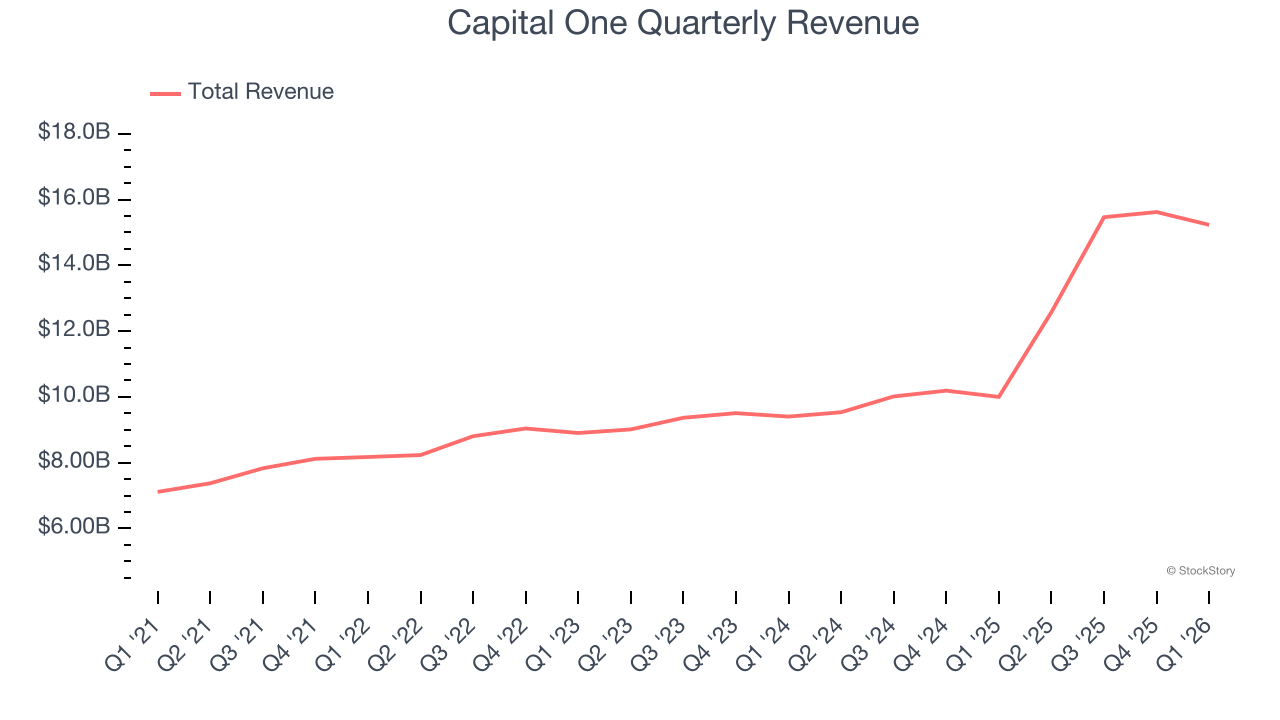
We at StockStory place the most emphasis on long-term growth, but within financials, a half-decade historical view may miss recent interest rate changes, market returns, and industry trends. Capital One’s annualized revenue growth of 25.7% over the last two years is above its five-year trend, suggesting its demand was strong and recently accelerated. 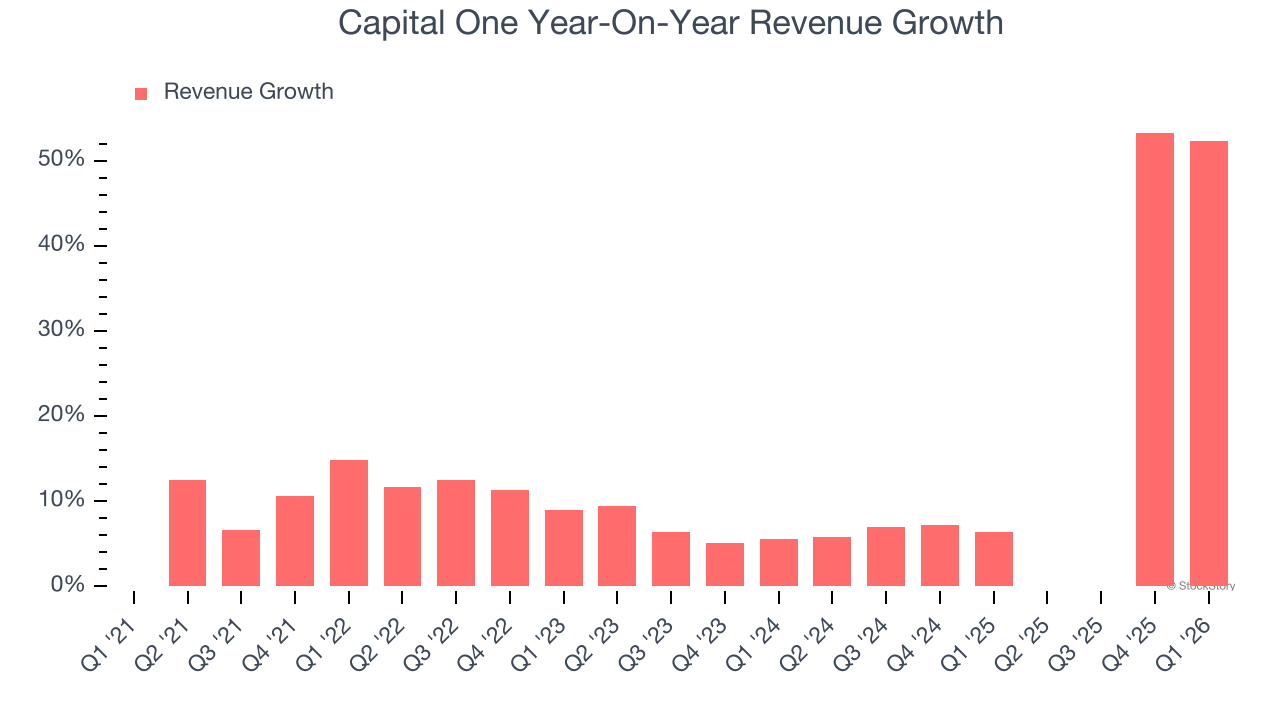 Note: Quarters not shown were determined to be outliers, impacted by outsized investment gains/losses that are not indicative of the recurring fundamentals of the business.
This quarter, Capital One achieved a magnificent 52.3% year-on-year revenue growth rate, but its $15.23 billion of revenue fell short of Wall Street’s lofty estimates.
ONE MORE THING: The $21 AI Application Stock Wall Street Forgot. While Wall Street obsesses over who’s building AI, one company is already using it to print money. And nobody’s paying attention.
AI chip stocks trade at ridiculous valuations. This company processes a trillion consumer signals monthly using AI and trades at a third of the price. The gap won’t last. The institutions will figure it out. You need to see this first. Read the FREE Report Before They Notice.
Tangible Book Value Per Share (TBVPS)
Financial institutions with multiple business lines manage complex balance sheets that span various financial activities. Market valuations reflect this operational complexity, prioritizing balance sheet strength and sustainable book value growth across all business segments.
This explains why tangible book value per share (TBVPS) is a premier metric for the sector. TBVPS provides concrete per-share net worth that investors can trust when evaluating companies with complex, multi-faceted business models. Traditional metrics like EPS are helpful but face distortion from the complexity of diversified operations, M&A activity, and various accounting rules that can obscure true performance across multiple business lines.
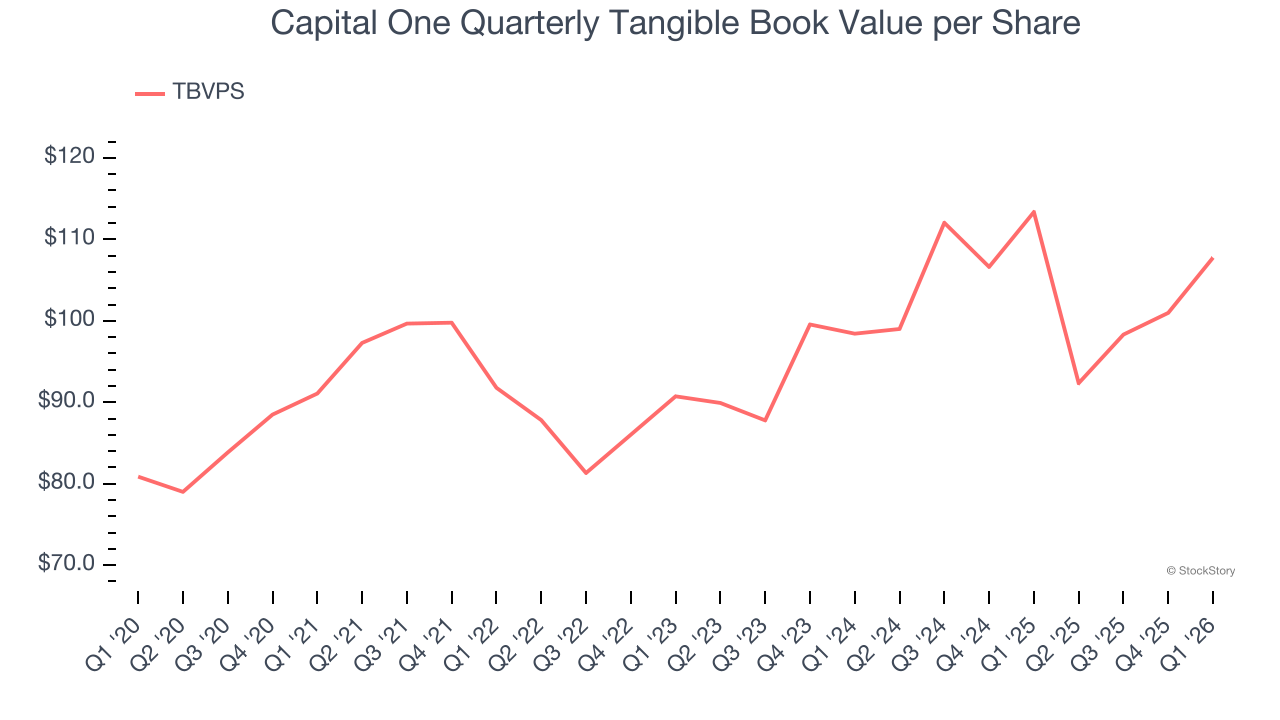
Capital One’s TBVPS grew at a sluggish 3.4% annual clip over the last five years. However, TBVPS growth has accelerated recently, growing by 4.6% annually over the last two years from $98.42 to $107.76 per share.
Tangible Book Value Per Share (TBVPS)
Diversified financial companies operate across multiple business segments, from investment banking and trading to wealth management and specialized lending. Their valuations hinge on balance sheet quality and the ability to compound shareholder equity across these diverse operations.
Because of this, tangible book value per share (TBVPS) emerges as the critical performance benchmark for the sector. This metric captures real, liquid net worth per share that reflects the institution’s overall financial health across all business lines. On the other hand, EPS is often distorted by the diverse nature of operations, mergers, and various accounting treatments across different business units. Book value provides clearer performance insights.
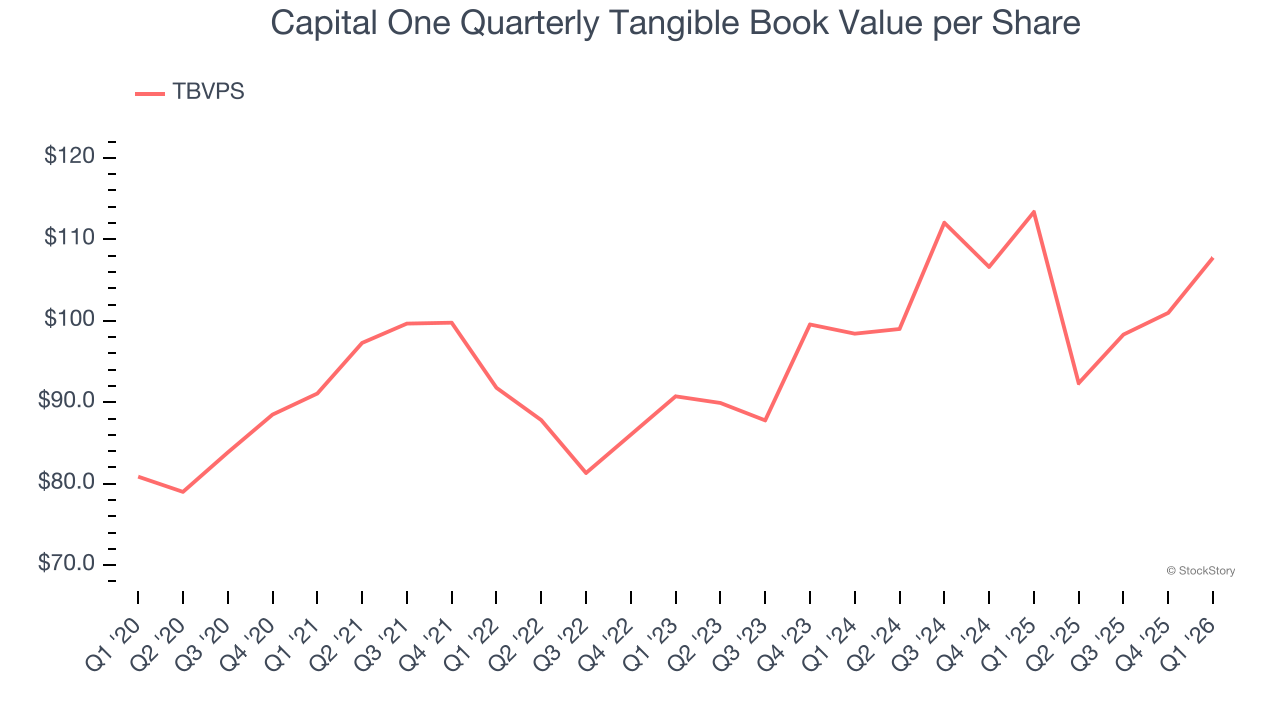
Capital One’s TBVPS grew at a sluggish 3.4% annual clip over the last five years. However, TBVPS growth has accelerated recently, growing by 4.6% annually over the last two years from $98.42 to $107.76 per share.
Key Takeaways from Capital One’s Q1 Results
We enjoyed seeing Capital One beat analysts’ efficiency ratio expectations this quarter. On the other hand, its net interest margin missed and its EPS fell short of Wall Street’s estimates. Overall, this quarter could have been better. The stock traded down 4.9% to $193.00 immediately following the results.
Capital One didn’t show it’s best hand this quarter, but does that create an opportunity to buy the stock right now? The latest quarter does matter, but not nearly as much as longer-term fundamentals and valuation, when deciding if the stock is a buy. We cover that in our actionable full research report which you can read here (it’s free).
