3 Software Stocks to Watch as the Industry Gains Momentum

At the same time, rapid advances in artificial intelligence (“AI”) and machine learning (“ML”) are reshaping the industry. The cutting-edge technologies are being swiftly integrated into enterprise and consumer applications. Software vendors are increasingly embedding generative AI into productivity tools, customer service platforms and enterprise resource planning systems. Per a Precedence Research report, the global software market is expected to witness a CAGR of 11.6% from 2026 to 2035 to reach 2,468.93 billion. These trends augur well for industry participants, such as Pegasystems PEGA, The Descartes Systems Group Inc.DSGX and Commvault Systems Inc. CVLT.
However, the sector is not without challenges. Uncertainty prevailing over global macroeconomic conditions continues to be concerning for the participants, as this might upend IT budgets. The software industry remains highly competitive, particularly in AI areas, which can lead to pricing pressure that could impact margins. Despite these headwinds, the industry's evolving trends point to sustained momentum ahead.
Industry Description
The Zacks Computer Software industry includes companies that provide software applications related to AI, cloud computing, electronic design automation (primarily for semiconductor and electronics industries), digital media and marketing, customer relationship management, on-premises and cloud-based database management, accounting and tax purposes, human capital management, cybersecurity and application performance monitoring and a cloud-based enterprise communications platform. Some companies develop and market simulation software (like computer-aided design or CAD, 3D modeling, product lifecycle management or PLM, data orchestration and experience creation), which engineers, designers and researchers use across various industries like architecture, engineering and construction, product design, manufacturing and digital media.
3 Trends Shaping the Future of the Software Industry
Higher Spending on AI and Cloud: Cloud computing will continue to be a dominant force in the software industry, with businesses adopting hybrid and multi-cloud environments to meet their growing needs for flexibility and scalability. Cloud offers a flexible and cost-effective platform for developing and testing applications. The deployment time is also shorter compared with legacy systems. SaaS companies are expected to register strong top-line growth on a higher percentage of recurring revenues, subscription gross margin and a lower churn rate.
However, AI, Generative AI, in particular, is now becoming the defining force behind the next chapter of software evolution. The continued investment in AI, big data and analytics, and the ongoing adoption of SaaS open up opportunities for these players. Going forward, AI and ML tech are expected to be widely integrated into the software tools. This increasing demand for AI-powered software tools for automation, personalization, predictive analytics and decision-making augurs well.
According to a report from Gartner, worldwide IT spending is projected to reach $6.15 trillion in 2026, calling for an increase of 10.8% from 2025 levels. Spending on AI-related hardware and software continues to be rising added Gartner, while server spending is anticipated to surge 36.9% year over year in 2026.
Increased Cybersecurity Focus: The increasing need to secure cloud platforms amid growing cyberattacks and hacking incidents drives demand for cybersecurity software. As software becomes more interconnected, cloud-native and AI-powered, it is driving the demand for performance management monitoring tools that are scalable and suitable for cloud-based environments. Zero-trust architectures, identity and access management and real-time threat detection powered by AI are becoming essential features of modern software platforms.
Macroeconomic Headwinds a Concern: Global macroeconomic weakness and volatile supply-chain dynamics are persistent concerns. Though tariff troubles are unlikely to affect the software industry directly, higher tariffs on hardware would lead to higher costs. This would affect the software pricing as well. Inflation could affect spending across small and medium-sized businesses globally. The uncertainty in business visibility could dent the industry’s performance in the near term.
Zacks Industry Rank Indicates Bright Prospects
The Zacks Computer Software industry is housed within the broader Zacks Computer and Technology sector. It carries a Zacks Industry Rank #85, which places it in the top 35% of more than 243 Zacks industries.
The group’s Zacks Industry Rank, which is the average of the Zacks Rank of all the member stocks, indicates bright near-term prospects. Our research shows that the top 50% of the Zacks-ranked industries outperform the bottom 50% by a factor of more than two to one.
Before we present a few stocks you may want to consider for your portfolio, given their bright prospects, let us look at the industry’s recent stock-market performance and valuation picture.
Industry Underperforms the Sector and the S&P 500
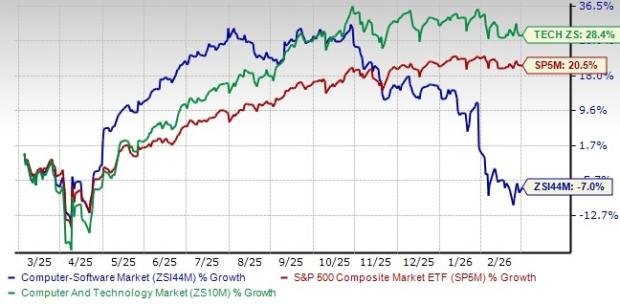
The Zacks Computer Software industry has underperformed the broader Zacks Computer and Technology sector and the S&P 500 Index in the past year.
The industry has lost 7% over this period against the S&P 500 and the broader sector’s increase of 20.5% and 28.4%, respectively.
One-Year Price Performance
Industry's Current Valuation
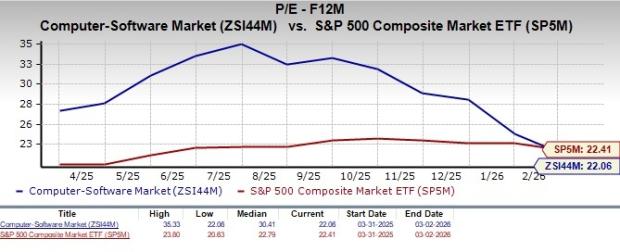
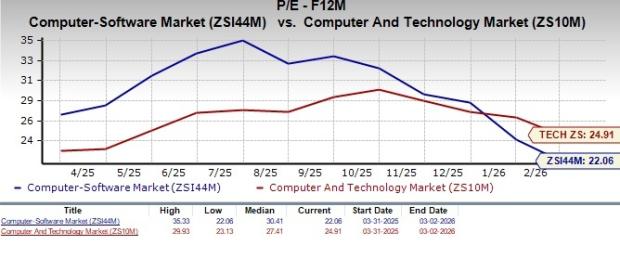
Based on the forward 12-month P/E, a commonly used multiple for valuing software companies, we see that the industry is currently trading at 22.06X compared with the S&P 500’s 22.41X. It is also down from the sector’s forward-12-month P/E of 24.91X.
In the past five years, the industry has traded as high as 35.33X and as low as 22.06X, with the median being 30.41X, as the chart below shows.
Forward 12-Month Price-to-Earnings (P/E) Ratio
3 Software Stocks to Boost Portfolio Returns
Pegasystems is an AI-powered enterprise software provider that helps global organizations transform their businesses through advanced decision-making and a workflow automation platform.
PEGA recently reported fourth-quarter 2025 results wherein revenues of $504.3 million increased 3% year over year. The company has transitioned toward a cloud-based subscription model, improving revenue visibility and recurring revenue mix. Pega Cloud’s Annual Contract Value (“ACV”) increased 33% year over year in the fourth quarter. Total ACV increased 17% year over year on a reported and 14% on a constant-currency basis, reaching $1.608 billion.
Pega Cloud backlog grew 36% year over year while overall backlog was up 28%, topping the $2 billion mark for the first time. Pega cloud ACV now represents more than 50% of total ACV and cloud backlog accounts for 74% of total backlog.
Increasing traction for its AI design agent, PEGA Blueprint, bodes well. Management noted that PEGA cloud ACV growth was driven by both its cloud-first strategy and Blueprint. PEGA expects cloud revenue growth to continue accelerating above 30% in 2026, while total revenues are projected to grow 15% to a robust $2 billion.
PEGA currently sports a Zacks Rank #1 (Strong Buy).
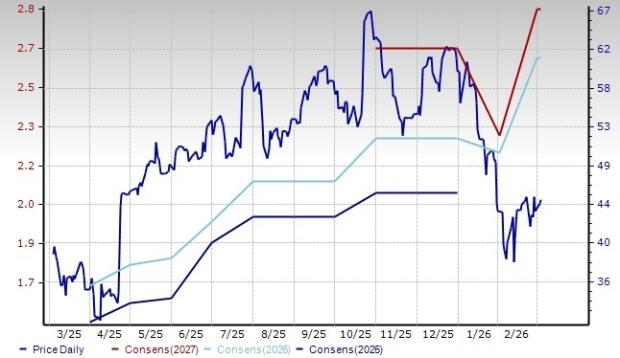
The Zacks Consensus Estimate for the company’s fiscal 2026 earnings is pegged at $2.63 per share, indicating year-over-year growth of 25.2%. The stock has gained 13.5% in the past year.
Price and Consensus: PEGA
Accelerating subscription and SaaS revenues are creating a favorable mix shift. In the third quarter of fiscal 2026, CVLT reported 30% year over year subscription revenue growth to $206 million, driving total revenues up 19% to $314 million. It added more than 700 new subscription customers in the last reported quarter. SaaS revenues surged 44%, reflecting strong cloud adoption.
Subscription ARR was up 28% to $941 million, while SaaS ARR jumped 40% to $364 million. Subscription ARR now represents 87% of total ARR. This suggests a shift toward recurring revenue streams and higher visibility.
The launch of the Commvault Cloud Unity platform, enabled by Metallic AI fabric, positions the company at the center of AI-driven cyber resilience.
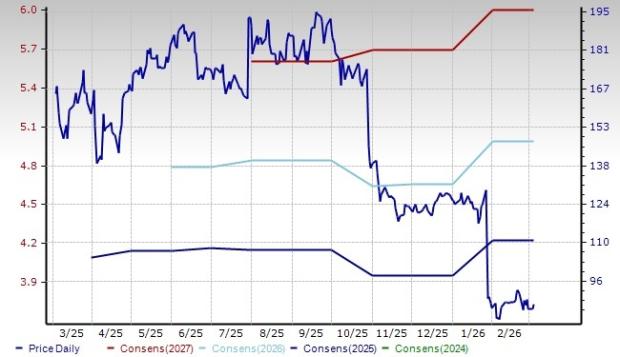
CVLT currently flaunts a Zacks Rank #1. The Zacks Consensus Estimate for the company’s fiscal 2026 earnings is pegged at $4.19 per share, indicating year-over-year growth of 14.8%. The stock has declined 47.3% in the past year.
Price and Consensus: CVLT
DSGX is gaining from healthy customer demand for its solutions, expanding its presence across the global logistics landscape. Services revenues, which are recurring and make up the largest portion of its business, continued to be the key performance driver. Synergies from acquisitions, including 3GTMS and Finale, bode well.
Descartes’ acquisition of Finale, Inc., a U.S.-based cloud-based inventory management provider serving e-commerce businesses, in August 2025, bodes well. The deal cost about $39.2 million in cash and up to $15 million in contingent payouts if Finale meets two-year revenue targets post-acquisition. This acquisition aligns with DSGX’s strategy to expand its cloud-based solutions and content offerings while strengthening the GLN ecosystem.
DSGX is slated to report fourth-quarter fiscal 2026 earnings on March 11. As of Nov. 1, 2025, using current FX rates and factoring in the Finale acquisition, DSGX estimated fourth-quarter fiscal 2026 baseline revenues of about $161 million and baseline operating expenses of roughly $98.5 million. This implies a baseline-adjusted EBITDA of roughly $62.5 million, or about 39% of baseline revenues as of Nov. 1, 2025. Margins may fluctuate depending on revenue mix, FX rates and acquisition integration.
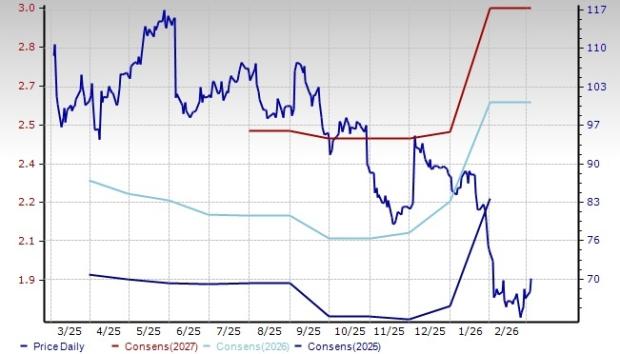
DSGX currently carries a Zacks Rank #2 (Buy). The Zacks Consensus Estimate for the company’s fiscal 2026 earnings is pegged at $2.26 per share, indicating year-over-year growth of 37.8%. The stock has declined 36% in the past year.
Price and Consensus: DSGX
Free Report: Profiting from the 2nd Wave of AI Explosion
The next phase of the AI explosion is poised to create significant wealth for investors, especially those who get in early. It will add literally trillion of dollars to the economy and revolutionize nearly every part of our lives.
Investors who bought shares like Nvidia at the right time have had a shot at huge gains.
But the rocket ride in the "first wave" of AI stocks may soon come to an end. The sharp upward trajectory of these stocks will begin to level off, leaving exponential growth to a new wave of cutting-edge companies.
Zacks' AI Boom 2.0: The Second Wave report reveals 4 under-the-radar companies that may soon be shining stars of AI’s next leap forward.
Access AI Boom 2.0 now, absolutely free >>Want the latest recommendations from Zacks Investment Research? Today, you can download 7 Best Stocks for the Next 30 Days. Click to get this free report
Pegasystems Inc. (PEGA): Free Stock Analysis Report
CommVault Systems, Inc. (CVLT): Free Stock Analysis Report
The Descartes Systems Group Inc. (DSGX): Free Stock Analysis Report
This article originally published on Zacks Investment Research (zacks.com).
