Key Points
U.S. EV registrations declined for the first time in a decade last year.
Tesla's massive market share lead is slowly dwindling.
General Motors' Cadillac was a rare bright spot in gloomy December data.
Last year was a bit challenging for the U.S. electric vehicle (EV) industry. A combination of factors that include the expiration of federal tax credits, historically higher interest rates, higher prices, and lingering concerns of inadequate charging infrastructure were speed bumps for the industry. In fact, EV registrations fell in 2025 for the first time in a decade.
The big question is: Should investors bank on a quick rebound in sales to drive EV stocks higher?
Will AI create the world's first trillionaire? Our team just released a report on the one little-known company, called an "Indispensable Monopoly" providing the critical technology Nvidia and Intel both need. Continue »
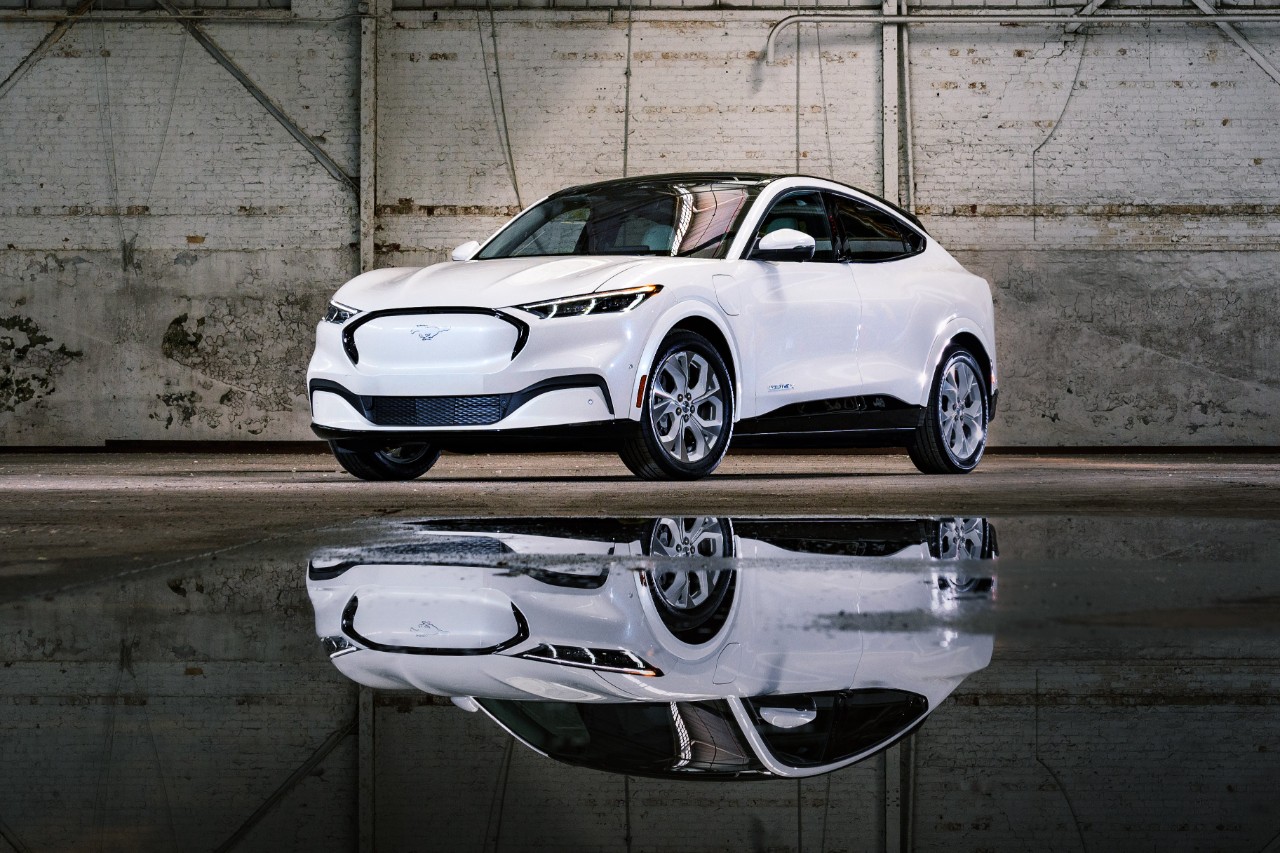
Image source: Ford Motor Company.
December plunge
U.S. registration data serves as a proxy for sales, as a number of EV makers, including Tesla(NASDAQ: TSLA), don't break out U.S. deliveries from global numbers, and some automakers don't report on a monthly basis.
Last year, U.S. EV registrations declined for the first time in a decade, dipping just a slight 0.4% below the prior year but a mile behind the growth rates of 11% and 52% in 2024 and 2023, respectively. December registrations quickly spiraled 48% lower compared to the prior year, driven by the expiration of the $7,500 federal EV tax credit. The EV share of the U.S. light-vehicle market fell to 7.8% from the prior year.
There were some notable points in the data for investors, including primarily that Tesla still holds a massive market share lead, despite that share consistently dwindling. Tesla registered over 42,400 vehicles in December, with the next closest competing brands, Ford Motor Company(NYSE: F) and General Motors' (NYSE: GM) Cadillac, generating only 5,138 and 3,694 vehicles, respectively.
While Ford remained the No. 2 brand in December, its registrations plunged deeper than the industry's with a 61% decline, driven by the F-150 Lightning, as its production of the vehicle ended that same month. GM's Cadillac EVs posted a rare win with their monthly registrations jumping 12% higher and an even more impressive 73% for the full year 2025.
While the EV industry's challenging 2025 brought more attention to the topic, slowing demand began in 2024. Waning demand was driven by higher EV prices, which pushed many consumers toward hybrid options, and after early adopters joined the market, there were hurdles remaining for mainstream consumers, such as lingering charging infrastructure issues and range anxiety.
To rebound or not to rebound
That is the question. Investors might remember a similar EV share decline in November, when it dropped to 4.6%. These figures might actually give investors confidence for a rebound, because despite December's 48% plunge in registrations, EV market share for the month still edged higher from November to 5.3%.
Tom Libby, an analyst for S&P Global Mobility, suggested investors not expect a sharp rebound: "I think there's going to be a very, very gradual increase going forward," he said, according to Automotive News.
The good news is that charging infrastructure is still improving, and the price gap between gasoline-powered vehicles and EVs is narrowing. Those factors, along with automakers offering discounts and incentives to offset the expiring tax credits, should prevent more declines and support momentum going forward.
What it all means
Investors hoping that the fourth-quarter plunge in EV registrations could present an opportunity for rebounding EV stocks in the near term would be better off taking a step back to view the bigger picture. This is a mere speed bump on the path to EVs growing a significant market share globally over the next decade, but it may not be a quick rebound.
Rather than focusing on albeit large short-term declines in registrations or sales, focus on companies' ability to offset uncertain demand with fresh products and lower prices while supporting margins through material cost reductions and other means. That's the key to finding the next winning EV investment.
Should you buy stock in Ford Motor Company right now?
Before you buy stock in Ford Motor Company, consider this:
The Motley Fool Stock Advisor analyst team just identified what they believe are the 10 best stocks for investors to buy now… and Ford Motor Company wasn’t one of them. The 10 stocks that made the cut could produce monster returns in the coming years.
Consider when Netflix made this list on December 17, 2004... if you invested $1,000 at the time of our recommendation, you’d have $508,607!* Or when Nvidia made this list on April 15, 2005... if you invested $1,000 at the time of our recommendation, you’d have $1,122,746!*
Now, it’s worth noting Stock Advisor’s total average return is 933% — a market-crushing outperformance compared to 188% for the S&P 500. Don't miss the latest top 10 list, available with Stock Advisor, and join an investing community built by individual investors for individual investors.
*Stock Advisor returns as of March 13, 2026.
Daniel Miller has positions in Ford Motor Company and General Motors. The Motley Fool has positions in and recommends S&P Global and Tesla. The Motley Fool recommends General Motors. The Motley Fool has a disclosure policy.
