Why AI Disruption Is a Short Seller’s Best Friend — Muddy Waters Founder Sees Profits in Market Turmoil
Famed short seller Carson Block, founder of Muddy Waters Research, says artificial intelligence (AI) is creating a golden era for short sellers. In a recent interview with the Financial Times, Block argued that AI could trigger a market shake-up bigger than the 2008–09 global financial crisis, opening fresh opportunities for short sellers after years of limited profits.
Claim 30% Off TipRanks
- Unlock hedge fund-level data and powerful investing tools for smarter, sharper decisions
- Discover top-performing stock ideas and upgrade to a portfolio of market leaders with Smart Investor Picks
For context, short selling is a trading strategy where an investor bets that a stock’s price will fall. If the stock price goes up instead, the investor has to buy it back at a higher price, which leads to a loss.
Job Losses May Hurt U.S. Stocks
Block argued that AI disruption could spread through the broader market by causing job losses, which may reduce contributions to 401(k) retirement plans and ultimately put additional pressure on stock prices.
He warned that over the medium term, the economic and market fallout — including strain on government finances — could be significant. Block added that this environment could be a major tailwind for short sellers, similar to the profits seen by those betting against markets during the 2008 crisis.
Additionally, the S&P 500 (SPX) has weakened this year, even before recent geopolitical tensions, as concerns that AI could disrupt business models have pushed some sectors lower. This has led to increased market volatility and reopened opportunities for short sellers.
What This Means for Investors
Block’s prediction shows a change after years of difficulty for U.S. short sellers. It comes as gains in the S&P 500 have slowed, while excitement about AI is splitting the market into winners and losers.
Additionally, AI is not only creating strong companies but also putting pressure on many traditional businesses. As adoption of AI increases, sectors such as software could see declining demand, weaker profits, or even structural decline. Block believes many of these vulnerable companies are still overvalued in the market, as investors have not fully priced in the long-term impact of AI-driven disruption.
For retail investors, it is important to remember that not all stocks can survive major technology shifts. While most attention is on AI winners, it’s equally important to identify companies that are at risk from disruption to protect a portfolio. Understanding these risks is key to protecting a portfolio and avoiding overexposure to structurally challenged sectors.
Wall Street’s Take on Major AI Stocks
Against this backdrop, investors may also consider taking a closer look at major AI companies. Using TipRanks’ stock comparison tool, they can evaluate leading AI stocks side by side and conduct deeper research to identify the most promising opportunities based on analyst ratings and insights.
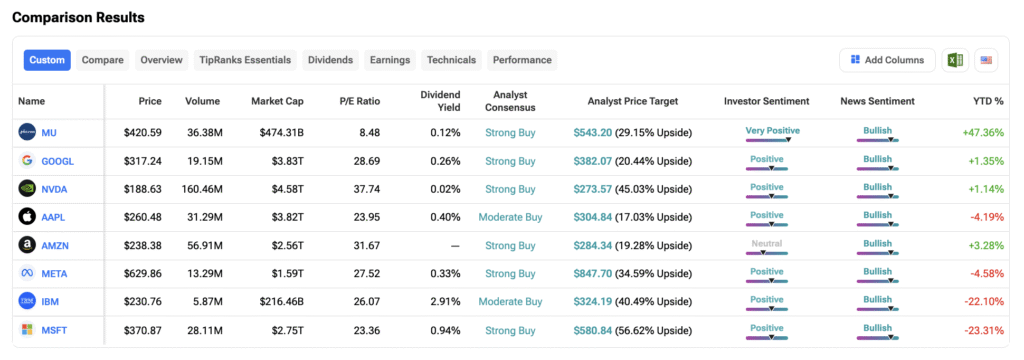
Currently, MSFT stock provides the highest upside among the above stocks at 56% with a Strong Buy rating from analysts. On the other hand, AAPL has the lowest upside of 17% with a Moderate Buy rating.
