Best Stocks to Withstand Rising Volatility
Best Stocks
(About StockTargetAdvisor.com (STA Research): Is a Canadian investment research company specializing in advanced stock research and analysis. Our research team comprises of Financial Professionals).
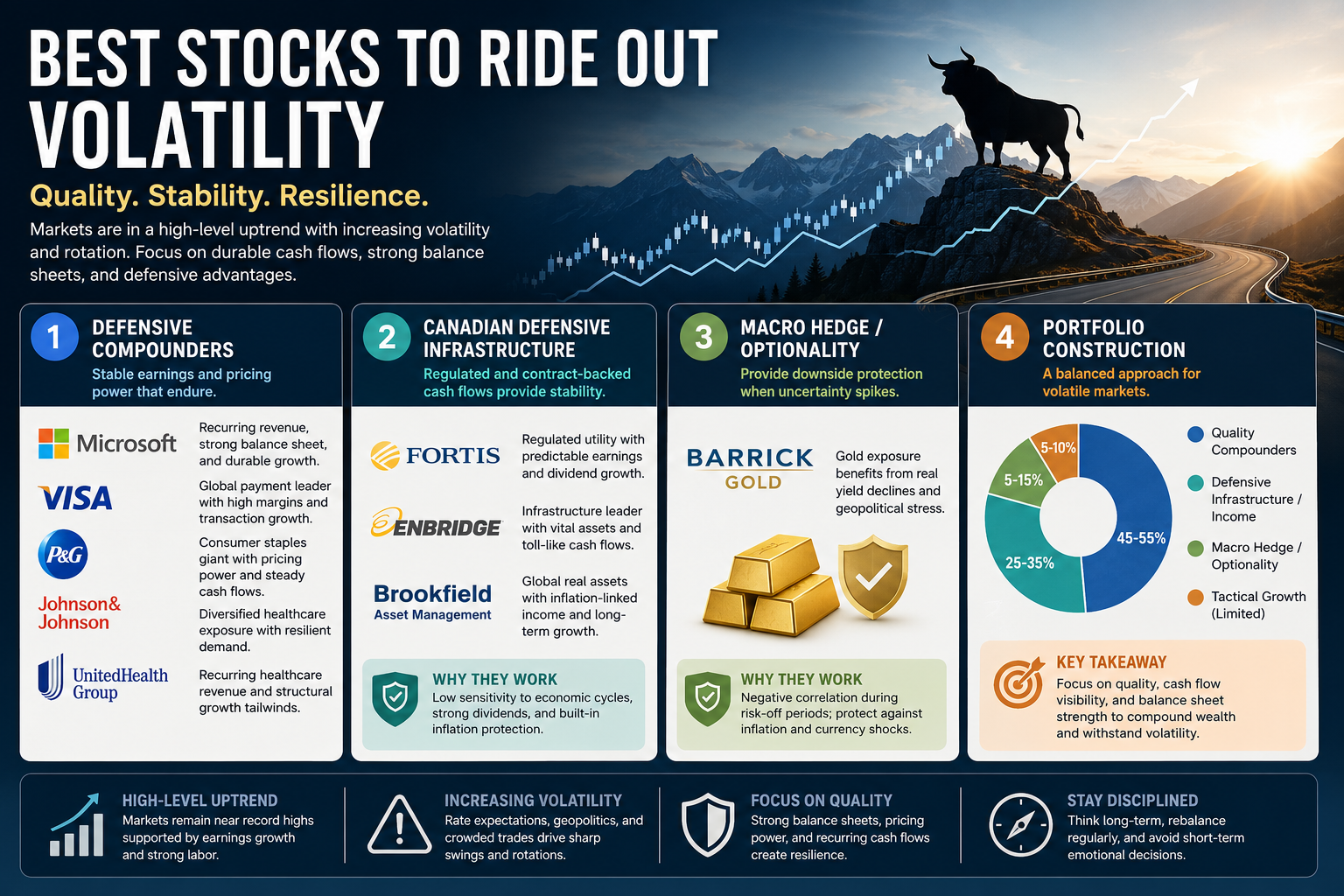
Currently financial markets are experiencing a but heightened path of volatility characterized by frequent and sharp drawdowns driven by shifting interest rate expectations, episodic geopolitical shocks, and rapid factor rotation across growth, value, and defensives. From a macro and factor attribution perspective, this environment can be described as a fragile bull market in which liquidity conditions remain broadly supportive of stocks, but return distributions exhibit elevated kurtosis, meaning that both upside and downside moves are amplified over short horizons. In such regimes, portfolio construction shifts away from maximizing cyclical beta exposure and toward minimizing earnings volatility per unit of return, with emphasis placed on balance sheet strength, pricing power, recurring revenue structures, and low sensitivity to macroeconomic discount rate fluctuations.
Within this framework, high-quality U.S. defensive stocks tend to provide the most consistent risk-adjusted performance because their earnings streams are less sensitive to economic cycles and their valuations are supported by structural growth rather than cyclical expansion.
Microsoft represents a hybrid defensive-growth profile due to its recurring enterprise software revenues, high switching costs, and strong free cash flow generation, which collectively reduce earnings dispersion during macro stress events.
Visa exhibits a transaction-based toll-road model tied to global nominal spending, which provides resilience through diversified geographic exposure and inflation-linked volume growth.
Procter & Gamble provides a non-discretionary consumer staples profile with strong brand-driven pricing power that stabilizes revenues during economic slowdowns.
Johnson & Johnson contributes diversified healthcare exposure with relatively inelastic demand, while UnitedHealth Group adds recurring premium-based cash flows supported by structural healthcare utilization trends and demographic tailwinds, making both effective defensive stabilizers in stock portfolios.
In Canada, defensive positioning is enhanced through regulated infrastructure and asset-backed income streams that behave as equity-duration proxies with reduced sensitivity to economic cycles.
Fortis provides regulated utility earnings linked to rate base growth, which delivers predictable cash flow expansion even in volatile macro environments. Enbridge offers infrastructure-based cash flows derived from energy transportation volumes rather than commodity prices, resulting in stable distributable earnings and strong dividend sustainability.
Brookfield Asset Management adds exposure to global real assets with inflation-linked characteristics and fee-based earnings that reduce correlation to traditional equity cycles while preserving long-duration compounding potential.
To complement these defensive and income-oriented allocations, selective macro hedges are often introduced to improve portfolio convexity during risk-off episodes, particularly in environments where real interest rates and geopolitical uncertainty drive abrupt equity repricing.
Barrick Gold functions as a real-rate-sensitive hedge whose performance tends to improve during periods of declining real yields, financial stress, or heightened geopolitical risk, thereby providing negative correlation benefits that enhance portfolio skewness and drawdown protection.
This approach favours a allocation structure consisting of high-quality growth companies, defensive infrastructure income assets, and selective macro hedges, while structurally underweighting high-beta, liquidity-sensitive segments such as speculative technology and semiconductors except for tactical positioning.
The primary objective in this environment is not maximizing short-term upside capture but rather optimizing risk-adjusted returns by controlling earnings volatility, reducing downside severity, and maintaining exposure to structurally durable cash flow streams that can withstand repeated macro shifts.
The post Best Stocks to Withstand Rising Volatility appeared first on Stock Target Advisor.
