GLP-1 Wars: Winners & Losers
America’s Obesity Epidemic
One of the most eye-opening exercises you can do is to look at an American beach photo from the 1960s or 1970s and compare it to a beach photo from today. In the early 1960s, less than 15% of Americans were obese. Today, the obesity rate in America is roughly 40%. What’s to blame for the soaring obesity rate? The widespread availability, addictiveness, and popularity of high-calorie, ultra-processed foods combined with an increase in sedentary lifestyle choices.
Obesity causes heart disease (the number one cause of death in the United States), type 2 diabetes, stroke, and high blood pressure. Despite these well-known risks, most Americans are unwilling to make lifestyle changes such as eating unprocessed foods and excercising. Meanwhile, until recently, weight loss drugs were mostly scams, or worse, had numerous adverse side effects.
GLP-1: The Largest Blockbuster Drug Ever
Every handful of decades, a groundbreaking drug transforms the pharmaceutical industry. GLP-1 receptor agonists (such as Ozempic, Wegovy, and Mounjaro) are the closest the pharmaceutical industry has come to a panacea. By manipulating brain receptors, these drugs can reduce appetite and spur weight loss of 20% or more, thereby significantly reducing heart attack and other health risks.
Should you Buy Novo Nordisk or Eli Lilly?
Pharma behemothsEli Lilly (LLY) andNovo Nordisk (NVO) are the two undisputed leaders in a GLP-1 industry that JP Morgan (JPM) expects to swell to $105 billion by the end of the decade. Although LLY and NVO dominate the market, their share prices are diverging significantly. Over the past year, LLY shares have gained 32.30% while NVO shares have plunged 28.40%.
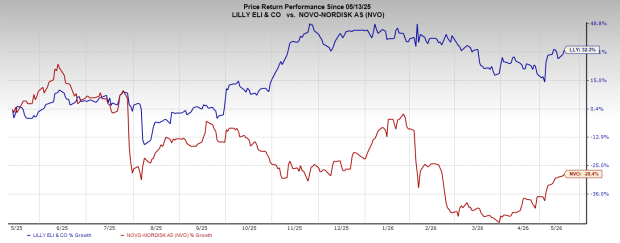
Image Source: Zacks Investment Research
The reason for the outperformance is that while NVO’s Ozempic/Wegovy drugs were first to market, Lilly’s tirzepatide (Mounjaro/Zepbound) has achieved more favorable results. The latest head-to-head trials show that Lilly’s dual agonist drug leads to ~20% weight loss, while NVO’s single agonist drug achieved ~13% weight loss. Meanwhile, LLY’s Retratrutide (which cleared FDA phase 2 trials) has shown that a mind-boggling 72% of prediabetics reached normal blood sugar levels after taking the drug. While it’s a stretch to call a company like NVO with $14 billion in quarterly revenue a loser, LLY’s drug is far superior to NVO’s and is likely to continue to be the leader in the group.
GLP-1 Losers: Snack Foods & Alcohol
Snack food companies like Coca-Cola (KO), PepsiCO (PEP), and Mondelez (MDLZ) are likely to struggle as more Americans adopt GLP-1s and junk food cravings decrease.
Bottom Line
With its best-in-breed GLP-1 drugs, Eli Lilly is beginning to cement itself as the dominant player in the massive GLP-1 market. In addition to LLY’s dominance, investors must recognize that the legacy snack industry is at risk of being disrupted.
Radical New Technology Could Hand Investors Huge Gains
Quantum Computing is the next technological revolution, and it could be even more advanced than AI.
While some believed the technology was years away, it is already present and moving fast. Large hyperscalers, such as Microsoft, Google, Amazon, Oracle, and even Meta and Tesla, are scrambling to integrate quantum computing into their infrastructure.
Senior Stock Strategist Kevin Cook reveals 7 carefully selected stocks poised to dominate the quantum computing landscape in his report, Beyond AI: The Quantum Leap in Computing Power.
Kevin was among the early experts who recognized NVIDIA's enormous potential back in 2016. Now, he has keyed in on what could be "the next big thing" in quantum computing supremacy. Today, you have a rare chance to position your portfolio at the forefront of this opportunity.
See Top Quantum Stocks Now >>This article originally published on Zacks Investment Research (zacks.com).
