Coca-Cola (KO) Keeps Delivering as Markets Turn Ugly. The Bull Case Still Holds
Coca-Cola (KO) continues to deliver steady performance amid volatile markets, reinforcing its bull case as a top high-quality compounder to own when the macro backdrop is messy. The stock is up about 9% year-to-date, comfortably ahead of the S&P 500’s (SPX) low-single-digit return over the same period, yet I still think Coca-Cola has room to run higher.
Claim 30% Off TipRanks
- Unlock hedge fund-level data and powerful investing tools for smarter, sharper decisions
- Discover top-performing stock ideas and upgrade to a portfolio of market leaders with Smart Investor Picks
Coca-Cola is not a hyper-growth story, but that misses the point. This is a global beverage leader with one of the deepest distribution systems in consumer staples, a portfolio built around everyday consumption occasions, and a business model that remains unusually resilient across cycles. I am bullish on KO because it combines dependable organic growth with margin support, improving cash conversion, and a valuation that still looks reasonable for this level of quality.
Built to Handle Uncertain Markets
What I like most about Coca-Cola right now is that management does not need a perfect backdrop to deliver acceptable results. Several analysts have described Coke’s current approach as an “all-weather strategy,” and that framing makes sense. Even as macro and geopolitical headwinds have picked up, the company still appears firmly in control of the key variables it can influence: brand investment, revenue growth management, affordability, innovation, and productivity.
That matters because many consumer staples companies are seeing sharper deterioration in volumes, weaker visibility, or more direct tariff and cost risk. Coca-Cola, by contrast, looks relatively insulated. Its category mix, geographic diversification, and pack-price architecture give it more flexibility than many peers. If consumers trade down, Coca-Cola can lean into affordability. If costs rise, it has more room than most to offset pressure through pricing and mix.
Fairlife, Pricing, and Mix Should Support Growth
The bull case here is not just about being defensive. There are still real growth levers. One of the most important is Fairlife, its ultra-filtered milk brand, which remains one of Coca-Cola’s best assets in North America. As capacity expands through 2026, Fairlife is expected to contribute roughly 2 percentage points to North America growth and about 1 point to total company organic growth this year. That is meaningful for a business of Coca-Cola’s size. In other words, Fairlife is not just a nice side brand anymore; it is becoming a material contributor to growth.
Beyond that, the core portfolio remains healthy. While Q4 reported price/mix softened due to unusual mix headwinds, management made clear that underlying pricing remained roughly 4%, consistent with the prior year. The issue was not pricing weakness; it was a temporary mix problem driven by water outperforming sparkling in some markets, emerging-market mix, and some marketing timing effects. Those factors may not disappear entirely, but they also do not look structural.
There are still weaker spots, including China, India, and Mexico, but the broader picture remains solid. Coca-Cola continues to gain share in many markets, and it still has one of the best pricing toolkits in staples. Beverage companies generally have better pricing optionality than packaged food peers because they can use pack sizes and channel mix more effectively. That should help preserve the 4%-5% organic sales algorithm even if demand remains uneven.
Margin Expansion and Free Cash Flow Are the Quiet Upside Drivers
The part of the story that I think is still underappreciated is the cash flow. Historically, Coca-Cola has had some free-cash-flow drags tied to operational complexity and bottling exposure. Those issues are fading. The company is simplifying operations, and with the pending divestiture of Coca-Cola Beverages Africa, the business should become more margin-accretive and less capital-intensive.
Coca-Cola expects free cash flow (FCF) conversion to remain in its normal 90–95% range in 2026 and beyond, with roughly $12.2 billion in FCF guided, based on 2025’s $11.4 billion adjusted figure. That is a big deal. High-quality compounders do not just win because of revenue growth; they win because they convert earnings into cash predictably and can redeploy that cash intelligently. Improved conversion should strengthen an already attractive model.
Margins should also benefit from the same simplification story. The Africa bottling divestiture is expected to be margin accretive, especially in the back half of the year, while productivity, pricing, and some foreign exchange support help offset cost inflation.
Fair Value
My valuation work supports a constructive stance. Based on 14 valuation models, including a multi-stage dividend discount model, price-to-sales multiples, and a 10-year discounted cash flow (DCF) revenue exit, I calculated intrinsic value at around $83 per share, implying close to 9% upside from the current stock price. That is not screamingly cheap, but for a business like Coca-Cola, mid- to high-single-digit upside plus dividend support is attractive — especially when many peers are facing more fragile fundamentals.
Wall Street’s View
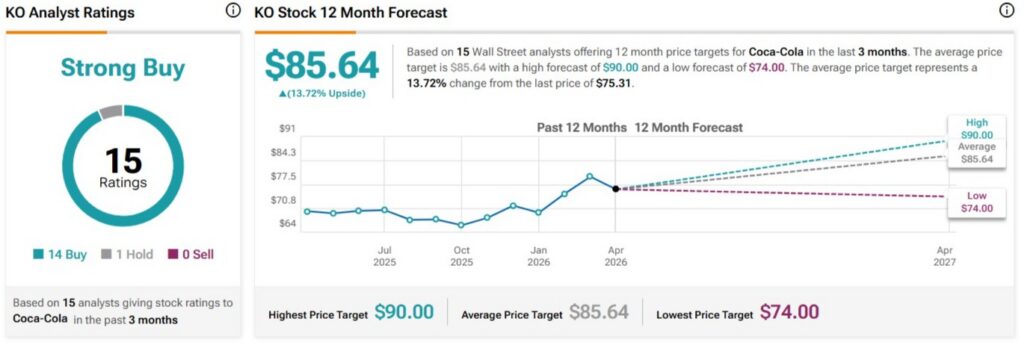
According to TipRanks, the average rating on KO is Strong Buy, with 14 Buy ratings, one Hold, and no Sell ratings. Based on 15 Wall Street analysts offering 12-month price targets for Coca-Cola, the average price target is $85.64, implying 13.72% upside from the last price of $75.31.
Conclusion
I am bullish on Coca-Cola because it remains exactly the kind of business that tends to outperform when the environment gets harder: strong brands, broad global reach, flexible pricing, resilient demand, and increasingly better cash generation.
Fairlife gives Coca-Cola a real growth kicker in North America, the core business still has healthy underlying pricing, and the company’s simplified structure should improve both margins and free cash flow conversion. Add in a fair valuation and a management team that has consistently executed well through tough environments, and I think KO still looks like a compelling long-term hold.
