Micron (MU) Is Riding the AI Boom, but the Stock Still Trades at a Discount
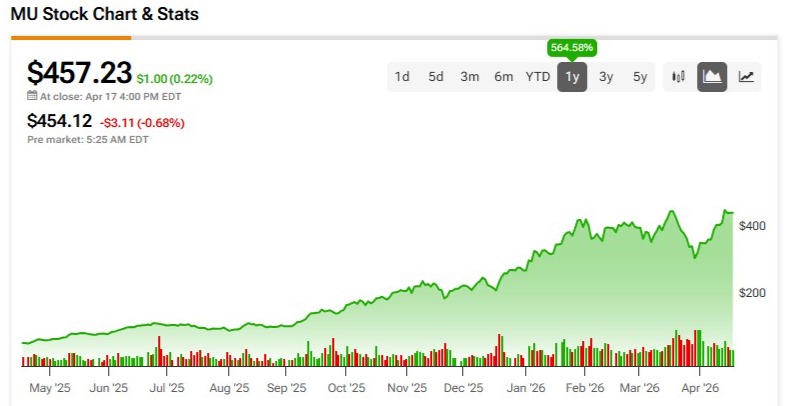
Micron Technology (MU) is in its strongest upcycle yet, fueled by surging spending on artificial intelligence (AI) infrastructure, which has turned memory into a critical bottleneck. Fiscal Q2 results validate that the semiconductor company delivered the largest sequential revenue increase in its history, and the business continues to accelerate. Yet at roughly 7x forward earnings, Wall Street has not fully priced in Micron’s earnings power. I remain long‑term bullish on MU, as the gap between its sharp earnings momentum and still‑modest valuation remains too wide to ignore.
Claim 30% Off TipRanks
- Unlock hedge fund-level data and powerful investing tools for smarter, sharper decisions
- Discover top-performing stock ideas and upgrade to a portfolio of market leaders with Smart Investor Picks
Smashing Results Validate the AI Memory Thesis
Micron’s Fiscal Q2 results showed total revenue of $23.9 billion, up roughly 75% sequentially and 196% year-over-year, marking the fourth consecutive quarterly record and the largest sequential dollar increase in the company’s history. In fact, Micron’s Q2 revenue alone exceeded the company’s entire Fiscal 2022 revenue of $15.5 billion.
Dynamic random-access memory (DRAM) revenue hit $18.8 billion, up 207% year-over-year, driven by tight supply and a favorable product mix. NAND revenue reached $5.0 billion, up 169% year-over-year, with data center NAND more than doubling sequentially. Gross margin reached 75%, operating margin 69%, non-GAAP earnings per share (EPS) $12.20, and free cash flow at a record $6.9 billion.
Micron reduced debt over the first half of Fiscal 2026, bringing its net cash position to $6.5 billion, the highest in the company’s history. That balance‑sheet strength gives Micron the financial flexibility to fund its next‑generation memory roadmap without relying heavily on external financing.
Q3 outlook highlighted by Micron’s management is equally striking. The chip company is targeting $33.5 billion in revenue, a gross margin of approximately 81%, and non-GAAP EPS of $19.15. Meanwhile, the projected margin expansion from 75% in Q2 to 81% in Q3 is particularly notable, as it suggests pricing power is still strengthening rather than plateauing. These targets signal that management views the current demand environment as durable rather than episodic.
HBM4 and Long-Term Technology Leadership
As we examine Micron’s competitive strengths, High Bandwidth Memory (HBM) stands out as a critical piece of the thesis. HBM is a stacked DRAM architecture purpose-built for AI accelerators, delivering data transfer speeds that conventional memory cannot match. In Fiscal 2025, HBM emerged as a meaningful contributor to Micron’s revenue, with Q4 HBM sales reaching nearly $2 billion. S&P Global (SPGI) Ratings expects that share to grow significantly as AI infrastructure spending accelerates.
With a market capitalization of approximately $520 billion, Micron is one of only three companies worldwide that produce DRAM at scale, alongside Samsung (SSNLF) and SK Hynix (HXSCL).
Micron’s HBM supply is completely sold out for calendar 2026, with allocations already set for 2027 and customer negotiations extending into 2028. Micron’s fourth-generation HBM4 is in high-volume production, shipping one quarter ahead of schedule, with yields on track. Nvidia (NVDA), Micron’s largest customer, as stated by Nvidia CEOJensen Huang, accounted for a significant share of total Fiscal 2025 revenue, underscoring how central the HBM relationship is to Micron’s growth trajectory.
Beyond the data center, Micron is expanding into edge AI through a strategic investment in SiMa.ai, a physical AI company focused on real-world robotics and autonomous systems, targeting industrial applications and edge inference. Micron’s 1γ (1-gamma) DRAM node, which incorporates extreme ultraviolet lithography for improved power efficiency and bit density, is ramping faster than any prior generation and is expected to account for the majority of DRAM bit output by mid-2026.
Together, these moves position Micron to capture AI memory demand well beyond the hyperscaler market as edge deployment accelerates.
Risks Are Real, but Do Not Outweigh the Opportunity
Micron remains a cyclical business, where memory pricing and profitability are driven by supply and demand dynamics. In other words, business conditions could reverse sharply, as the net loss of $5.83 billion in Fiscal 2023 demonstrated. In a severe AI investment downturn, memory would be one of the hardest-hit segments in technology, given historically strong current pricing conditions.
Geopolitical risk adds another layer, with China representing roughly 10% of revenue and U.S. export controls already restricting certain chip sales there. China is also developing domestic memory competitors, with ChangXin Memory Technologies in DRAM and Yangtze Memory Technologies in NAND expected to capture a growing share of the Chinese market over time. U.S. CHIPS Act-backed fabrication projects in Idaho and New York aim to reduce that concentration, supported by up to $6.4 billion in direct federal funding.
Capital intensity remains the other key consideration. Micron’s own Fiscal 2026 capital expenditure guidance reflects a significant increase from prior years, raising execution risk if demand softens or costs overrun. Micron is reportedly able to meet only 50%–66% of DRAM allocation requests, which introduces customer relationship risk. That said, demand anchored by multi-year hyperscaler AI commitments is a structurally different backdrop than the consumer-driven cycles that produced prior downturns.
Valuation Leaves Room for Upside
At roughly 21x trailing earnings and about 7x forward earnings, Micron trades at a significant discount to peers such as Nvidia (NVDA), at about 24x forward earnings, and Applied Materials (AMAT), at roughly 33x forward earnings. The trailing P/E for the broader semiconductor sector averages around 27.5x, underscoring how compressed MU’s multiple appears relative to its earnings power.
For a company guiding to record‑high earnings and multi‑billion‑dollar quarterly revenue, that valuation is difficult to justify on fundamentals alone. A PEG ratio materially below the sector average captures the disconnect most precisely, as the market is still treating Micron as a cyclical commodity supplier rather than a structural AI‑memory infrastructure company.
Some analysts project DRAM and NAND prices rising further in the coming quarters as supply constraints persist, a tailwind not yet fully reflected in consensus estimates. With EPS growth forecasts of over 150–200% over the next few years, the gap between where MU trades and where its earnings trajectory points remains the core of the bullish thesis.
Prefer Not to Buy MU Directly? Three ETFs That Give You the Exposure
Investors seeking diversified exposure to the AI memory theme without owning MU directly can look to exchange-traded funds (ETFs). The most direct expression of the thesis is the Roundhill Memory ETF (DRAM), launched recently on April 2, making it the world’s first ETF dedicated exclusively to memory semiconductors. As a fund with limited trading history, it carries the usual caveats of an unproven vehicle, but the product logic is compelling. Micron is one of three core holdings alongside Samsung and SK Hynix, each representing approximately 25% of the portfolio, and the fund pulled in $245 million in assets within its first week of trading.
For investors who prefer a fund with an established track record, the iShares MSCI USA Value Factor ETF (VLUE) holds MU at approximately 10.32% of its large- and mid-cap value portfolio. The inclusion signals that value-oriented institutional investors already recognize the valuation disconnect in MU at current prices.
Finally, the Invesco AI and Next Gen Software ETF (IGPT), which focuses on AI, automation, and cloud computing across a diversified portfolio of technology firms, holds 8.3% of its portfolio in MU. This frames the position around the AI infrastructure buildout rather than the memory cycle specifically, offering a different entry point to the same underlying bullish thesis.
Is MU Stock a Buy, Sell, or Hold?
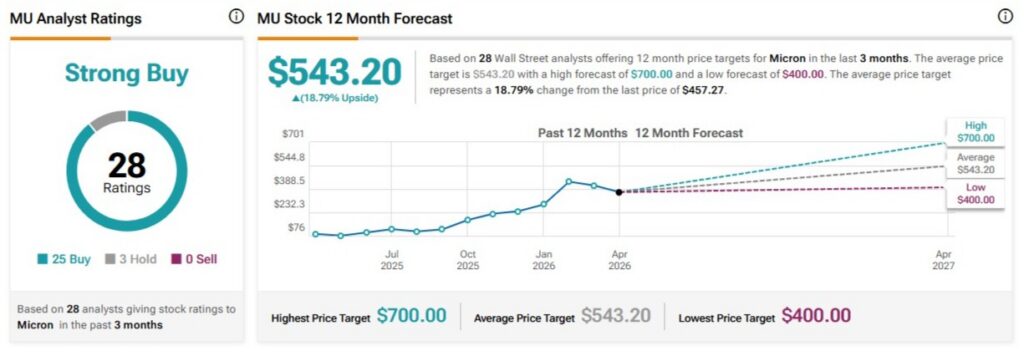
According to Wall Street analysts, Micron currently carries a Strong Buy consensus rating, based on 28 analyst ratings assigned in the past three months, consisting of 25 Buy, three Hold and zero Sell ratings. The average 12-month price target for MU is $543.20, implying approximately 19% upside from the current share price of $457.27.
Conclusion
Micron’s Fiscal Q2 results and Q3 guidance mark a structural shift in the value of memory within AI infrastructure. I believe a strong balance sheet, HBM4 leadership, and rapid DRAM execution support the bullish case. MU trades well below what its growth trajectory and technology leadership justify. In my assessment, the mispricing remains an opportunity, and MU investors with a multi-year horizon who can tolerate semiconductor volatility have a compelling entry point at current prices.
