LLY or PFE: Which Drugmaker Offers the Stronger Growth Story?

Eli Lilly & Company LLY and Pfizer PFE are large-cap U.S. drugmakers supported by broad product portfolios and strong research capabilities. Lilly has emerged as a leader in cardiometabolic medicine, fueled by the blockbuster performance of its GLP-1 drugs, Mounjaro and Zepbound, while Pfizer’s primary strength is its oncology franchise.
Outside these core areas, Lilly develops and markets therapies spanning oncology, immunology, cardiovascular disease and neuroscience. Pfizer also maintains significant positions in inflammation and immunology, rare diseases and vaccines.
Both companies possess extensive and promising pipelines that have the potential to drive innovation and support long-term expansion. The main question for investors, however, is which stock currently presents the more attractive investment opportunity. Below, we compare their fundamentals, growth outlook and key risks to assess the better pick.
The Case for Lilly Stock
Lilly's biggest strength is its dominance in the rapidly expanding obesity and diabetes markets. Its blockbuster drugs, Mounjaro for type II diabetes and Zepbound for obesity, have become some of the fastest-growing medicines in pharmaceutical history, gaining from enormous global demand for GLP-1 therapies.
In addition to Mounjaro and Zepbound, Lilly has secured approvals for several other new therapies over the past few years. These include Omvoh, Jaypirca, Ebglyss and Kisunla. These newly approved drugs are also contributing to Lilly’s revenue growth.
Lilly is developing several next-generation, more powerful and more convenient GLP-1–based treatments, including oral options and multi-acting candidates.
In early April 2026, Lilly gained FDA approval for its once-daily oral GLP-1 pill Foundayo (orforglipron) for treating obesity. Foundayo shipments began soon after. Foundayo, which offers the benefits of GLP-1 therapy in a pill form, can prove to be a commercial game-changer for Lilly. Early launch data are encouraging. Lilly expects to launch Foundayo in most international markets during 2027, potentially opening another large growth avenue.
Oral pills will be a more convenient alternative to the currently available once-weekly injectable obesity treatments like Zepbound and Novo Nordisk’s NVO Wegovy. Novo Nordisk had gained approval for an oral version of its obesity drug, Wegovy, in December 2025 and launched the pill in January 2026, which gave it a first-mover advantage over Foundayo. However, Lilly may be able to close the gap quickly now that it has launched Foundayo.
In addition to obesity and diabetes, Lilly is evaluating Foundayo in six phase III studies for other diabetes and obesity-related diseases. For the type II diabetes indication, Lilly has filed regulatory applications in several countries, while it expects to file the same in the United States in late second-quarter 2026.
The company is evaluating another next-generation candidate, triple-acting incretin, retatrutide, in type II diabetes and obesity, along with other indications like obstructive sleep apnea, knee osteoarthritis and chronic low back pain, in late-stage studies. Retatrutide represents a new generation of “triple-action” therapy as it targets three biological pathways — GLP-1, GIP and glucagon — whereas existing medicines mostly act on one or two biological pathways. The candidate has demonstrated approximately 28% weight loss in late-stage studies. Lilly plans to seek approval for retatrutide for obesity and knee osteoarthritis pain in 2026. If approved, retatrutide could become another multibillion-dollar product.
In the past couple of years, Lilly has upped its efforts to diversify beyond GLP-1 drugs by expanding into cardiovascular, oncology and neuroscience areas. So far in 2026, it has already announced six proposed acquisitions — Centessa Pharmaceuticals, Ajax Therapeutics, Kelonia Therapeutics, Orna Therapeutics, CrossBridge Bio and Ventyx Biosciences — to expand beyond its GLP-1 franchise. In May 2026, Lilly agreed to acquire three private vaccine makers, Curevo, LimmaTech and Vaccine Company, gaining vaccine programs targeting shingles, bacterial infections and Epstein-Barr virus.
Lilly has its share of problems. Prices of most of Lilly’s products are declining in the United States. Price is expected to continue to be a drag on top-line growth in the low to mid-teens percentage in 2026. Rising competition in the GLP-1 diabetes/obesity market is a key headwind. Also, sales of late-life cycle products like Trulicity, Taltz and Verzenio are expected to be flat to down in 2026.
The Case for PFE Stock
Pfizer is one of the largest and most successful drugmakers in oncology. Its position in oncology was strengthened with the acquisition of Seagen in 2023.
Oncology sales comprise around 27% of its total revenues. Its oncology revenues grew 7% to $3.8 billion in the first quarter of 2026, driven by drugs like Lorbrena, the Braftovi-Mektovi combination and Padcev.
Pfizer’s dependence on its COVID business has now reduced. Its non-COVID operational revenues are improving, driven by key in-line products like Vyndaqel, Padcev and Eliquis, new launches and newly acquired products like Nurtec and those from Seagen. In 2026, Pfizer expects its recently launched and acquired products to record continued double-digit growth.
Pfizer is also trying to rebuild its pipeline through acquisitions. Seagen, Metsera and Biohaven are the most significant strategic acquisitions in recent years.
The company is rebuilding its pipeline in oncology and obesity, which it believes can drive growth in 2028 and beyond. Pfizer plans to start 20+ obesity studies in 2026, including 10 phase III studies for its monthly GLP-1 receptor agonist, berobenatide for obesity and obesity-related comorbidities, including knee osteoarthritis and obstructive sleep apnea. It also plans to start four pivotal studies for PF-08634404, a dual PD-1/VEGF inhibitor in-licensed from Chinese biotech 3SBio in 2025. Pfizer is targeting the first of a series of potential approvals for berobenatide in 2028.
Pfizer’s significant cost reduction and efforts to improve R&D productivity measures are also driving profit growth. Pfizer’s dividend yield stands at around 7%, which is also impressive.
However, Pfizer expects a significant negative impact on revenues from LOE impact in the 2026-2030 period as several of its key products, including Eliquis, Ibrance, Xeljanz and Xtandi, face patent expirations. The LOE cliff is expected to hurt sales by approximately $1.5 billion in 2026.
Pfizer’s 2026 outlook also failed to impress investors. Pfizer’s revenue and earnings guidance for 2026 represents mostly flat to slightly negative growth.
Nonetheless, although Pfizer’s 2026 sales guidance indicates minimal growth, the company expects a high single-digit revenue CAGR for five years starting in 2029. Pfizer expects the growth to be driven by its advancing R&D pipeline and the continued progress of new and acquired products.
How Do Estimates Compare for LLY & PFE?
The Zacks Consensus Estimate for LLY’s 2026 sales and EPS implies a year-over-year increase of 33.1% and 47.3%, respectively. EPS estimates for 2026 have risen from $33.87 to $35.67 over the past 60 days.
LLY Estimate Movement
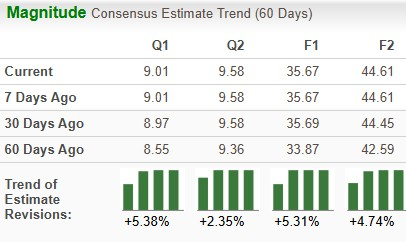 Image Source: Zacks Investment Research
The Zacks Consensus Estimate for Pfizer’s 2026 sales and EPS implies a year-over-year decline of 1.5% and 7.1%, respectively. Earnings estimates for 2026 have risen from $2.98 per share to $2.99 per share over the past 60 days.
PFE Estimate Movement
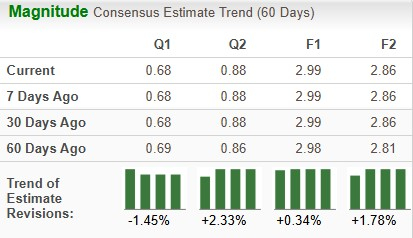 Image Source: Zacks Investment Research
Price Performance and Valuation of LLY & PFE
So far this year, Lilly’s stock has risen 3.0%, while Pfizer’s stock has declined 0.7%. The industry has risen 3.1% in the said time frame.
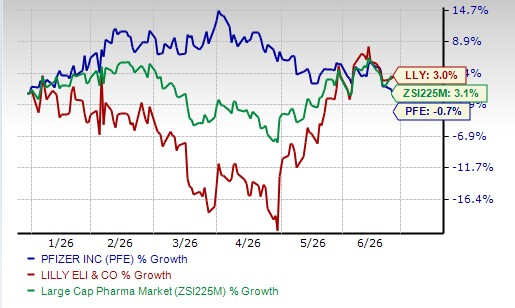 Image Source: Zacks Investment Research
Pfizer looks more attractive than LLY from a valuation standpoint. Going by the price/earnings ratio, LLY’s shares currently trade at 27.66 forward earnings, much higher than 17.34 for the industry. However, LLY’s stock is trading below its 5-year mean of 34.57. Pfizer’s shares currently trade at 8.45 forward earnings, significantly lower than the industry and the stock’s 5-year mean of 9.49.
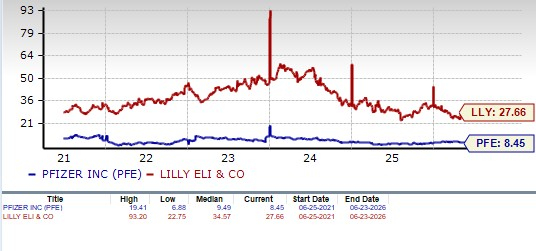 Image Source: Zacks Investment Research
Lilly’s dividend yield is 0.6%, while Pfizer's is around 7%.
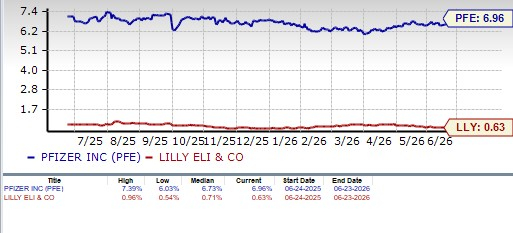 Image Source: Zacks Investment Research
PFE or LLY: Which is a Better Pick?
Lilly and Pfizer both have a Zacks Rank #3 (Hold), which makes choosing one stock a difficult task. You can see the complete list of today’s Zacks #1 Rank (Strong Buy) stocks here.
Pfizer stock has taken a beating in the past three years as its revenues have declined substantially due to lower sales of its COVID products. Though Pfizer is on a recovery path, the upcoming patent cliff raises uncertainty about how the company navigates through the challenge.
On the other hand, Lilly stands alone among large drugmakers as the only company valued at more than $1 trillion, with its stock trading above $1,000 per share.
Lilly has one of the strongest growth profiles in big pharma. Though not cheap, Lilly is a great stock to have in one’s portfolio, given its product and pipeline portfolio in high-growth therapeutic areas like obesity, robust growth prospects and bullish analyst sentiment, which makes it a clear winner over Pfizer.
7 Best Stocks for the Next 30 Days
Just released: Experts distill 7 elite stocks from the current list of 220 Zacks Rank #1 Strong Buys. They deem these tickers "Most Likely for Early Price Pops."
Since 1988, the full list has beaten the market more than 2X over with an average gain of +23.7% per year. So be sure to give these hand picked 7 your immediate attention.
See them now >>This article originally published on Zacks Investment Research (zacks.com).
