07/06/2026 ValuEngine Weekly Market Summary & Commentary
Weekly Market Recap – Week Ending Jul 02, 2026
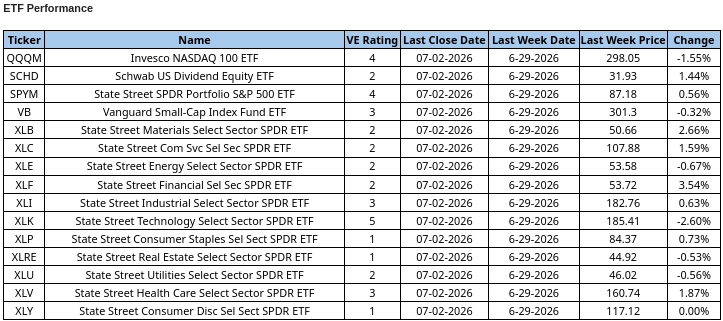
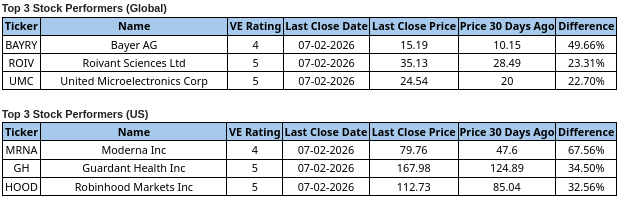
U.S. equity markets were mixed over the shortened trading week, with broad index performance modestly positive but sector leadership remaining uneven. The S&P 500 ETF (SPYM) gained 0.56%, while the NASDAQ 100 ETF (QQQM) declined 1.55%, weighed down by continued weakness in Technology (XLK), which fell 2.60%. Financials (XLF), Materials (XLB), Health Care (XLV), and Communication Services (XLC) led the ETF group higher, while Energy (XLE), Utilities (XLU), Real Estate (XLRE), and Small Caps (VB) moved lower. Stock-specific momentum remained strong in selected health care, biotech, semiconductor, and fintech names, with Moderna (MRNA), Bayer (BAYRY), Guardant Health (GH), Robinhood Markets (HOOD), Roivant Sciences (ROIV), and United Microelectronics (UMC) posting notable 30-day gains.
Trade ValuEngine supported portfolio strategies, www.ValuEngineCapital.com
Free Trial: Direct Access to ValuEngine Research on over 5,000 stocks and 700 ETFs HERE
Strategy Note:
Monday July 6 will be marked by some closely watched in-kind swap for the Invesco QQQ ETF (QQQ) and similar transactions for other ETFs and other funds the use the Nasdaq-100 as a basis and/or a selection universe. It is the day that SpaceX (SPCX) will be added to the Nasdaq-100 index and the ETFs in question at the close of trading. The advent of the recent mega-ETF motivated Nasdaq to change its index rules to allow SPCX to be added at a multiple of its currently available “float”, the total market value of shares not held by company insiders. Because an effective trade of this magnitude causes an up-and-down blip, chart-followers refer to this as a “heartbeat trade.”
The other US-listed stock-only ETFs that hold only Nasdaq-100 stocks include:
1. QQQM (Invesco NASDAQ 100 ETF): The lower-expense-ratio and retail-focused version of QQQ;
2. QQQE (Direxion Nasdaq-100 Equal Weighted Index Shares): Weights all 100 companies equally, reducing the concentration risk of mega-cap tech giants, but less reflective of the market’s massive movements of capital flows into and out of mega-cap tech stocks;
3. QEW (Invesco QQQ Equal Weight ETF): Invesco’s equal-weighted version of the Nasdaq-100; and
4. QQMG (Invesco ESG Nasdaq 100 ETF): Tracks the Nasdaq-100 but filters out companies that do not meet strict Environmental, Social, and Governance criteria.
The largest ETF by total assets, however, is JEPQ, JPMorgan Nasdaq Equity Premium Income ETF. This actively managed fund combines Nasdaq-100 stocks with non-listed derivatives called equity-linked notes to generate options premium income. Three other ETFs combine the index’s stocks with listed call options to generate significant dividend yields and distribute that income monthly. These ETFs are:
1. QYLD (Global X Nasdaq 100 Covered Call ETF): Buys the stocks in the index and writes (sells) call options on the index to distribute high monthly yields;
2. QQA (Invesco QQQ Income Advantage ETF): An options-based income fund designed to provide consistent yield backed by the Nasdaq-100; and
3. FTQI (First Trust Nasdaq BuyWrite Income ETF): Utilizes a buy-write option strategy against the Nasdaq-100 to generate income.
For professionals and others that make daily trades, there are four leveraged and inverse products that are called ETFs that facilitate making positive or negative “bets” on whether the Nasdaq-100 will go up or down. They can up-to-triple the magnitude of the change, positive or negative. Investors are warned that these products for trading should not be held for weeks or longer. The expense ratios are high and the mathematics of compounding can produce very disappointing results even if you were right about whether the index would go up or down. These tactical tools for traders are: TQQQ (ProShares UltraPro QQQ): A leveraged ETF providing 3x the daily return of the Nasdaq-100; QLD (ProShares Ultra QQQ): A leveraged ETF providing 2x the daily return of the Nasdaq-100; SQQQ (ProShares UltraPro Short QQQ): An inverse leveraged ETF providing -3x the daily return, designed to gain value when the Nasdaq-100 falls; and PSQ (ProShares Short QQQ): An inverse ETF providing -1x the daily return of the index.
This should provide more excitement after a relatively sluggish start to July and follows a strong two-day rally to end the month of June. State Street S&P 500 ETF Index Trust (SPY) gained 2.5% while QQQ gained an explosive 4.5%. When strong up trading days occur to end a quarter, professionals call such trades “window dressing” where mutual funds managers that must display end-of-quarter holdings sell losing stocks and buy stronger names to make the reported fund portfolio appear stronger. After such trades the market usually goes back down the next two days. That’s exactly what happened here. The first two days of July, punctuated by relatively light trading volume, saw SPY slide 0.2% while QQQ declined 3.4% in just two days.
Free Trial: Direct Access to ValuEngine Research on over 5,000 stocks and 700 ETFs HERE
In order to plan a strategy for the market now, it’s useful to look at how the market has performed in the first half of this year since that is now complete. The following table, beyond SPY and QQQ, also looks at four other segments of the market. They include mid-cap; small cap; growth; and value. The category with the best return in each time period is shown in bold. The 3-month, year-to-date, and 12-month periods all end on June 30, 2026.
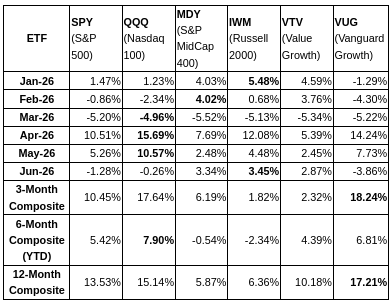
Historic calendar trends would tend to favor a positive July for the market. Our predictive model’s rating for SPY is a neutral or “hold” 3 while the 4 rating currently maintained by QQQ is a “buy.” So, our model is still relatively optimistic on the market. A note for income investors, two 5-rated stocks (Strong Buy) that have at least a 2% yield include cellular technology provider Millicom International (TIGO) and UK bank and finance company NatWest Financial (NWG).
www.ValuEngine.com (
www.ValuEngineCapital.com (
BLOG.VALUENGINE.COM for the full history of ValuEngine.com financial blog posts
____________________________________________________________________________
5,000 stocks, 600 ETFs, 16 sector groups, and 140 industries updated on www.ValuEngine.com
Full Two Week Free Trial HERE
Financial Advisory Services based on ValuEngine research and Portfolios available through www.ValuEngineCapital.com
