Should You Buy, Sell or Hold OKLO Stock Post First Revenues?

Oklo Inc. OKLO crossed an important threshold in the second quarter of 2026 by reporting revenues for the first time, showing that its advanced nuclear strategy is beginning to produce commercial activity. The milestone came alongside operational progress, including criticality at the Groves isotope facility. However, the quarter also highlighted the cost of building a nuclear business from the ground up: losses widened, and spending rose. With nuclear peers NuScale PowerSMR and NANO NuclearEnergyNNE also racing toward commercialization, investors need to weigh OKLO’s improving execution against its early financial profile.
First Revenues Mark Progress, but Losses Remain High
OKLO reported second-quarter revenues of $1.2 million compared with no revenues in the year-ago period. Of this amount, $800,000 came from engineering and consulting services, $168,000 from manufacturing and fabrication services, and $242,000 from other activities. Most of these revenues were generated by businesses OKLO acquired in 2026, including ARMEC and Creative Engineers. This means the company has started generating sales, but its main Aurora reactor business has yet to contribute meaningful revenues.
At the same time, OKLO’s losses increased. The company reported a loss of 28 cents per share compared with a loss of 18 cents a year ago and the Zacks Consensus Estimate of a 17-cent loss. Research and development expenses more than tripled to $39.5 million, while general and administrative expenses more than doubled to $34.2 million. The higher costs reflect increased spending on engineering, hiring and the development of its nuclear projects.
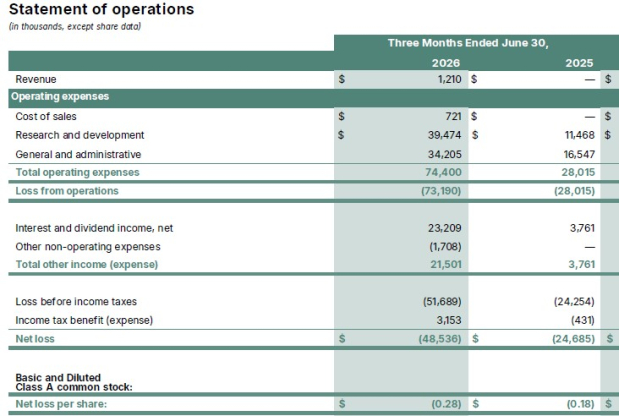 Image Source: Oklo Inc.
Competition in the advanced nuclear market is also growing. NuScale is focusing on regulatory approvals, supply-chain preparation and getting its technology ready for commercial deployment. NANO Nuclear, meanwhile, continues to move its KRONOS MMR toward licensing and construction. Against this backdrop, OKLO’s first revenues are a positive sign, but investors still need to see whether its Aurora reactors can eventually generate meaningful and profitable revenues.
OKLO Stock Lags Peers as Loss Estimates Widen
The market has already cooled considerably on OKLO. Shares are down 34.5% year to date compared with declines of 30.2% for NuScale and 19.3% for NANO Nuclear. After peaking around $194, OKLO is currently trading near $47. The correction improves the entry price, but reflects uncertainty around commercialization and profitability.
YTD Price Performance
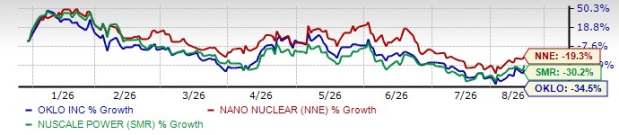 Image Source: Zacks Investment Research
Earnings estimates reinforce that caution. The Zacks Consensus Estimate calls for a loss of 85 cents per share in 2026, implying a 18.1% deterioration from 2025. For 2027, the projected loss widens further to 94 cents per share, a 9.7% deterioration from 2026. Thus, even with revenues finally appearing, investors should not expect near-term profitability.
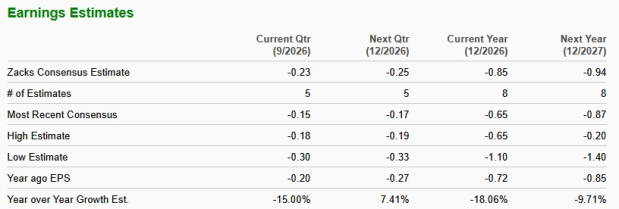 Image Source: Zacks Investment Research
Groves and Aurora Offer Reasons for Optimism
Operational progress is the strongest part of the investment case. The Groves isotope facility achieved first criticality on Aug. 5, less than a year after construction began, with substantial construction completed in 229 days. The achievement gives OKLO practical experience that could support future projects.
Aurora-INL is also advancing. The Department of Energy approved its Preliminary Documented Safety Analysis, while site development and construction continue. OKLO is additionally progressing a planned 1.2-gigawatt Ohio clean-energy campus and strengthening its fuel strategy through planned fabrication, recycling and potential HALEU supply from Centrus.
Competition remains important. NuScale has a more mature regulatory and supplier-readiness story, while NANO Nuclear is pursuing its KRONOS MMR and has completed a feasibility study for supplying up to 1 gigawatt to an AI data-center project in Texas. Like OKLO, both SMR and NNE are targeting the growing need for dependable power from data centers and other energy-intensive customers.
Strong Liquidity Provides a Valuable Cushion
OKLO ended June with roughly $3 billion in cash, cash equivalents and marketable debt securities, giving it substantial capacity to fund development. This compares favorably with about $1.9 billion of liquidity at NuScale and approximately $569 million in cash, cash equivalents and short-term investments at NANO Nuclear.
Still, OKLO plans to spend more. Management raised its 2026 operating cash-use outlook to $120-$150 million from $80-$100 million and increased expected property, plant and equipment spending to $400-$500 million from $350-$450 million. The higher spending reflects accelerated Aurora-INL work and fuel purchases. Investors must watch whether this spending translates into recurring revenues.
Conclusion
OKLO’s first revenues and the Groves criticality milestone show that the company is making progress in turning its nuclear ambitions into operating activities. Its roughly $3 billion liquidity position gives it substantial resources to fund Aurora development, fuel initiatives and isotope projects. However, the financial picture remains challenging. Revenues are still very small compared with the company’s spending, losses are projected to widen through 2027, and Aurora has yet to prove its commercial economics.
At the same time, SMR and NNE are making progress with their own advanced nuclear technologies, adding to competitive pressure. Given OKLO’s rising costs, continued losses and significant execution and commercialization risks, the stock does not appear attractive at present despite its recent operational achievements. OKLO stock is currently a Zacks Rank #4 (Sell).
You can see the complete list of today’s Zacks #1 Rank (Strong Buy) stocks here.
Beyond Nvidia: AI's Second Wave Is Here
The AI revolution has already minted millionaires. But the stocks everyone knows about aren't likely to keep delivering the biggest profits. AI’s second wave is moving from infrastructure to implementation and these companies are at the forefront of this transition, positioned to become what Amazon and Google were to the internet era.
See Stocks Now >>This article originally published on Zacks Investment Research (zacks.com).
