Can Opendoor's AI Workflows Protect Contribution Margins?

Opendoor Technologies Inc.OPEN is using automation and AI-enabled tools to support cost control under its Opendoor 2.0 framework. The company is focused on improving operating accuracy, reducing friction and maintaining expense discipline as contract volumes recover in a weak housing market.
In the first quarter of 2026, OPEN highlighted early efficiency gains across several operating areas. The company cited an AI-powered repair negotiation tool that reduced buyer fall-through rates by double digits. It also noted that AI scoping feedback helped lower pre-list renovation spend by 10-20% per home in pilot markets, while ticket-triage automation allowed three full-time employees to shift from classification work to resolution activity.
OPEN’s model remains sensitive to execution costs, resale timing and inventory quality. Lower renovation spend, fewer failed buyer transactions and faster internal processes can reduce operational leakage across the resale cycle. Fixed operating expenses were $33 million in the first quarter, down 15.4% year over year, further supporting the company’s cost-discipline efforts.
AI also supports OPEN’s broader effort to accelerate home turns. The company has rebuilt parts of its buyer apps, messaging systems and offer pages while using automation to improve inspection, repair and operational execution. Greater efficiency can support faster resale cadence and better inventory discipline — both of which are important to protecting contribution margins in a pressured housing market.
Automation’s margin contribution will likely depend on whether these early use cases can scale as acquisition volumes increase. If AI-enabled tools continue to reduce renovation costs, limit transaction fall-through and improve operating productivity, they could become a more durable support for OPEN’s contribution margins under Opendoor 2.0.
Opendoor’s Competitor Landscape
Zillow Group, Inc.ZG provides a relevant benchmark for AI-led operating efficiency, although its model is less exposed to inventory ownership and resale-cost risk than OPEN’s. Zillow is embedding AI across consumer search, agent workflows, loan officer tools and rentals, while also noting that engineers are shipping 40% more code per engineer at the same or higher quality. This highlights how AI can improve productivity across a housing platform, even though Zillow’s margin profile is less tied to renovation costs, resale timing and home-level execution.
Offerpad Solutions Inc.OPAD provides a closer comparison for OPEN’s margin-focused AI opportunity. Offerpad is using SCOUT to improve seller intake, routing and acquisition accuracy, while HENRY is being expanded to support renovation estimates, listing prices, holding-time decisions and disposition strategy. The company also said cost per qualified lead declined 37% year over year, underscoring the role of AI-enabled workflows in improving conversion efficiency and cost discipline in a weak housing market.
Against this backdrop, OPEN’s AI strategy will be most relevant if it improves the economics of the resale process. Zillow shows how AI can support platform productivity at scale, while Offerpad highlights the use of AI in seller routing, renovation and asset-level decisions. For OPEN, automation’s contribution-margin impact will depend on whether it can consistently reduce repair costs, limit transaction leakage and improve operating productivity as acquisition volumes recover.
OPEN’s Stock Price Performance, Valuation & Estimates
Shares of Opendoor have skyrocketed 680.5% in the past year against the industry’s 16.4% decline.
OPEN One-Year Price Performance
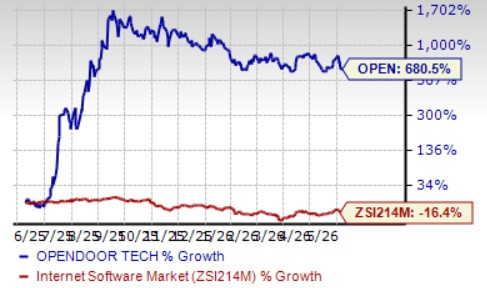
Image Source: Zacks Investment Research
From a valuation standpoint, OPEN trades at a forward price-to-sales (P/S) multiple of 0.80, significantly below the industry’s average of 3.80.
OPEN’s P/S Ratio (Forward 12-Month) vs. Industry
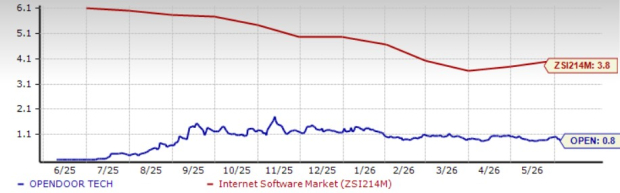
Image Source: Zacks Investment Research
The Zacks Consensus Estimate for OPEN's 2026 loss per share suggests a 61.5% year-over-year improvement. Loss per share estimates for 2026 have narrowed in the past 30 days.
EPS Trend of OPEN Stock
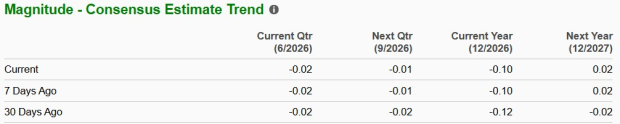
Image Source: Zacks Investment Research
OPEN stock currently has a Zacks Rank #4 (Sell).
You can see the complete list of today’s Zacks #1 Rank (Strong Buy) stocks here.
Beyond Nvidia: AI's Second Wave Is Here
The AI revolution has already minted millionaires. But the stocks everyone knows about aren't likely to keep delivering the biggest profits. AI’s second wave is moving from infrastructure to implementation and these companies are at the forefront of this transition, positioned to become what Amazon and Google were to the internet era.
See Stocks Now >>This article originally published on Zacks Investment Research (zacks.com).
