Key Points
Philip Morris has a strong position in the nicotine market, which should help its dividend grow.
Investors are too pessimistic about Pfizer's future, even as it pays a huge dividend yield right now.
Health insurance stocks like UnitedHealth Group look like a good value today.
It is during market drawdowns and investor panic that many realize stable dividend income is a superior investing strategy that helps you sleep easy at night. They may not be the sexiest growth stocks, but cash flow matters at the end of the day, which is why high-dividend-yielding stocks can be great assets to own across market environments.
Here are three monster dividend stocks you can buy today and hold for the next 10 years.
Will AI create the world's first trillionaire? Our team just released a report on the one little-known company, called an "Indispensable Monopoly" providing the critical technology Nvidia and Intel both need. Continue »
Image source: Getty Images.
New nicotine devices
First up is a stock in a sector full of huge dividend payers: nicotine. Philip Morris International(NYSE: PM) is one of the tobacco giants worldwide, and it has successfully expanded its business outside of cigarettes to the fast-growing categories of vaping and nicotine pouches.
Volumes at Philip Morris International actually grew in 2025, up 1.4% despite cigarettes facing declining demand worldwide. Smoke-free volumes grew 12.8% year over year, driven by the Zyn and Iqos brands. Organically, gross profit grew 19% year over year for the smoke-free business, demonstrating the pricing power and strong unit economics inherent in nicotine products.
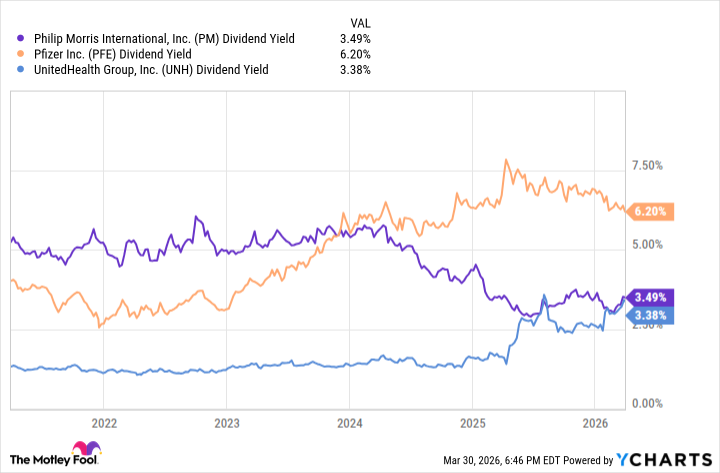
Right now, Philip Morris' stock has a dividend yield of 3.5%. As earnings from these new smoke-free products and cigarette price hikes grow, the company will be able to significantly increase its dividend per share in the years ahead.
Drugmaker downturn
The largest dividend on this list is Pfizer(NYSE: PFE), paying out a 6.2% yield as of this writing. Shares of the pharmaceutical giant are down big after the COVID-19 pandemic boom, when it made a lot of money selling vaccines around the globe. The stock is off 55% from all-time highs.
What's more, there has been a lot of recent noise around drug prices in the United States, with the government trying to take action to lower the costs for consumers. Pfizer has also been behind in the obesity drug market, which has sent the stocks of competitors like Eli Lilly soaring.
Expectations could not be lower. However, the company is researching heavily into oncology (cancer treatments) through its Seagen acquisition, as well as preparing its own obesity drugs for the market. With a high starting dividend yield, Pfizer stock is a steady income payer with upside if any of its new drugs become blockbusters.
PM Dividend Yield data by YCharts
Healthcare recovery
A different side of the healthcare market that has been beaten up last year is the health insurers. The largest in the United States is UnitedHealth Group(NYSE: UNH), with the stock down 58% from its highs and now paying a dividend yielding 3.4%.
Health insurance is not a loved industry, but healthcare spending is a growing part of the United States economy due to the country's aging population and healthcare cost inflation. Stocks like UnitedHealth Group have been hit by rising healthcare costs that were much higher than expected in 2025, hurting the profitability of its insurance operations. Earnings from operations fell 41% to $19 billion in 2024 due to rising costs and a confluence of headwinds, including a cyberattack.
In 2026, management expects operating earnings to rebound to $24 billion and to generate positive operating cash flow. Right now, UnitedHealth Group stock has a market cap of $237 billion, or only around 10x its projected 2026 operating earnings.
Investors are concerned about the ending of health insurance subsidies for the Affordable Care Act (ACA) marketplace, but this is only a small part of UnitedHealth's business. What smart investors will do is stay focused on the long term, which should drive more healthcare spending as the average age of the United States population continues to rise year after year.
This is definitely not the most popular business in the world, but UnitedHealth Group stock should deliver strong earnings growth in the years ahead, which can power its dividend payments to shareholders.
Should you buy stock in UnitedHealth Group right now?
Before you buy stock in UnitedHealth Group, consider this:
The Motley Fool Stock Advisor analyst team just identified what they believe are the 10 best stocks for investors to buy now… and UnitedHealth Group wasn’t one of them. The 10 stocks that made the cut could produce monster returns in the coming years.
Consider when Netflix made this list on December 17, 2004... if you invested $1,000 at the time of our recommendation, you’d have $518,530!* Or when Nvidia made this list on April 15, 2005... if you invested $1,000 at the time of our recommendation, you’d have $1,069,165!*
Now, it’s worth noting Stock Advisor’s total average return is 915% — a market-crushing outperformance compared to 183% for the S&P 500. Don't miss the latest top 10 list, available with Stock Advisor, and join an investing community built by individual investors for individual investors.
*Stock Advisor returns as of April 2, 2026.
Brett Schafer has no position in any of the stocks mentioned. The Motley Fool has positions in and recommends Pfizer. The Motley Fool recommends Philip Morris International and UnitedHealth Group. The Motley Fool has a disclosure policy.
