KROS: Is the Discount Book Value a Value Trap?

Keros TherapeuticsKROS posted a dramatic revenue jump in 2025, but the mix matters as much as the magnitude. The shares also trade at a steep discount to book value, creating the classic biotech question: deep value setup or value trap.
The answer hinges on whether Keros can convert a partner-driven, one-time windfall into steadier drivers while keeping burn in check long enough for its lead neuromuscular program to mature.
KROS Revenue Mix: License Gains, No Product Sales Yet
Keros generated total 2025 revenue of $244.1 million, up from $3.6 million in 2024, driven primarily by licensing and transition services tied to its Takeda partnership.
License revenue was $205.4 million, reflecting recognition of a $200.0 million upfront payment and a $10.0 million development milestone under the Takeda license for elritercept. Service and other revenue totaled $38.7 million, largely from transition services associated with clinical and manufacturing support.
The key constraint is straightforward: Keros has not recorded product sales to date. That leaves the top line dependent on partner economics and clinical progress rather than an internal commercial engine.
Keros Earnings Quality: One-Time Boost vs Repeatable Drivers
The central debate is earnings quality. A revenue base dominated by one-time license recognition can flatter results in a given year, then fade quickly if milestone timing is uneven. In 2025, the bulk of revenue came from the Takeda-related license line, with the remainder from reimbursed-type services.
That dynamic showed up late in the year. In the fourth quarter, revenue was just $0.4 million, entirely service and other revenue related to transition services, with no license revenue recognized in the period.
Until Keros establishes clearer, repeatable revenue drivers and a more predictable milestone cadence, forward financials can normalize lower and remain volatile. This makes valuation harder to underwrite, even when the stock looks statistically cheap.
KROS Cost Structure Reset After the Takeda Transition
A major offset to revenue volatility is a structurally leaner cost base after the Takeda transition. Development responsibilities and costs for elritercept shifted to Takeda, reshaping the profit-and-loss profile while preserving potential upside through milestones and tiered royalties.
The expense impact was visible in the fourth quarter. Research and development expense fell 61% year over year to $17.9 million, attributed to the transition of elritercept development responsibilities and expenses to Takeda.
This “leaner R&D base” matters because it supports a reduced internal cash burn narrative. It also allows management to prioritize execution on rinvatercept, the lead wholly owned program, while leveraging a capable partner on the other major asset.
Keros Runway: Cash Into the First Half of 2028
Liquidity is the second pillar of the thesis. Keros ended 2025 with $287.4 million in cash and cash equivalents, and management expects this to fund operations into the first half of 2028 under current operating assumptions. That runway reduces near-term financing overhang and gives Keros time to move rinvatercept through key clinical and regulatory steps, including a planned phase II start in Duchenne muscular dystrophy in the second quarter of 2026 and regulatory engagement on an amyotrophic lateral sclerosis phase II design in the second half of 2026.
Still, there is no quantified 2026 expense outlook. If external costs persist and clinical activity expands, burn could rise and funding needs could re-emerge sooner than expected.
Keros Therapeutics, Inc. Price, Consensus and EPS Surprise
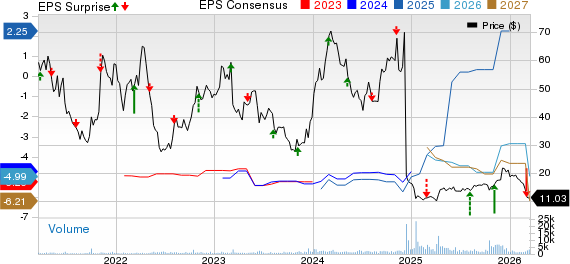
Keros Therapeutics, Inc. price-consensus-eps-surprise-chart | Keros Therapeutics, Inc. Quote
KROS Capital Return: Buybacks Changed the Share Count
Keros also made an unusually aggressive capital return move for a clinical-stage biotech. The company’s year-end cash balance was down 49% year over year, primarily reflecting capital return actions in 2025.
Those actions included an issuer tender offer of approximately $194.4 million and separate repurchases totaling approximately $180.6 million. Shares outstanding fell to 19.5 million at year-end.
This can support per-share metrics and amplify upside if clinical execution goes well, but it also reduces the cash cushion. With the stock trading at 0.71x trailing 12-month book value per share, investors are effectively weighing the balance sheet discount against program risk and revenue visibility.
Keros Decision Lens: Zacks Rank and What It Implies
In the Zacks framework, the practical decision comes down to whether Keros offers enough downside support and enough identifiable catalysts to justify holding through volatility. On the supportive side, the Takeda transition lowers internal spend and extends runway into the first half of 2028 under current assumptions.
On the risk side, the 2025 revenue surge was dominated by license recognition, with an uncertain milestone cadence and no product sales, which can keep results choppy. Execution risk is also concentrated in rinvatercept, where timing and follow-through on planned study starts and regulatory interactions will shape sentiment.
Competitive context reinforces the need for clean execution. Sarepta Therapeutics SRPT has an established Duchenne muscular dystrophy franchise, and PTC Therapeutics PTCT markets Emflaza in Duchenne muscular dystrophy, highlighting how crowded and complex the space is. Conviction improves as Keros demonstrates clearer, repeatable revenue drivers and steadier milestone execution alongside disciplined spending.
Research Chief Names "Single Best Pick to Double"
From thousands of stocks, 5 Zacks experts each have chosen their favorite to skyrocket +100% or more in months to come. From those 5, Director of Research Sheraz Mian hand-picks one to have the most explosive upside of all.
This company targets millennial and Gen Z audiences, generating nearly $1 billion in revenue last quarter alone. A recent pullback makes now an ideal time to jump aboard. Of course, all our elite picks aren’t winners but this one could far surpass earlier Zacks’ Stocks Set to Double like Nano-X Imaging which shot up +129.6% in little more than 9 months.
Free: See Our Top Stock And 4 Runners UpWant the latest recommendations from Zacks Investment Research? Today, you can download 7 Best Stocks for the Next 30 Days. Click to get this free report
Sarepta Therapeutics, Inc. (SRPT): Free Stock Analysis Report
PTC Therapeutics, Inc. (PTCT): Free Stock Analysis Report
Keros Therapeutics, Inc. (KROS): Free Stock Analysis Report
This article originally published on Zacks Investment Research (zacks.com).
