Tariffs Rose: 1 Steelmaker Thrived, 1 Still Struggles
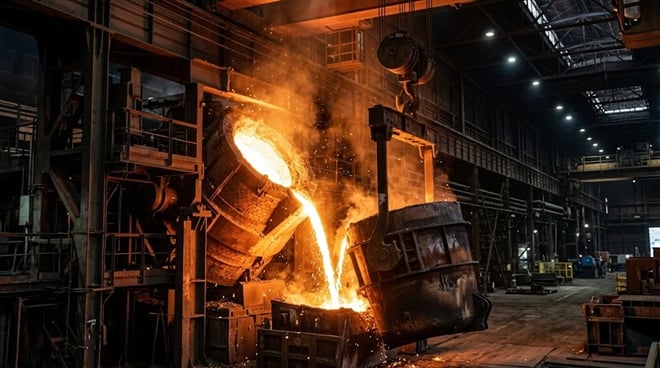
On April 20, two of America's largest steel companies reported earnings at a time that should have been bullish for steel companies. Imports are at a 17-year low in a tariff-sheltered market. However, having protected pricing is only bullish if a company can profit from it.
That’s where the outlook for Steel Dynamics (NASDAQ: STLD) and Cleveland-Cliffs (NYSE: CLF) diverges. For Q1 2026, Steel Dynamics made $403 million; Cleveland-Cliffs lost $229 million. Understanding the why behind those numbers is essential before investors decide how to approach each stock.
Why Steel Tariffs Aren’t an Automatic Buy Signal
The 50% tariff on imported steel has helped choke off foreign competition and push buyers toward domestic suppliers. In Q1 2026, U.S. steel imports hit their lowest quarterly level since 2009. Domestic producers are capturing demand that used to go offshore.
But the tariff is a floor, not a rocket. And how high a steelmaker can go depends entirely on how cheaply they can make steel. This is where the business models of Cleveland-Cliffs and Steel Dynamics diverge sharply.
The Old Model and the New Model
At its core, Cleveland-Cliffs is an integrated steelmaker. The process is expensive, requires a lot of energy, and the costs are largely fixed. That is, you can't easily throttle a blast furnace up or down when demand shifts. It also comes with a cost structure that includes infrastructure and workforce obligations.
Adding to those obligations, Cliffs has a heavily unionized labor force and, despite a remarkable 95% reduction in pension and OPEB liabilities since its ArcelorMittal acquisition, still operates with a debt load that means the company has to prioritize repayment before growth.
By contrast, Steel Dynamics runs 100% on electric arc furnace (EAF) technology. EAF mills melt recycled scrap metal using electricity, skipping the iron ore and blast furnace entirely, and can be dialed up or down with demand.
Plus, EAF steelmaking uses roughly one-quarter of the energy of traditional blast furnace production and generates a fraction of the emissions.
It's faster, cheaper to operate and structurally more flexible.
STLD also owns its own scrap recycling network through OmniSource, one of the largest nonferrous recyclers in North America, which gives it a cost advantage on raw materials that integrated producers simply can't replicate.
How the Business Models Showed Up in Earnings
Higher steel prices have benefited both companies with higher revenue per ton. But after that, the fundamentals come down to the spread between revenue and cost.
Steel Dynamics was able to convert $5.2 billion in revenue into $700 million of adjusted EBITDA, a 13% margin. That allowed the company to repurchase $115 million in stock and increase its dividend payout by 6%. STLD shot up over 10% in the days following the earnings release.
Cleveland-Cliffs converted $4.9 billion in revenue into $95 million of adjusted EBITDA, a margin of roughly 2%. Plus, it still posted a net loss of $229 million after interest and other charges. It’s not lost on investors that CLF doesn’t pay a dividend and fell over 8% in the days after the earnings release.
Where and Why Investors Need to Look Before They Leap
Having said that, earnings reports are backward-looking, and Cleveland-Cliffs is saying that the coming quarter will be better. They could be right.
On Sept. 17, 2025, the company signed a Memorandum of Understanding (MOU) with POSCO, Korea’s largest steelmaker and one of the top 10 global steelmakers. This could be a win-win. POSCO is looking to support and grow its established customer base in the United States, which has now become a favorable market.
However, the two companies have not reached a final agreement, and management says that will only happen if the deal is for “full and fair value.” Putting that not inconsequential detail to the side, analysts have a Hold rating on CLF, and Morgan Stanley lowered its price target to $12 from $18. But that’s in line with a consensus price target of $12.19; a 33% upside that suggests a belief in more than just hope.
On the other hand, Steel Dynamics is expanding into aluminum. Currently, that’s driving a loss of $65 million every quarter. In the long run, analysts believe this is a growth investment and not a liability.
But analysts are mixed. STLD gets a Hold rating with a consensus price target of $185.11, which is a downside of over 15%.
Nevertheless, analysts are raising their price targets, although the highest price rating still implies downside from recent prices.
Where Should You Invest $1,000 Right Now?
Before you make your next trade, you'll want to hear this.
MarketBeat keeps track of Wall Street's top-rated and best performing research analysts and the stocks they recommend to their clients on a daily basis.
Our team has identified the five stocks that top analysts are quietly whispering to their clients to buy now before the broader market catches on... and none of the big name stocks were on the list.
They believe these five stocks are the five best companies for investors to buy now...
The article "Tariffs Rose: 1 Steelmaker Thrived, 1 Still Struggles" first appeared on MarketBeat.
