Synchrony Financial (NYSE:SYF) Reports Sales Below Analyst Estimates In Q1 CY2026 Earnings


Consumer financial services company Synchrony Financial (NYSE:SYF) fell short of the market’s revenue expectations in Q1 CY2026, with sales falling 40% year on year to $2.23 billion. Its GAAP profit of $2.27 per share was 3.1% above analysts’ consensus estimates.
Is now the time to buy Synchrony Financial? Find out by accessing our full research report, it’s free.
Synchrony Financial (SYF) Q1 CY2026 Highlights:
- Net Interest Margin: 15.5% vs analyst estimates of 15.7% (20.8 basis point miss)
- Revenue: $2.23 billion vs analyst estimates of $3.79 billion (40% year-on-year decline, 41.2% miss)
- Efficiency Ratio: 35.6% vs analyst estimates of 34.3% (131.6 basis point miss)
- EPS (GAAP): $2.27 vs analyst estimates of $2.20 (3.1% beat)
- Tangible Book Value per Share: $37.62 vs analyst estimates of $38.15 (8.1% year-on-year growth, 1.4% miss)
- Market Capitalization: $27.31 billion
Company Overview
Powering over 73 million active accounts and partnerships with major brands like Amazon, PayPal, and Lowe's, Synchrony Financial (NYSE:SYF) provides credit cards, installment loans, and banking products through partnerships with retailers, healthcare providers, and digital platforms.
Revenue Growth
A company’s long-term sales performance can indicate its overall quality. Any business can experience short-term success, but top-performing ones enjoy sustained growth for years. Unfortunately, Synchrony Financial’s 4.8% annualized revenue growth over the last five years was tepid. This wasn’t a great result compared to the rest of the financials sector, but there are still things to like about Synchrony Financial.
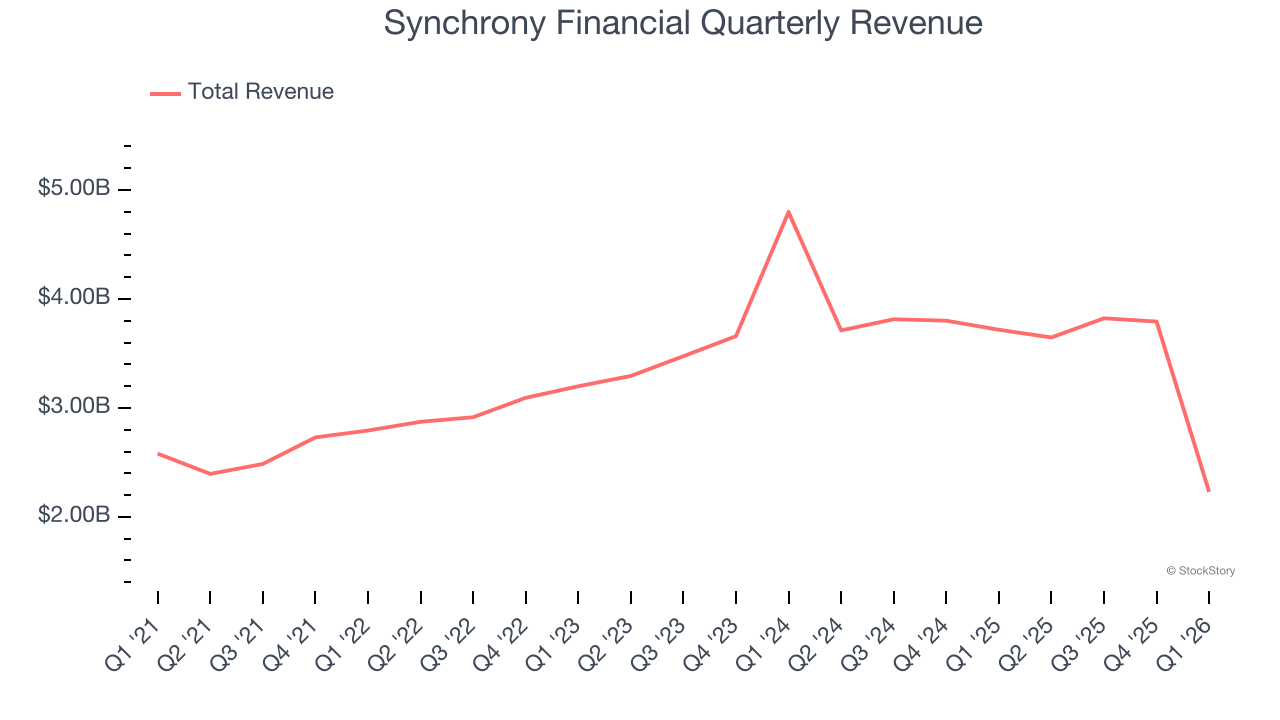
Long-term growth is the most important, but within financials, a half-decade historical view may miss recent interest rate changes and market returns. Synchrony Financial’s performance shows it grew in the past but relinquished its gains over the last two years, as its revenue fell by 5.9% annually. 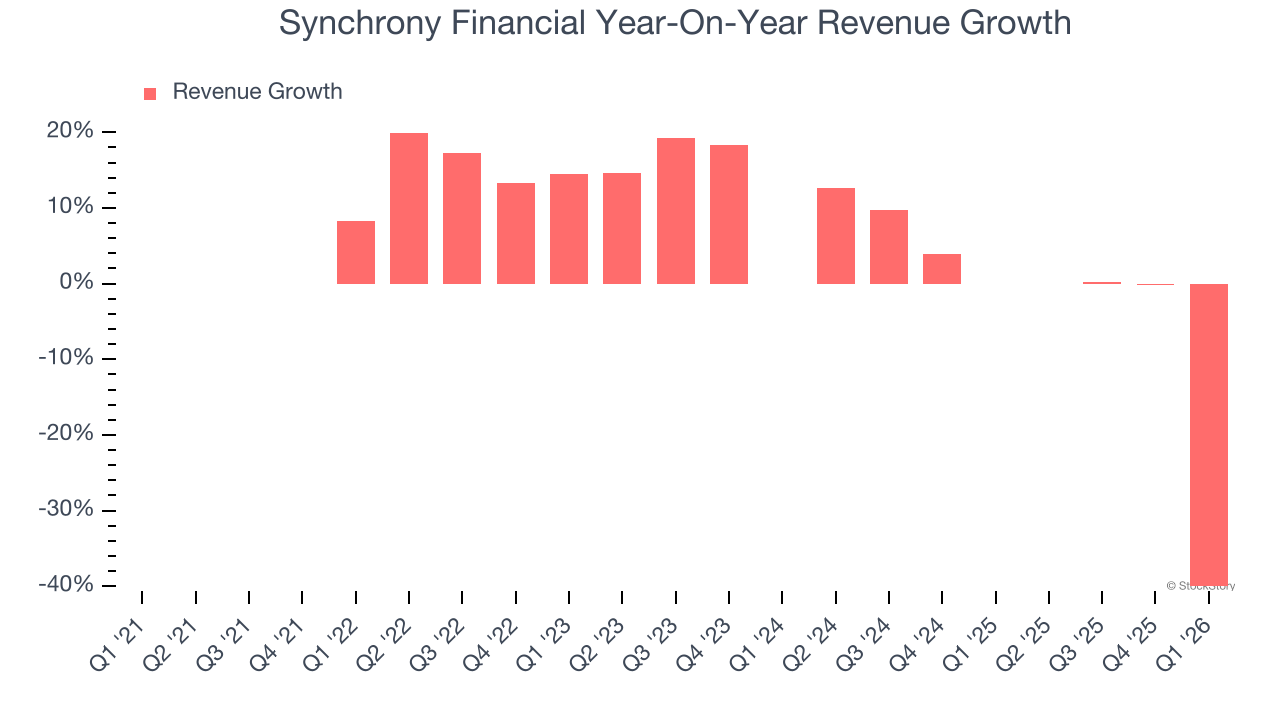 Note: Quarters not shown were determined to be outliers, impacted by outsized investment gains/losses that are not indicative of the recurring fundamentals of the business.
This quarter, Synchrony Financial missed Wall Street’s estimates and reported a rather uninspiring 40% year-on-year revenue decline, generating $2.23 billion of revenue.
ONE MORE THING: 3 Hidden Platforms Growing 3X Faster than Amazon, Google, and PayPal. Amazon, Google, and Meta all followed the same playbook: Dominate an ignored market. Build an unbeatable moat. Scale until you’re unstoppable.
These three platforms are running that exact playbook right now. The early investors in Amazon made fortunes. The early investors in these could do the same. Get All 3 Stocks Here for FREE.
Tangible Book Value Per Share (TBVPS)
Financial institutions manage complex balance sheets spanning various financial activities. Valuations reflect this complexity, emphasizing balance sheet quality and long-term book value compounding across multiple revenue streams.
This is why we consider tangible book value per share (TBVPS) an important metric for the sector. TBVPS represents the real net worth per share across all business segments, providing a clear measure of shareholder equity regardless of the complexity of operations. On the other hand, EPS is often distorted by the diverse nature of operations, mergers, and various accounting treatments across different business units. Book value provides clearer performance insights.
Synchrony Financial’s TBVPS grew at an excellent 15.9% annual clip over the last five years. TBVPS growth has recently decelerated to 11.3% annual growth over the last two years (from $30.36 to $37.62 per share).
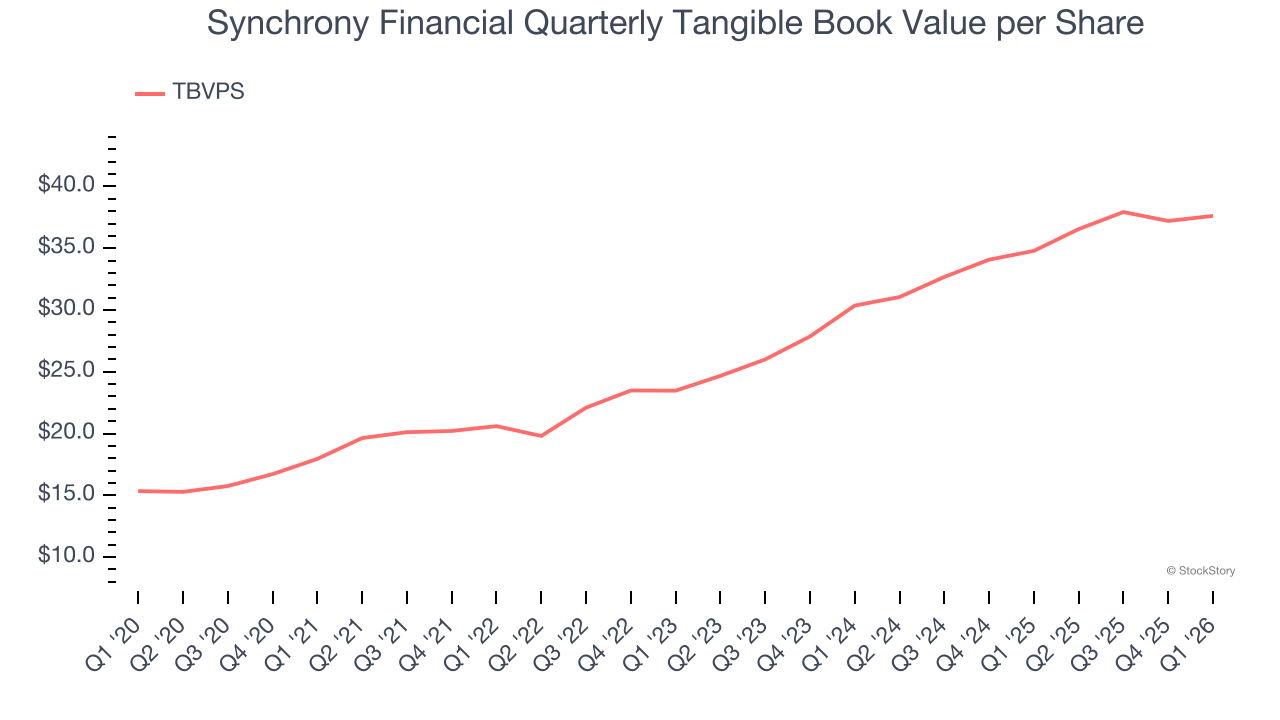
Tangible Book Value Per Share (TBVPS)
The balance sheet drives profitability for financial firms since earnings flow from managing diverse assets and liabilities across multiple business lines. As such, valuations for these companies concentrate on capital strength and sustainable equity accumulation potential across their varied operations.
This explains why tangible book value per share (TBVPS) is a premier metric for the sector. TBVPS provides concrete per-share net worth that investors can trust when evaluating companies with complex, multi-faceted business models. Other (and more commonly known) per-share metrics like EPS can sometimes be murky due to the complexity of multiple business lines, M&A activity, or accounting rules that vary across different financial services segments.
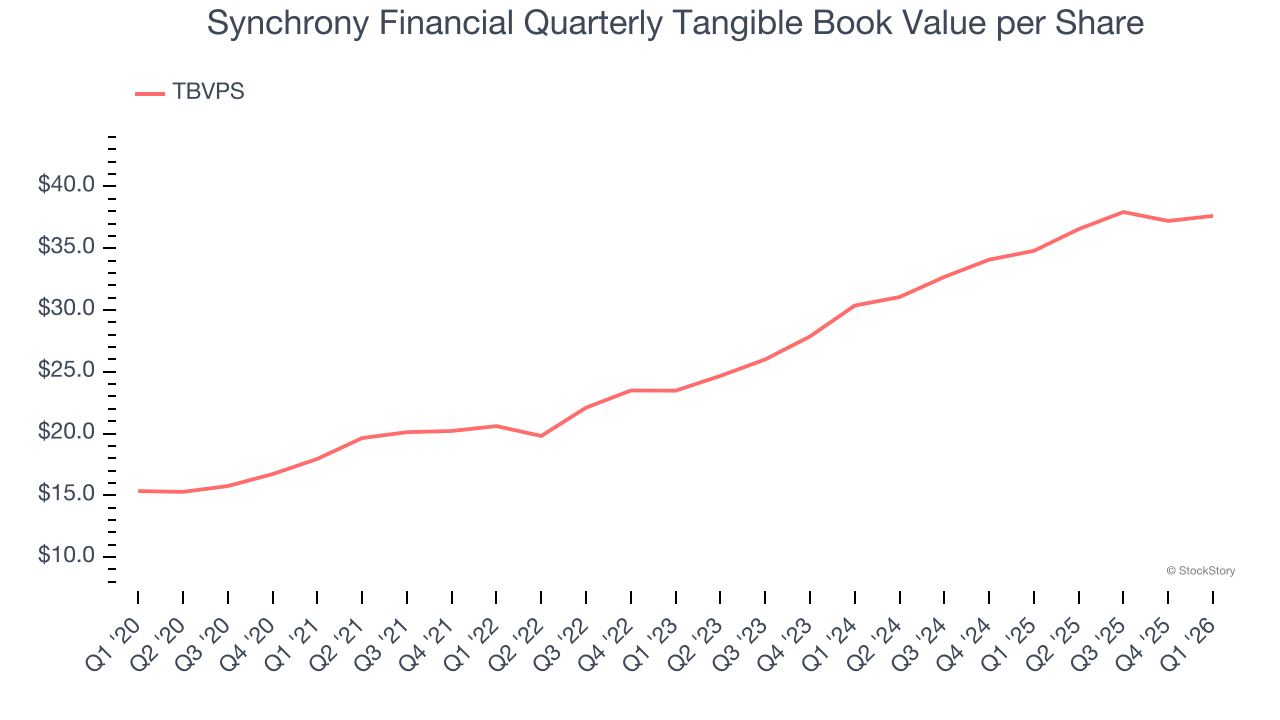
Synchrony Financial’s TBVPS grew at an excellent 15.9% annual clip over the last five years. TBVPS growth has recently decelerated to 11.3% annual growth over the last two years (from $30.36 to $37.62 per share).
Key Takeaways from Synchrony Financial’s Q1 Results
We enjoyed seeing Synchrony Financial beat analysts’ efficiency ratio expectations this quarter. We were also glad its EPS outperformed Wall Street’s estimates. On the other hand, its net interest margin missed and its revenue fell short of Wall Street’s estimates. Overall, this was a softer quarter. The stock traded down 1.1% to $77.71 immediately following the results.
Synchrony Financial underperformed this quarter, but does that create an opportunity to invest right now? If you’re making that decision, you should consider the bigger picture of valuation, business qualities, as well as the latest earnings. We cover that in our actionable full research report which you can read here (it’s free).
