Key Points
The Magnificent Seven tech stocks led the market higher in recent years -- but they stumbled in the first quarter.
Each of these players is involved in the high-growth field of AI.
The Magnificent Seven isn't just a Western from 1960. The term these days is also associated with a group of technology-related stocks that have driven stock market gains in recent years. They specialize in a variety of exciting areas, from cloud computing to electric cars, and investors have been eager to get in on these growth stories. But in the recent quarter, the momentum screeched to a halt.
In the first quarter of the year, every Magnificent Seven stock delivered a negative performance, with declines spanning about 6% to 23%. This came amid a generally difficult environment for growth stocks: The war in Iran has represented considerable uncertainty, driving up oil prices and calling into question the delivery of industrial supplies via the Strait of Hormuz.
Will AI create the world's first trillionaire? Our team just released a report on the one little-known company, called an "Indispensable Monopoly" providing the critical technology Nvidia and Intel both need. Continue »
So it wasn't surprising to see even the most successful tech stocks falling out of favor with investors. Today, the conflict in Iran isn't resolved, and in recent days we've seen progress followed by setbacks -- still, amid the current ceasefire, investors remain hopeful that leaders will continue on the path of negotiations. That's favored a rebound in many growth stocks. With all of the stocks across industries to choose from, however, is the Magnificent Seven yesterday's news? Let's find out.

Image source: Getty Images.
Profitable growth companies
First, let's identify this group of tech mammoths. They are: Amazon(NASDAQ: AMZN), Apple (NASDAQ: AAPL), Alphabet(NASDAQ: GOOG)(NASDAQ: GOOGL), Meta Platforms(NASDAQ: META), Microsoft (NASDAQ: MSFT), Nvidia(NASDAQ: NVDA), and Tesla(NASDAQ: TSLA). These are profitable companies that have delivered growth for investors over several years.
They are also each involved -- in varying degrees -- in artificial intelligence (AI), so investors have sought them out to benefit from the AI boom. Nvidia may be considered the biggest AI stock as it's the leading provider of globally of AI chips, but cloud providers Amazon, Microsoft, and Alphabet may represent a close second -- they provide customers with chips and related products and services to run AI workloads.
It's important to note that, along with the uncertainty about conflict in Iran, these players also faced a specific headwind: Some investors worried about the level of investment in AI, and whether AI-driven revenue down the road truly would be a game-changer for companies. All of this prompted investors to hesitate before buying AI stocks, particularly those that had risen significantly, such as the Magnificent Seven.
Four major tech players
Now, let's return to our question: Is this group of tech stocks yesterday's news? A look at history offers us a valuable clue. Here, I zoomed in on four of the major players over the past 20 years -- and at their performance through challenges such as the financial crisis of 2008, a U.S. recession, shown as the shaded area in the chart, and the pandemic in 2020.
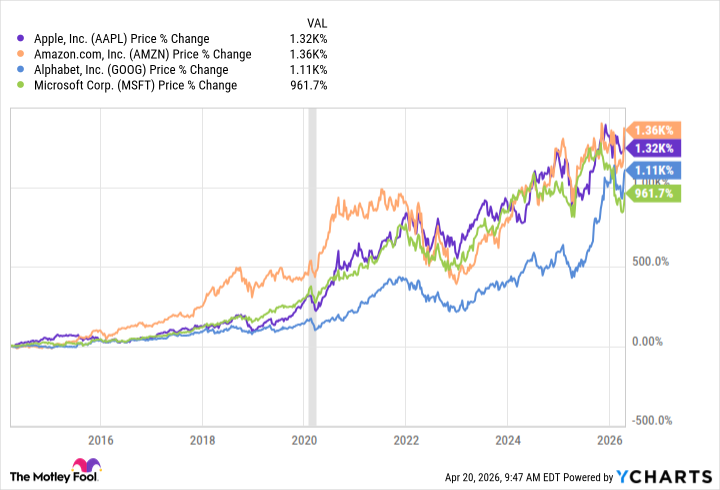
As we can see, they've each gained in the triple or quadruple digits over this period, have rebounded from times of trouble fairly quickly, and the general path over the long run has been upward.
So, history shows us that quality tech stocks won't stay down for long and are likely to recover and grow. This is great news for shareholders of the Magnificent Seven.
Still, it's important to keep in mind that the Magnificent Seven may not remain the main growth driver for the S&P 500 index eternally. Many other strong tech players -- such as Broadcom or Oracle, for example -- aren't members of this elite group, yet they've delivered impressive earnings growth in recent quarters and are likely to continue along that path. All of this means that though the Magnificent Seven isn't yesterday's news, this group isn't the only route to growth for the index or for your portfolio.
It's key to consider other tech players that, in some cases, have already delivered growth and have fantastic prospects as the AI boom marches on. And in the quarters ahead, stocks from other industries may play a bigger role in the S&P 500's gains, too. All of this supports the idea of diversifying across a broad range of quality stocks -- and, as history reminds us, holding on for the long term.
Should you buy stock in Microsoft right now?
Before you buy stock in Microsoft, consider this:
The Motley Fool Stock Advisor analyst team just identified what they believe are the 10 best stocks for investors to buy now… and Microsoft wasn’t one of them. The 10 stocks that made the cut could produce monster returns in the coming years.
Consider when Netflix made this list on December 17, 2004... if you invested $1,000 at the time of our recommendation, you’d have $511,411!* Or when Nvidia made this list on April 15, 2005... if you invested $1,000 at the time of our recommendation, you’d have $1,238,736!*
Now, it’s worth noting Stock Advisor’s total average return is 986% — a market-crushing outperformance compared to 199% for the S&P 500. Don't miss the latest top 10 list, available with Stock Advisor, and join an investing community built by individual investors for individual investors.
*Stock Advisor returns as of April 21, 2026.
Adria Cimino has positions in Amazon, Oracle, and Tesla. The Motley Fool has positions in and recommends Alphabet, Amazon, Apple, Broadcom, Meta Platforms, Microsoft, Nvidia, Oracle, and Tesla. The Motley Fool has a disclosure policy.
