Key Points
Ackman looks for "simple, predictable, and free-cash-flow-generative" businesses.
SpaceX doesn't exactly meet these definitions yet, but it could in the future.
The IPO is expected to be massive and could value SpaceX at $2 trillion.
Billionaire investor Bill Ackman and his fund, Pershing Square Capital Management (PSCM), have invested in plenty of large technology and artificial intelligence stocks lately. Pershing now has a stake in Uber, Amazon, Meta Platforms, and Alphabet.
With SpaceX's initial public offering just a few weeks away, it could value the Elon Musk-founded company as high as $2 trillion. Would Ackman consider jumping into this initial public offering (IPO)?
Will AI create the world's first trillionaire? Our team just released a report on the one little-known company, called an "Indispensable Monopoly" providing the critical technology Nvidia and Intel both need. Continue »
Ackman has shown interest in SpaceX before
While not fully conclusive, Pershing's ownership of Amazon could indicate some interest in the space economy. Similar to SpaceX's Starlink, Amazon has been building a low-Earth orbit satellite network to provide phone and data services in areas with limited access to traditional internet infrastructure.
Recently, Amazon furthered those ambitions by announcing the acquisition of Globalstar, which has 24 satellites and a key agreement with Apple in place that helps users send distress messages when they don't have service. Still, Ackman and his team likely bought Amazon primarily for its e-commerce business and its Amazon Web Services cloud business.
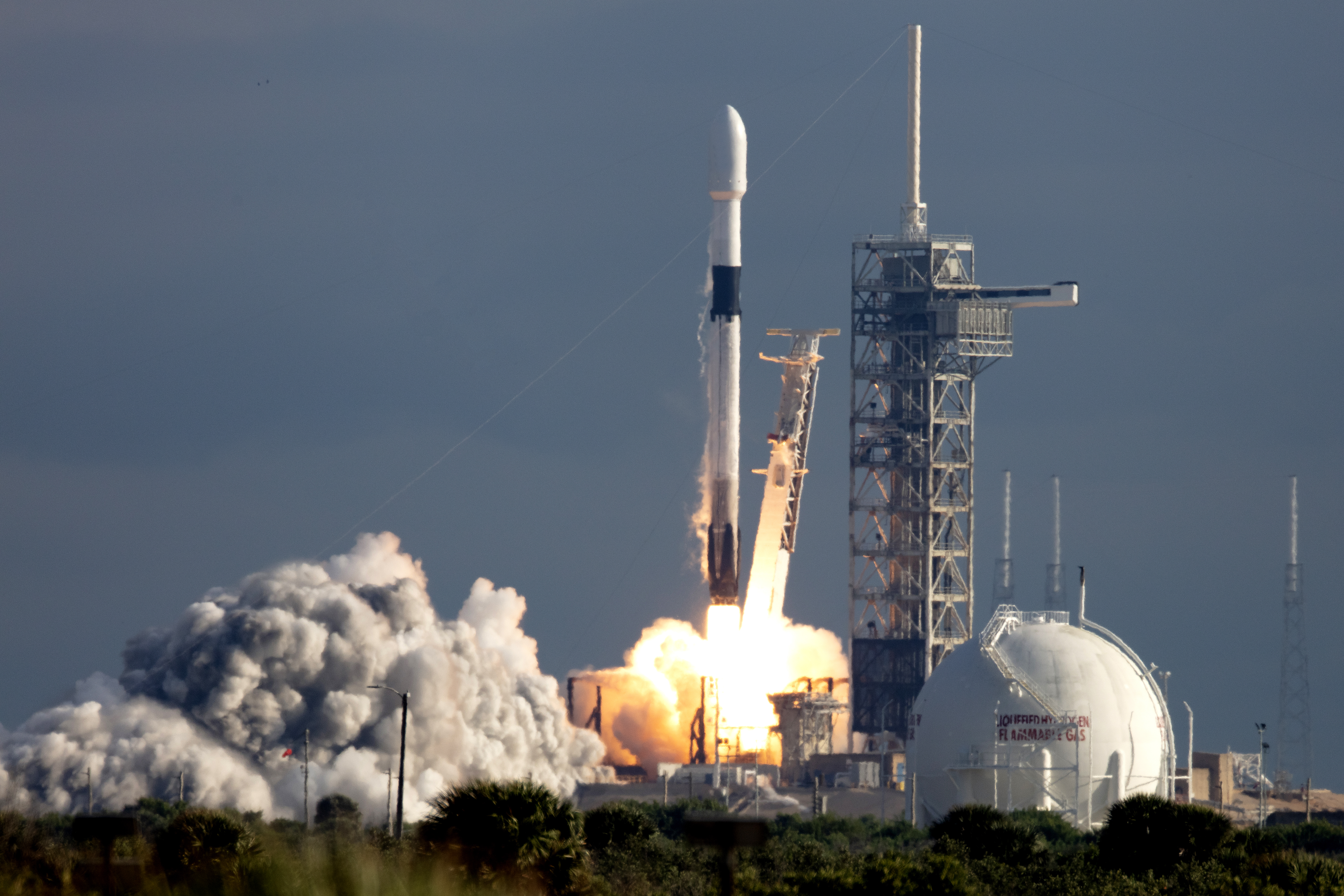
Image source: Getty Images.
However, last December, Ackman showed clear interest in SpaceX. On X, Ackman proposed combining SpaceX with Pershing Square SPARC Holdings. A SPARC is a special-purpose acquisition rights vehicle. SPARCs differ from SPACs (special purpose acquisition companies) because they distribute rights to investors and don't raise or hold capital until a deal is finalized. SPARCs also typically have longer timelines than SPACs.
In a long post on X, Ackman said that SPARC rights could be distributed to Tesla shareholders. Musk has previously expressed a desire to give Tesla shareholders access to the SpaceX IPO. The purpose, according to Ackman, would be to allow SpaceX to go public with no underwriting fees or dilution in the raise.
Musk clearly chose a different direction, given that SpaceX has reportedly hired over 20 banks to help carry out the massive IPO.
SpaceX doesn't exactly meet Ackman's criteria
Recently, Ackman and Pershing announced a new closed-end fund targeted at U.S. investors that would allow them to buy into PSCM without paying performance fees, unlike most institutional investors who invest in hedge funds.
In a letter to prospective shareholders, Ackman discussed his investment philosophy and how he and his team choose stocks:
Over time, we have come to learn that the best businesses for investment have similar characteristics. They are simple, predictable, and free-cash-flow-generative. They have impenetrable 'moats' or large barriers to entry protecting them from disruption, a growing risk in a world in the midst of massive technological change. They are often asset-light, and generate recurring and rapidly growing, inflation-protected, free cash flows that do not need to be reinvested in the business for the company to grow. They do not need large amounts of leverage to generate high returns on capital. And they have limited exposure to extrinsic threats outside of the control of the company.
Based on this description, SpaceX doesn't seem like a good fit for PSCM's portfolio, at least for now. According to The Information, while Starlink generated $3 billion in free cash flow, SpaceX's launch business and artificial intelligence (AI) segment collectively posted negative free cash flow of $17 billion. Capital expenditures were reportedly nearly $21 billion.
That's likely because Starlink is very capital-intensive right now due to the build-out of its low-Earth orbit satellite network. Starlink reportedly has 10,000 satellites in orbit, but it aims to have over 40,000 when everything is said and done.
While SpaceX appears to be a leader in the space economy, it faces competition and could, of course, face "extrinsic" threats beyond its control, such as regulation or a range of potential disasters beyond Earth's atmosphere.
It could become an Ackman stock in the future
Now, this doesn't mean SpaceX couldn't eventually turn into an Ackman stock down the line. For instance, once the satellite network is built out, the business will likely be less capital-intensive and generate much more free cash flow. SpaceX already has a head start in building its low-orbit network.
Plus, Gene Munster of Deepwater Asset Management said on X that what SpaceX is really trying to do is have sovereign AI, where it has complete control over the entire AI stack from the infrastructure to the models powering the intelligence. SpaceX also holds spectrum licenses that authorize it to operate Starlink. There is a finite number of spectrum licenses available in the U.S.
One could argue that these attributes give the company a strong, impenetrable moat, especially if SpaceX can achieve sovereign AI.
Whether Ackman invests in the IPO or the stock will depend on how much he and his team believe SpaceX can achieve all and in what time frame. PSCM's portfolio suggests that Ackman prefers mature businesses at fair valuations and turnaround stories, so I don't see it getting involved in the IPO. However, given the billionaire's prior interest in SpaceX, there is still a small chance.
Where to invest $1,000 right now
When our analyst team has a stock tip, it can pay to listen. After all, Stock Advisor’s total average return is 994%* — a market-crushing outperformance compared to 199% for the S&P 500.
They just revealed what they believe are the 10 best stocks for investors to buy right now, available when you joinStock Advisor.
*Stock Advisor returns as of April 21, 2026.
Bram Berkowitz has no position in any of the stocks mentioned. The Motley Fool has positions in and recommends Alphabet, Amazon, Apple, Meta Platforms, Tesla, and Uber Technologies and is short shares of Apple. The Motley Fool has a disclosure policy.
