3 Stocks to Invest in From the Flourishing Foreign Banks Industry

The Zacks Foreign Banks Industry remains shaped by restructuring, divergent interest-rate paths and an uneven economic recovery. While lenders are streamlining operations, exiting non-core markets and reallocating capital toward higher-return, fee-generating businesses, automation and workforce optimization support efficiency. Meanwhile, elevated rates should provide support to net interest income (NII), although margin trends will vary across regions.
Against this backdrop, Mitsubishi UFJ Financial GroupMUFG, UBS GroupUBS and KB Financial GroupKB are positioned to benefit differently. However, slower growth in certain economies, geopolitical tensions, trade disruptions and persistent inflation could constrain loan demand and hurt profitability across the industry.
About the Industry
The Zacks Foreign Banks Industry consists of overseas banks with operations in the United States. Since a foreign banking organization may have federal and state-chartered offices in the country, the Federal Reserve plays a major role in supervising its U.S. operations. In addition to providing a broad range of products and services to customers in the United States, these banks offer financial services to corporate clients having businesses in the country. Financial firms establish relations with U.S. corporations operating in their home countries. Some units of foreign banks offer a broad range of wholesale and retail services, and conduct money-market transactions for their parent organizations. Some industry players are involved in developing only specialized services like wealth/asset management and investment banking.
3 Themes Impacting the Foreign Banks Industry
Restructuring Efforts to Drive Efficiency: Global lenders continue to streamline operations by exiting non-core markets, reducing low-return businesses and reallocating capital toward higher-growth, fee-generating segments such as wealth management, transaction banking and digital platforms. These efforts are strengthening the revenue mix and improving capital efficiency while deepening client relationships.
At the same time, workforce optimization, branch rationalization and technology-driven automation are supporting tighter cost control and lower cost-to-income ratios. Continued restructuring should therefore provide a sustainable lift to profitability by aligning capital, costs and resources with higher-return growth opportunities.
Higher-for-Longer Rates to Support NII, While Creating Divergent Margin Trends: The global interest-rate environment remains uneven, with major central banks following different policy paths. The Federal Reserve and Bank of England are maintaining relatively high policy rates, while the European Central Bank has paused after its June hike and the Bank of Japan is moving toward further monetary tightening. This divergence should provide near-term support to foreign banks’ NII by keeping asset yields elevated and slowing the pace of margin compression in higher-rate markets.
At the same time, net interest margin (NIM) performance will remain uneven across geographies. Banks in markets experiencing rate stability or renewed tightening should retain stronger spreads, whereas those exposed to earlier easing cycles may continue to face pressure as loan yields reprice downward. However, lower rates could also stimulate loan demand and partially offset margin compression. Overall, the current rate backdrop is likely to be a modest positive for foreign banks’ near-term NII and profitability, although the benefit will vary significantly by geographic and balance-sheet exposure.
Inconsistent Global Economic Recovery to Limit Growth: Uneven global economic recovery remains a key challenge, which will likely create significant differences in growth and profitability across foreign banks. While some economies, particularly the United States and parts of Asia, have returned to relatively stable growth, many regions are still contending with the lingering effects of the pandemic, including weak consumer spending, subdued business investment and elevated debt levels. At the same time, geopolitical tensions, trade disruptions and persistent inflationary pressures continue to weigh on economic activity in Europe, China and several emerging markets. Because banks’ earnings are closely tied to the health of the broader economy, slower growth can limit loan demand from households and businesses, reducing opportunities for balance sheet expansion and revenue growth.
Zacks Industry Rank Indicates Bright Prospects
The Zacks Foreign Banks Industry is an 83-stock group within the broader Zacks Finance Sector. The industry currently carries a Zacks Industry Rank #93, which places it at the top 38% of more than 250 Zacks industries.
The group’s Zacks Industry Rank, which is basically the average of the Zacks Rank of all the member stocks, indicates outperformance in the near term. Our research shows that the top 50% of the Zacks-ranked industries outperform the bottom 50% by a factor of more than 2 to 1.
The industry’s positioning in the top 50% of the Zacks-ranked industries is because of an improving earnings outlook for the constituent companies in aggregate. The aggregate earnings estimate revisions show that analysts are gaining confidence in this group’s growth potential. Since the end of August 2025, the industry’s most recent earnings estimates for 2026 have been revised 7.9% higher.
Thus, we present a few stocks from the industry that you may want to consider for long-term gains. But before that, let us check out the industry’s recent stock market performance and valuation picture.
Industry vs. S&P 500 & Sector
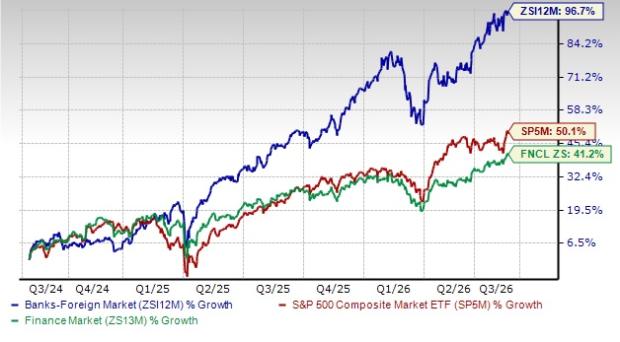
The Zacks Foreign Banks Industry has outperformed the S&P 500 and its sector in the past two years. Stocks in the industry have collectively surged 96.7%. The S&P 500 composite has rallied 50.1% and the Zacks Finance Sector has appreciated 41.2%.
2-Year Price Performance
Industry's Valuation
One may get a good sense of the industry’s relative valuation by looking at its price-to-tangible book ratio (P/TBV), which is commonly used for valuing foreign banks because of large variations in their earnings from one quarter to the next.
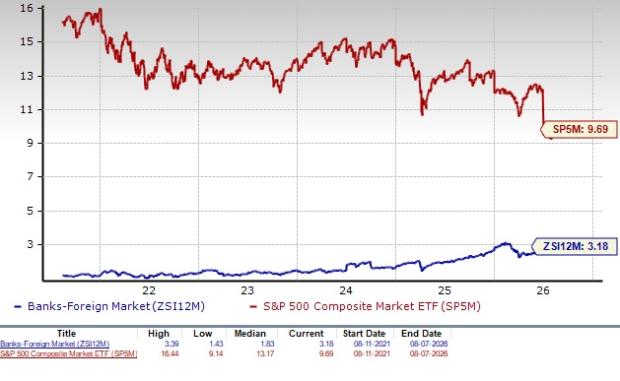
The industry currently has a trailing 12-month P/TBV of 3.18X. This compares with the highest level of 3.39X, the lowest level of 1.43X and the median of 1.83X over the past five years. The industry is trading at a significant discount compared with the market at large, as the trailing 12-month P/TBV for the S&P 500 composite is 9.69X, which the chart below shows.
Price-to-Tangible Book Ratio (TTM)
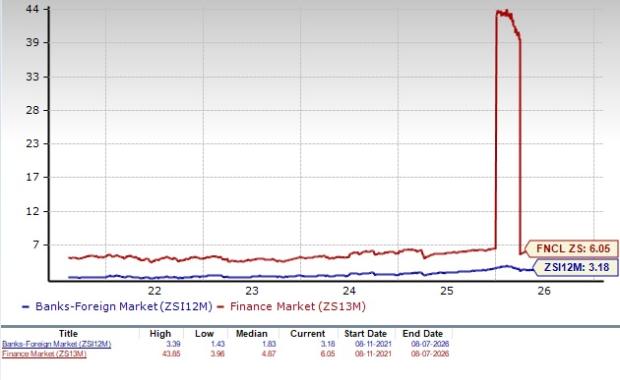
As finance stocks typically have a lower P/TBV ratio, comparing foreign banks with the S&P 500 may not make sense to many investors. However, a comparison of the group’s P/TBV ratio with that of its broader sector ensures that it is trading at a decent discount. The Zacks Finance Sector’s trailing 12-month P/TBV of 6.05X and the median level of 4.87X for the same period are above the Zacks Foreign Banks Industry’s ratios.
Price-to-Tangible Book Ratio (TTM)
3 Foreign Bank Stocks to Invest In
Mitsubishi UFJ: Headquartered in Tokyo, Japan, this Zacks Ranked #2 (Buy) company is the world’s leading bank-holding company that operates under an integrated business group system.
The company has pursued inorganic growth alongside business restructuring to broaden its earnings base. In October 2025, MUFG Bank completed regulatory procedures to acquire 100% of its overseas securities subsidiaries, strengthening the integrated platform for its global wholesale, investment-banking and securities operations. Also, MUFG has expanded its digital and sustainability footprint through investments in Greenprint Technologies, an alliance with Curiosity Lab focused on smart-city and next-generation technologies, the acquisition of a 50.02% stake in Zenhoren through its credit-card affiliate and the full buyout of fintech/robo-adviser WealthNavi.
The strategy is increasingly centered on diversification and higher-value businesses. MUFG is targeting stronger domestic retail banking, corporate and investment banking, wealth management, global markets and non-interest income, while reducing dependence on traditional NII over time. The company is also deepening its retail franchise through the Emut platform, with more than 1 million new accounts, while plans to establish a digital bank and use AI and data are expected to enhance cross-selling and customer engagement. The May 2026 strategic alliance with Google further supports its push toward AI-enabled financial services.
Recent results indicate that this diversification is already translating to stronger earnings. MUFG reported record-high fiscal first-quarter (ended June 30, 2026) net income of 809.4 billion yen, up 48% year over year, while net operating profit rose to 809 billion yen, reaching 28% of its full-year target. Growth was driven by higher loan balances, fee income and the benefit of higher rates, while fee income remained strong across solutions, lending-related businesses and asset management.
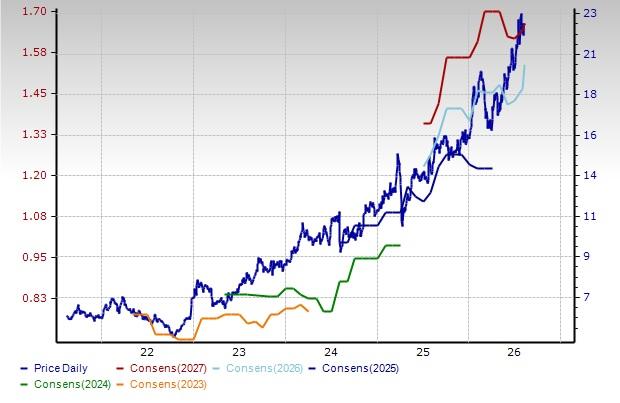
International expansion and capital returns support the outlook. In July 2026, MUFG Bank and JCB agreed to a comprehensive ASEAN alliance targeting affluent customers, digital payments and cross-border financial services, with a premium card planned for Indonesia and potential collaboration with MUFG’s digital-finance investees. This builds on MUFG’s strategy of capturing Asia growth through commercial-bank investments and digital finance. Meanwhile, strong capital generation continues to provide flexibility for shareholder returns. Over the past six months, MUFG shares have gained 14.6% on the NYSE. Earnings estimates for the current fiscal year have been revised marginally higher in the past seven days.
Price & Consensus: MUFG
UBS Group: Headquartered in Zurich, Switzerland, this Zacks Ranked #1 (Strong Buy) company has, for years, fortified its footprint and expanded operations on the back of partnerships and buyouts. In June 2023, UBS completed the regulatory-assisted acquisition of Credit Suisse, followed by the merger with Credit Suisse AG in May 2024. The integration progressed steadily, with more than 90% of Credit Suisse Wealth Management accounts in key international markets migrated by 2024. By March 2026, UBS had migrated all Swiss-booked clients, completing the transition of 1.2 million former Credit Suisse clients globally.
It has now entered the final phase of the integration, including the decommissioning of legacy IT infrastructure, expected to continue through 2026. Also in March 2026, UBS Bank USA received a national bank charter, expanding its U.S. banking and wealth management capabilities. In April, UBS partnered with 360 ONE WAM, selling its Indian wealth business while acquiring a 4.95% stake. More recently, in July, it partnered with MSCI Inc. to enhance transparency in private markets by combining MSCI’s data, analytics and AI capabilities with UBS’s alternatives expertise.
UBS Group’s NII has seen a compound annual growth rate (CAGR) of 5.7% over the last five years (ending 2025), with the uptrend continuing in the first half of 2026. Its net fee and commission income also witnessed a year-over-year rise in the first half of this year, reflecting higher fee-generating assets and client activity. Going forward, repricing efforts, deposit cost management and an improvement in loan demand are expected to continue driving the top line.
However, the company’s escalating expense base is concerning, as it exposes it to operational risks. Expenses witnessed a CAGR of 10.7% in the five years ended 2025, with the uptrend continuing in the first half of 2026. The company expects to incur cumulative integration-related expenses of $15 billion by the end of 2026, while assuming constant foreign-exchange rates.
Shares of UBS Group have gained 27.2% on the NYSE in the past six months. The Zacks Consensus Estimate for the company’s 2026 earnings has been revised marginally higher in the past seven days.
Price & Consensus: UBS
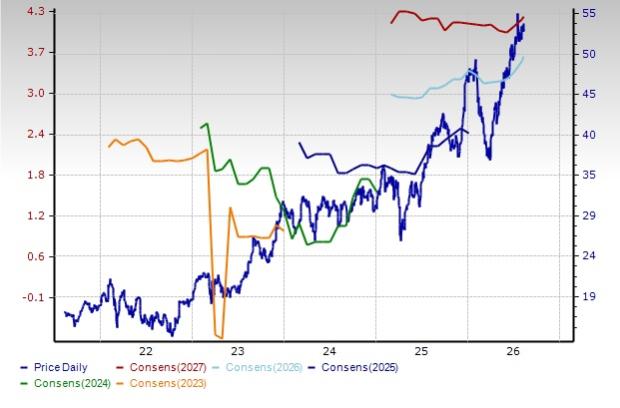
KB Financial: Headquartered in Seoul, South Korea, KB Financial is one of the country’s largest financial holding companies by consolidated assets. Established in 2008, the group was created to bring Kookmin Bank and several related financial businesses under a single holding-company structure, enabling greater integration across businesses, broader product offerings and more efficient capital allocation.
KB operates as a diversified financial-services group rather than a pure-play commercial bank. Alongside Kookmin Bank, its major subsidiaries include KB Securities, KB Kookmin Card, KB Insurance, KB Life Insurance, KB Asset Management, KB Capital, KB Savings Bank and KB Real Estate Trust.
Its business model remains anchored by NII from the banking franchise, but KB is increasingly benefiting from diversification into fee-based and capital-markets businesses. In 2025, group NII rose 1.9% to KRW 13.07 trillion despite the lower-rate environment, as funding costs declined faster than interest income. At the same time, net fee and commission income increased 6.4% to KRW 4.10 trillion, supported by stronger securities commissions and foreign-currency-related fees.
The diversification trend has become more pronounced in 2026. In the first half, KB Financial reported KRW 3.88 trillion of net profit, up 13.1% year over year, driven primarily by strong non-interest income and capital-market-related fees. Group NII increased 1.7% to KRW 6.48 trillion, while net non-interest income jumped 33.3% to KRW 3.63 trillion, with net fee and commission income surging 50.6% to KRW 2.96 trillion. Non-bank businesses contributed 44% to group net profit, underscoring the increasing importance of diversification.
Currently, KB sports a Zacks Rank of 1. Its shares have gained 10.9% on the NYSE in the past six months. The Zacks Consensus Estimate for the company’s 2026 earnings has been unchanged in the past seven days.
Price & Consensus: KB
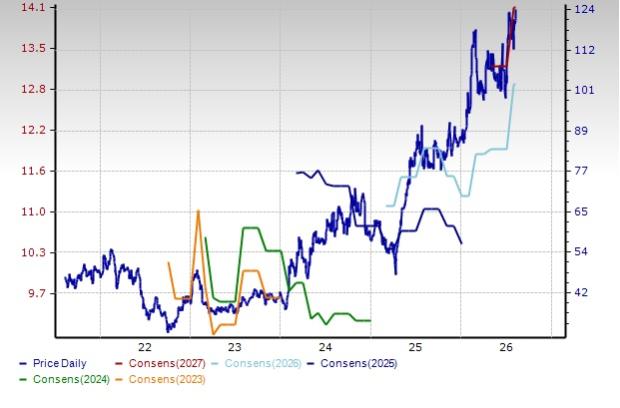
Zacks' Research Chief Names "Stock Most Likely to Double"
Our team of experts has just released the 5 stocks with the greatest probability of gaining +100% or more in the coming months. Of those 5, Director of Research Sheraz Mian highlights the one stock set to climb highest.
This top pick is a little-known satellite-based communications firm. Space is projected to become a trillion dollar industry, and this company's customer base is growing fast. Analysts have forecasted a major revenue breakout in 2025. Of course, all our elite picks aren't winners but this one could far surpass earlier Zacks' Stocks Set to Double like Hims & Hers Health, which shot up +209%.
Free: See Our Top Stock And 4 Runners UpThis article originally published on Zacks Investment Research (zacks.com).
