Is SASE Emerging as a Key Growth Driver for Palo Alto Networks?

Palo Alto NetworksPANW is seeing strong growth in its Secure Access Service Edge (SASE) business. In the third quarter of fiscal 2026, SASE annual recurring revenues (ARR) reached $1.6 billion, up 40% year over year. The growth rate was more than twice the overall SASE market growth rate, according to management. PANW's SASE business is benefiting from strong customer demand for cloud-delivered networking and security solutions as enterprises continue to support hybrid work environments and secure access to cloud applications.
Customer wins remain a key contributor to growth. Year to date, PANW recorded nearly 50 displacement wins worth $200 million in contract value. These wins came from customers replacing competing networking and security products with PANW's platform. Management noted that many enterprises are increasingly looking to reduce the number of vendors they work with and prefer a single platform that combines networking, security and policy management capabilities. This trend is helping PANW gain market share in the SASE market.
Another growth driver is strong momentum in Secure Browser adoption as organizations are adopting browser security solutions to improve visibility and control over employee activity and data access. Secure Browser reached 11 million licenses in the third quarter, up four times compared with the year-ago period, as more employees increase their usage of cloud applications and AI tools through web browsers.
PANW also benefits from its large installed base of firewall customers. Existing customers can extend the same security policies across their networks and SASE environments without adding another vendor. With $1.6 billion in SASE ARR, 40% year-over-year growth, strong competitive wins and rising Secure Browser adoption, SASE is becoming a larger and more meaningful contributor to Palo Alto Networks' long-term growth.
The Zacks Consensus Estimate for fiscal 2026 and 2027 revenues indicates a year-over-year increase of around 23.7% and 20.2%, respectively.
How Competitors Fare Against PANW
ZscalerZS and Fortinet FTNT are key rivals to Palo Alto Networks in the SASE space.
Zscaler is also expanding into browser-based security. ZS offers cloud-native secure access through its ZIA and ZPA platforms. In the third quarter of fiscal 2026, Zscaler saw continued demand from customers replacing legacy VPNs with its zero-trust architecture.
Fortinet is growing fast, driven by the rising adoption of its FortiSASE platform. In the first quarter of 2026, Fortinet’s Unified SASE ARR grew 12% year over year. Fortinet delivers all core SASE capabilities within a single operating system. Further, Fortinet’s Sovereign SASE enables large enterprises and service providers to have full on-premises or in-country control of their data.
PANW’s Price Performance, Valuation & Estimates
Shares of Palo Alto Networks have jumped 51.6% in the year-to-date period compared with the Zacks Security industry’s return of 44.2%.
PANW’s YTD Price Return Performance
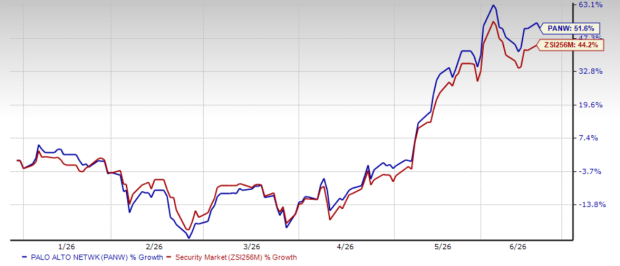
Image Source: Zacks Investment Research
From a valuation standpoint, Palo Alto Networks trades at a forward price-to-sales ratio of 17.27X compared with the industry’s average of 15.81X. The Zacks Value Score of F also suggests that PANW stock is overvalued.
PANW Forward 12-Month P/S Ratio
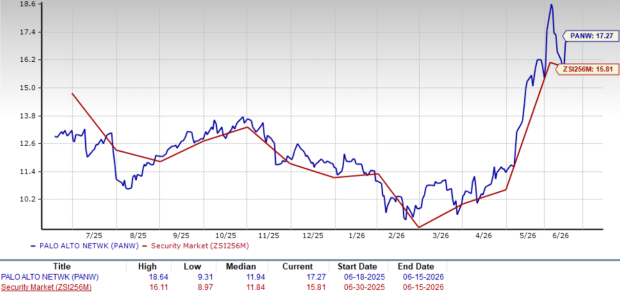
Image Source: Zacks Investment Research
The Zacks Consensus Estimate for Palo Alto Networks’ fiscal 2026 and 2027 earnings implies year-over-year growth of 12.9% and 8.1%, respectively. The estimates for fiscal 2026 and 2027 have been revised up by 6 cents and 8 cents, respectively, over the past 30 days.
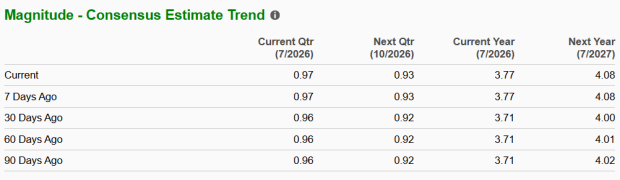
Image Source: Zacks Investment Research
Palo Alto Networks currently carries a Zacks Rank #3 (Hold). You can see the complete list of today’s Zacks #1 Rank (Strong Buy) stocks here.
Beyond Nvidia: AI's Second Wave Is Here
The AI revolution has already minted millionaires. But the stocks everyone knows about aren't likely to keep delivering the biggest profits. AI’s second wave is moving from infrastructure to implementation and these companies are at the forefront of this transition, positioned to become what Amazon and Google were to the internet era.
See Stocks Now >>This article originally published on Zacks Investment Research (zacks.com).
