Kristine Hui spent Canada Day 2020 in the southern Scottish town of Hawick, pouring her investment into a barrel.
Donning a yellow waterproof jacket and handling what looked like a gas pump nozzle, she filled a wooden wine cask with 200 litres of an alcoholic spirit strong enough to send her into a coughing fit, before corking it and adorning it with a drawing of a Canadian flag.
If all goes according to plan, she’ll be able to return to the Borders Distillery next summer to claim her cask of what is by now whisky. The B.C. native may also find that, after accounting for bottling, taxes and navigating Canada’s labyrinthine import requirements, she has lost money.
Four years since a whisky boom gave way to a bust, and despite the opportunity cost of not participating in a surprisingly resilient stock market, people like Ms. Hui are continuing to tie their money up in illiquid and inconvenient whisky casks and bottles. While a report from investment platform WineCap showed 91 per cent of British wealth managers expect to see increased demand for whisky as an investment, it remains a difficult way to make money. For many, that’s beside the point.
“I don’t think it is a good investment,” she said. “I think a lot of people that purchase whisky casks do it for emotional reasons, not really for financial gain.” For Ms. Hui, the reason was a connection to the Borders Distillery, the site of her first distilling job out of university.

Kristine Hui poses with her whisky cask at the Borders Distillery in Hawick, Scotland, in July, 2020.Supplied
“I kind of bought it as more of a memento.” She is able to keep track of her whisky’s flavour profile using a mobile app, but deciding what to do when it’s ready has become “a bit of a headache.” If bottling it and importing it to Canada proves too much of a hassle, she may try to sell the cask in Britain – if she can find a buyer.
The math certainly seemed more favourable a few years ago. At the time Ms. Hui bought her cask at a discounted employee price of £1,837 (about $3,000 at the time), she expected a “not terribly exciting” 7 per cent annualized return but hoped that a strengthening distillery brand might boost that number.
Others in the market were betting on much more. Years of steadily rising prices had been driving expectations of continued appreciation, a trend that accelerated in the early years of the COVID-19 pandemic.
An index of whisky bottle prices published by data provider Whiskystats jumped nearly 78 per cent between the end of 2019 and a peak in 2022. That year, a single 1975 cask of Ardbeg single-malt whisky, from the Scottish island of Islay, sold for a record £16-million (about $26-million at the time).
But high prices came with their own risks as whisky-related fraud proliferated. Some investors found they had received fraudulent ownership certificates, or that middlemen had sold the same casks several times over. The Supreme Court of Tasmania is currently hearing the case of an investment scheme in which some casks bought for investment at an Australian distillery were allegedly left unfilled.
Business Brief Newsletter
A daily look at the most important business stories that are making news and moving markets, written by Chris Wilson-Smith
Already have account?
The boom particularly affected the market for bourbon, with side-effects for Canadian and Scotch whisky producers who commonly use “ex-bourbon” barrels – ones previously used to age bourbon – for their own spirits. At its height, with production of the American spirit soaring on a belief of unquenchable demand, barrels became “basically unobtainable,” said James Lester, owner of the Sons of Vancouver distillery in North Vancouver, B.C. An ex-bourbon barrel that sold for $350 in 2022 goes for around $90 today, he said.
A combination of deflating expectations, falling consumption and oversupply of some spirits has hit prices, exacerbated in the case of bourbon by the introduction of trade tariffs on the American export. Today, there is “three times more seven-year-old bourbon in Kentucky than there is a market globally [in] any given year,” Mr. Lester said.
U.S. spirits sales fell 2.2 per cent in 2025 compared with a year earlier, according to the U.S. Distilled Spirits Council, an industry group, while Statistics Canada data shows per capita sales of alcohol falling more than 18 per cent between 2020 and 2025. The Whiskystats index has fallen more than 40 per cent from its peak, erasing all gains since the start of the pandemic.
Mr. Lester said that the slump may be an encouraging sign for potential investors in the commodity whisky market, where he has organized whisky investment schemes. There, investors can focus on keeping costs low to create a margin of safety around their investments. Most of what is sold in Canada is three-year old whisky used by many mass market brands, Mr. Lester said.
“We manufacture new make, we put it in a barrel, and then we warehouse it. And then after three years you bottle it yourselves or we sell it,” he explained. The model, he said, may appeal to investors near retirement who don’t want to have full exposure to the stock market.
At the other end of the market are distilleries whose names have the potential to appreciate more than their whisky.

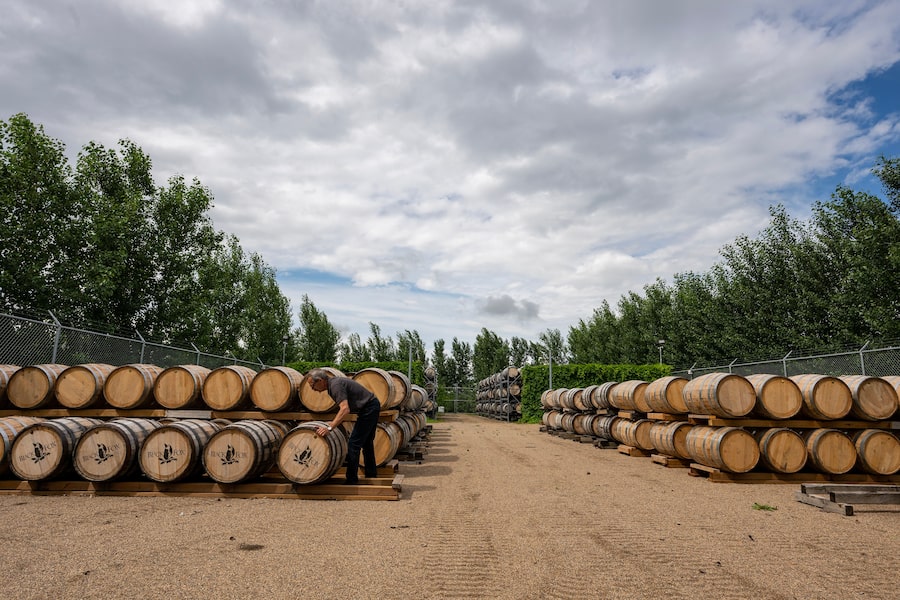
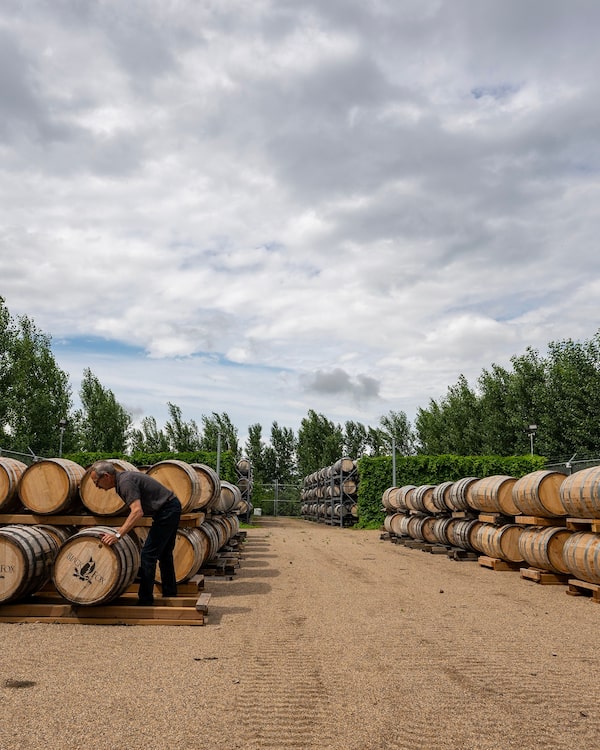
John Cote, co-owner of Black Fox Farm and Distillery, on his farm in Saskatoon, on Sunday.Liam Richards/The Globe and Mail
“You really have to do your homework and look for those brands that you think, ‘in 200 years these guys are still gonna be a thing’,” said John Cote, co-owner of Black Fox Farm and Distillery in Saskatoon, which grows the grains it uses to make its whiskies and offers a limited number of casks for purchase each year.
Choosing to buy a cask, he said, is a way to show support for the distillery’s story. “And we’re gonna have some fun along the way and at the end ... either we’re gonna pick up our barrel of whisky all bottled up nicely, or we’ll make a little bit of money off it,” he said.
“It’s so unlike investing in the stock market ... it’s all about going along, and part of the journey.”
Quanbo Xie and Horst Hohberger, faculty members at Shanghai Jiao Tong University Global College, have purchased five separate casks from different Scottish distilleries, including two to celebrate each of their daughters’ births. They say investment returns have never been a consideration, particularly after a stressful experience of buying a rare bottle that leaked after it was improperly stored by the custodian.
“It creates so much stress if your expectation is in some way to make a living or to make a profit out of whisky,” Mr. Hohberger said.
“Investing in whisky is great, but you’re investing for future happiness, not for finance.”

Liam Richards/The Globe and Mail