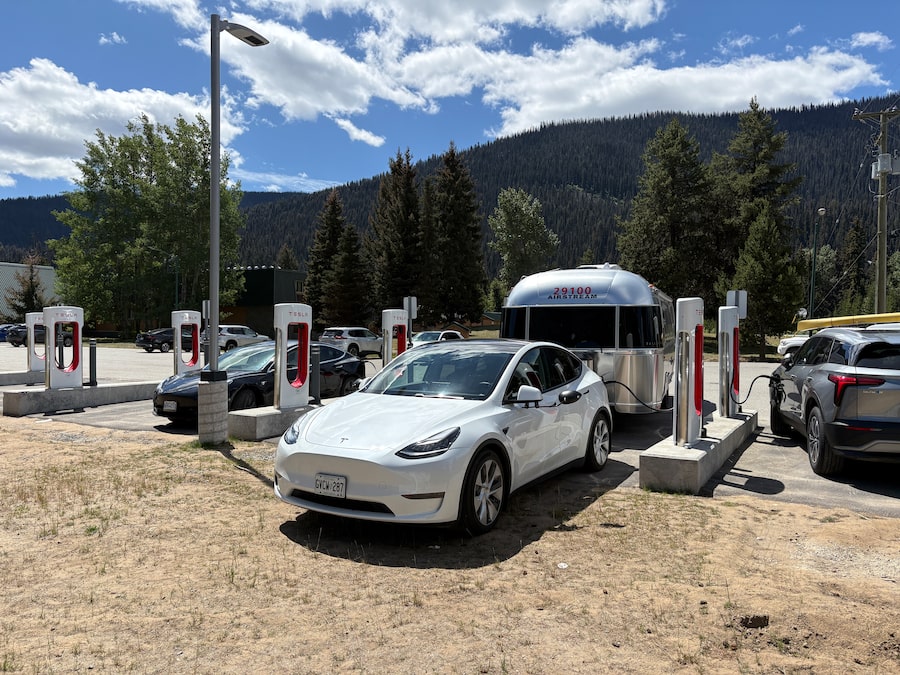
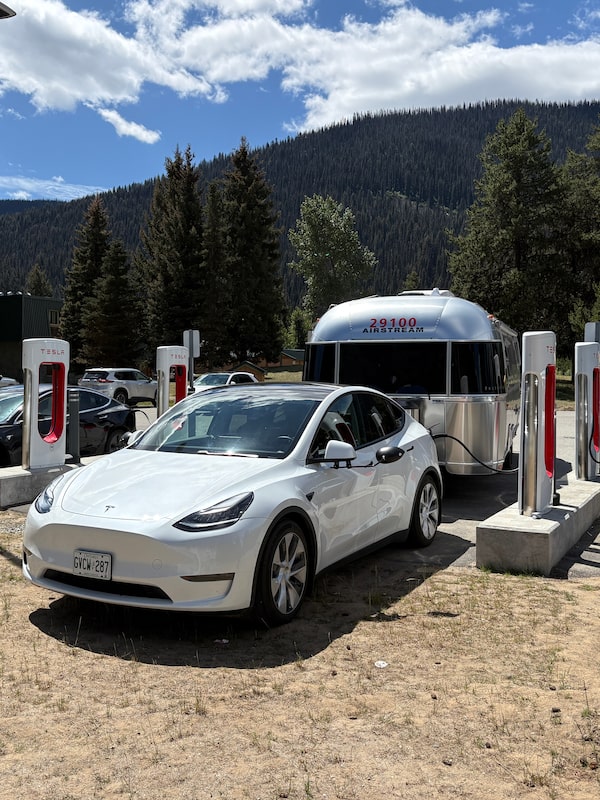
Stephen Hill hooked up a 28-foot Airstream to his vehicle last year and took a few practice runs with the 3,500-kilogram aluminum-clad RV. Ten days later, he and his wife embarked upon a three-and-a-half-month trip across Canada.
From their home in Milton, Ont., they drove to Vancouver Island and back, camping most of the way. Mr. Hill, now 73, wasn’t towing the Airstream behind a gas-guzzling pickup truck or some other powerhouse designed to carry heavy payloads or conquer rocky landscapes.
Instead, he drove an electric vehicle, a Tesla Model Y, outfitted with a reinforced hitch and weight-distribution bars. “We’ve done a lot of long road trips without a trailer, and they’ve been a piece of cake – blindingly simple,” Mr. Hill said. “With a trailer, it adds to the challenge. There’s no doubt, we are pushing the limits.”

Stephen Hill and his wife in the midst of their 2025 EV camping adventure.Stephen Hill/Supplied
During the cross-country trip, they kept a close eye on the vehicle’s sophisticated navigation system, which tracks energy consumption. And he would sometimes drive a little slower during difficult stretches to conserve energy.
Even so, they once arrived at their destination with the EV’s battery at just one per cent – or less than six kilometres away from conking out.
“We were squeezing every bit of juice we could out of the battery,” Mr. Hill said. For a trip to the East Coast this summer, he bought a GMC Sierra EV Max with a bigger battery and more range.
While EVs and urban commuting are a natural combination, especially when drivers can recharge their vehicles overnight at a low cost, long-distance driving is a harder sell for many. Adding a trailer to the mix might appear to be a non-starter, given that it reduces a vehicle’s range by as much as 40 to 50 per cent and can create parking challenges at some charging stations, with few alternatives in remote areas.
How much EV range do you regain going downhill? We put a Cadillac Optiq to the test
Keeping a gas-powered vehicle for demanding journeys is one solution for those who insist on towing Airstreams. For EV skeptics, staying clear of the vehicles altogether is another approach.
Many EV owners are confident they can overcome these obstacles, though.
They are driving thousands of kilometres across the continent. They are hauling large boats 500 km to remote cabins that aren’t even wired with electricity. And they are traversing the Rocky Mountains, venturing into the United States and exploring Mexico, where los vehículos eléctricos are still relatively rare.

The couple’s plan this year is to haul the Airstream to the East Coast using their new GMC electric pickup.Stephen Hill/Supplied
There can be a learning curve.
Several years ago, Abhi Manerikar was returning to his home in Calgary with bikes on the back of his electric Hyundai Kona, under a cover that caused significant drag.
“It was like having a big parachute out there, and I ran out of juice,” he said.
Not a big deal: He needed a short tow to Calgary and gained valuable experience.
He upgraded to a beefier Rivian, with superior navigation software that included information about charging stops and range estimates, which eased his concerns.
He made trips to Victoria and the Grand Canyon, then added a 17-foot teardrop-style trailer for camping.
“I’m not evangelic about EVs because I recognize that they’re definitely not for everyone. You have to be flexible and willing to adapt to a new world. Towing a trailer adds a level of complexity to that,” Mr. Manerikar said.
For those who have adapted, there is an upside to pushing EVs well beyond their perceived limits – and it extends beyond the lower environmental impact of a zero-emission vehicle.
They are saving money on gas. The heavy batteries installed in the floor of EVs give the vehicles a low centre of gravity that adds stability when towing. And the instant torque from electric motors is another bonus.
Even charging comes with an upside: Rather than standing beside a smelly gas pump, plugging in offers time to sit back and relax when you’ve essentially got a living room on your hitch.
When EV owners charge overnight, say at a campground, there’s no downtime at all. They’re just living the life.
Despite the advantages and positive word-of-mouth from owners, though, the pitch often doesn’t get through.
Last year, EVs accounted for just 7.4 per cent of new vehicle sales in the U.S., not including plug-in hybrid vehicles, according to Edmunds.
Canada isn’t much better. Here, EV sales slipped to 8.7 per cent in 2025, down from 11 per cent in 2024.
North American auto manufacturers, including Ford Motor Co. and General Motors Co., have retreated from ambitious targets for EV production. They have ceased producing some models, including Ford’s F150 Lightning, adding another reason to stick with gas.
But drivers who see few – if any – limitations in EVs offer an effective response to the hesitancy of many North Americans in making the switch from gas to electric.

Andy Thomson of Can-Am RV Centre in London, Ont., decided to try EV towing after enough customers pulled it off without trouble.Nicole Osborne/The Globe and Mail
Before Andy Thomson became a go-to source in Southern Ontario for towing RVs, he was skeptical that electric vehicles could pull hulking trailers over long distances.
He runs Can-Am RV Centre in London, Ont., where he and his younger brother, Kirk, sell everything from small tent trailers to luxury campers.
“We’d get people asking about towing with a Tesla. And we’d say: ‘Geez, you know, as far as we can tell, the range is going to be way too little to do that,’” Mr. Thomson said.
But a couple of his customers with Tesla Model X’s bought smaller Airstreams, and they seemed to be getting along just fine.
So he and his brother bought a Tesla Model 3 – the smallest in the Tesla fleet – to see how towing with an EV compared with traditional gas-powered vehicles.
They quickly realized that EVs not only got the job done, they did just about everything better than gas-powered vehicles, including handling heavy loads on a hitch.
“We get good tow vehicles by accident,” Mr. Thomson said. “To make room for bigger batteries in electric vehicles, they’ve widened the stance and lengthened the wheel base – which is ideal for what we want.”
He and his wife initially towed a 22-foot Airstream, and could easily drive 160 km in one stretch. That would get them to the next charging station without breaking a sweat.
They graduated to a bigger Tesla Model S and towed a larger 27-foot Airstream. They made some customizations to improve the aerodynamics of the RV, mostly by removing attachments on the outside and finding better places for them.
The biggest test: In 2021, Mr. Thomson drove 2,200 km from London to Colorado Springs, completing the trip in two-and-a-half days – towing the giant Airstream the whole way.
Part of the trip went through Vail Pass in the Rocky Mountains − up and up, to an elevation of 3,250 metres, then back down. He noticed something intriguing about the range of his Tesla under these conditions: Its range improved.
Regenerative braking, which charges an EV battery when the car is slowing down or coasting, helped on the downward-sloping roads – but not enough to fully offset the draw when driving uphill. Instead, the added efficiency came from the mountainous terrain, notching one more point in an EV’s favour.
“At those elevations, the air is thinner, so the aerodynamics made more difference than going up and down did,” Mr. Thomson said.
Still, anyone driving long distances in an EV will freely admit that it is not always easy.
On unfamiliar roads with sometimes spotty charging infrastructure, EVs require more planning than, say, looking out for the next gas station when you need to fill the tank.
Frequent stops for charging, perhaps every 90 minutes or so when pulling a large load, can sap your momentum. Tight charging spaces can require deft handling; at times, you might have to disconnect the trailer to fit the vehicle in, then reconnect it.
Opinion: The EV surge: How Ottawa can turn increased demand into mainstream adoption
And some regions are difficult with a trailer that limits your range. That’s because of the limitations of our current public charging infrastructure in some of the more remote areas of this country, where the distances between fast-charging stations can be intimidating.
Mr. Thomson points to the roads north of Lake Superior as a particularly challenging area to drive. And a customer of his once towed a trailer to Edmonton with a Tesla, and then rented a gas-burning pickup to get to Alaska.
Many seasoned EV owners are cruising through these challenges.
Before Ian Graham bought his Tesla Model 3, he noticed that Tesla’s network of fast chargers – the gold standard for EVs – extended to Espanola, Ont., the town closest to his off-grid cabin.
He realized that the 525-km journey from his home in Kitchener, Ont., was feasible in an EV, with places to recharge along the entire route. He could top up the charge whenever he liked in Espanola, and even make day trips from his cabin.
“When I saw that, it was like: Perfect, I can get there no problem,” Mr. Graham said.
He had no qualms about his next move: using the same EV to haul his 21-foot pontoon boat, which dwarfs the size of the car, to the cabin.
This time, though, he took a different route to cut out a number of charging stops. He drove to Tobermory, Ont., took the Chi-Cheemaun ferry to Manitoulin Island and drove north from there.
All without incident. His two trips to Mexico also went smoothly, though he wasn’t towing the pontoon boat then.
“It’s funny how people don’t have a positive outlook on this. I’m very optimistic, I guess,” Mr. Graham said.
Significant gas savings provide some encouragement. So does recognizing that vehicles with internal combustion engines also suffer reduced range when towing heavy loads, since they burn more gas.

Greg Harris says he has lost track of how much money he’s saved since buying an EV and replacing his gas-guzzling Ford F-150. His family now owns three EVs.Nick Iwanyshyn/The Globe and Mail
Greg Harris, 60, used to tow a horse trailer behind his previous truck – a Ford F-150 twin-turbocharged EcoBoost – which wasn’t exactly a light sipper.
“It got terrible gas mileage when I was towing the trailer – but it had 136-litre tanks. I didn’t care, I just paid,” he said.
Mr. Harris and his family now own three EVs, including an F-150 Lightning, and he has lost track of how much money he has saved since buying his first EV in 2021.
The more he drives, the bigger the savings. He tows a 12-foot, double-axle aluminum trailer near his home in Haldimand County, on the Niagara Peninsula, where most trips are at least 30 minutes long. He also takes occasional drives to Cleveland, Ohio.
“I’m not a professional transport driver. If I was, I don’t think I’d have an EV for that,” Mr. Harris said.
But as a casual driver, he makes an event of it: He takes his time, plans a route around charging stations and thinks of interesting things to do while his vehicle is charging.
“If I look at it from that perspective, it’s enjoyable,” he said.