Facts & Arguments is a daily personal piece submitted by readers. Have a story to tell? See our guidelines at tgam.ca/essayguide.
“Daddy’s in the ground.”
My four-year-old son has taken to randomly telling family, friends and even strangers this conversation stopper. Confusion and discomfort instantly follows for everyone within earshot. I cringe inside every time I hear his little voice saying those four words. I never quite know how to respond.
Technically, it’s not even true. Will’s father is actually in an urn high on a book shelf in our kitchen. I haven’t yet been able to remove the urn from its red velvet pouch. Truthfully, I try to forget it’s there.
My husband was a well-loved TV and film actor, his most famous role being Wes, the liquor and insurance salesman on Corner Gas. But cancer doesn’t play favourites.
Mike had metastatic synovial sarcoma. It started as a lump in his left thigh, which doctors believed was a blood clot. Just to be sure, we went to an oncologist who told us she was 99.9-per-cent sure it wasn’t cancer. Months later, a vascular surgeon discovered the truth about Mike’s now peach-sized lump. By then it was too late.
When he was finally diagnosed, just before Father’s Day in June, 2011, tumours had already taken root in both lungs. Doctors gently but plainly told us: “It’s treatable, not curable.”
Will was 10 months old. Our son has grown up with doctors and nurses, in hospitals and waiting rooms. After he learned to speak, he told us the doctors were giving Daddy medicine to help his cough go away. Multiple surgeries, radiation and chemotherapy every 21 days for the better part of four years became our normal. And even with all that the cough, though it subsided at times, never really went away.
When Will first asked me what dying was, I told him it was like a flower in spring that grows leaves in summer and then, slowly, as each leaf browns and falls off, withers in autumn. His toddler brain accepted my simple definition. I am sure there are much clearer and age-appropriate explanations out there.
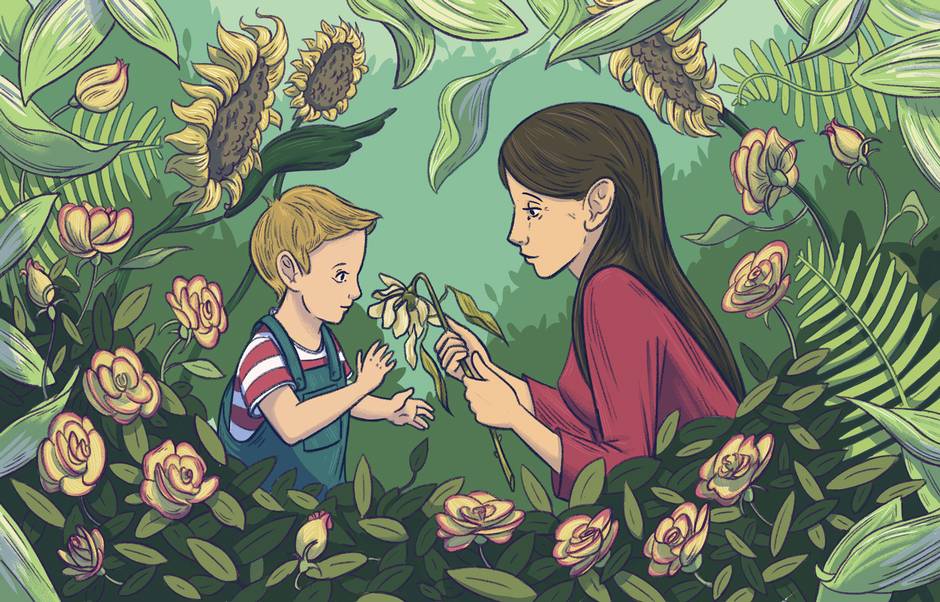
The day after Mike died, I sat Will down on our front lawn after playschool and told him that Daddy’s body stopped working. Daddy died. I explained it a second time. I used plain language, didn’t get into specifics and tried to remember what phrases not to use. (A tip: Don’t tell kids the dead have “gone to sleep forever.” Getting kids to sleep is hard enough without the terrifying spectre of never waking again.)
It was a short conversation on our lawn. Will didn’t cry. Was that a look of confusion crossing his face? Who could tell? I certainly couldn’t. I don’t think he asked any questions. “Grief brain,” that stupefying fog, had already taken hold of me.
Will toddled off inside with my mother in search of a snack and his after-school cartoons as I sat on the grass wondering, “What next?”
Was I in denial? No, I always knew this day was coming. But why wasn’t I crying more? And why, after calling all the people on our “he’s dead” list, had I felt compelled to mow the front and back lawns earlier that morning? As I’d pushed the mower back and forth, I disconnected from my body, watching the scene as a detached observer. Perhaps I was in shock. But was I actually cutting the grass just 14 hours after sitting by my beloved’s hospital bed, telling him to “Let go,” “Take your rest” and that “You are surrounded by love, my sweetheart.”
What else was there to do? My husband was dead: The grass was long. I could change only one of those things.
Since Mike’s death, in late May, our yard has given me joy. Planting, weeding, cutting the grass, monitoring the daily growth of vegetables and coaxing wildflowers to bloom lighten me. I have never been an avid gardener, but gardening has become a salve for my grief. It’s tactile, dirty, sweaty and so, so satisfying. Every snip of the clippers and weed pulled from the earth delivers instant gratification. I may be simplifying this, but after four years of fighting and failing to keep my darling alive, it’s rewarding to help something survive and thrive.
Mike, Will and I had a great life together. We flourished in one another’s company. But cancer was our weed. Despite all efforts to contain it, cancer always grew back. And as it grew, Mike withered. So now I tend to my sunrise roses (Mike’s favourite), faithfully watering and fertilizing my precious buds every two weeks. Sunflowers (another favourite) are shooting up by the foot. By autumn, they will touch the eavestrough at the back of our house. My peas are going gangbusters and the carrots are coming along nicely. Pots of mixed flowers have mysteriously appeared on my front deck.
My friend delivered a cranberry bush recently, in honour of Mike. I love the idea of a living memorial. Armed with a spade, I will soon dig a new home for this welcome addition. I will use the special root feed to make it feel at home. And I will sprinkle a few of Mike’s ashes into the mix.
Will and I will watch it grow, year after year. It will reach up and out, and berries will bud – all a tangible reminder of life moving forward without our beloved.
And maybe, just maybe, some day it will be okay that Daddy’s in the ground.
Robin Summerfield lives in Winnipeg.